- The paper presents the QMMW algorithm that efficiently integrates quantum generative adversarial learning with online learning.
- It uses parameterized quantum circuits and matrix exponential updates to rapidly converge to a Nash equilibrium.
- The approach offers practical applications in quantum state discrimination and entanglement tests with reduced computational overhead.
Efficient Online Quantum Generative Adversarial Learning Algorithms with Applications
This paper presents an approach integrating quantum generative adversarial learning (QuGAL) with online learning to create efficient quantum algorithms. The authors introduce the quantum multiplicative matrix weight (QMMW) algorithm, which achieves efficient quantum processing of fundamental tasks through the strategic use of parameterized quantum circuits. This work establishes a direct pathway for employing quantum generative adversarial models in quantum information processing, presenting an implementation structure tailored for near-term quantum devices.
Quantum Generative Adversarial Learning (QuGAL)
QuGAL is framed as a quantum counterpart to classical GANs, where two quantum models—a generator and a discriminator—engage in a zero-sum game to reproduce a given quantum state. The generator attempts to approximate a target state while the discriminator aims to distinguish between the real and generated states. The authors propose that this framework can potentially achieve exponential quantum advantages under the assumption that target distributions can be efficiently encoded in a density matrix.
The problem of applying QuGAL to complex quantum information tasks is translated into a constrained optimization problem where the expressiveness of the generator is specifically limited. This ensures that the Nash equilibrium in the game theoretic sense is reached only when the target state corresponds directly to the desired quantum-specific property, such as separability in entanglement tests.
Quantum Multiplicative Matrix Weight (QMMW) Algorithm
The QMMW algorithm is inspired by classical online convex optimization algorithms and is adapted to exploit the convex-concave properties of the quantum zero-sum game problem. The algorithm is designed to achieve rapid convergence to a Nash equilibrium through a series of iterative updates of the generated and discriminator states.
Implementation Details
- Initialization: Initialize the quantum state for the discriminator as a maximally mixed state. Define a tolerable error and set the total number of training rounds.
- Iterative Updates: For each training round, update the generated quantum state using exponential scaling functions and similarly update the discriminator state using matrix exponentials.
- Convergence Checking: Calculate the loss function using averaged states from the training rounds to evaluate how closely the generated state matches the target.
The proposed method leverages advanced techniques for Gibbs state preparation, which can be efficiently executed on fault-tolerant quantum devices using known sampling techniques. The computational complexity is O(N3T4) where N is the number of qubits and T is the number of training rounds.
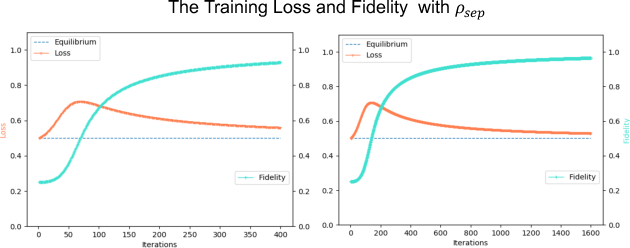
Figure 1: The left panel is the simulation result of QMMW with setting T=400. The right panel is the simulation result of QMMW with setting T=1600.
The paper emphasizes the use of QuGAL for tasks in quantum information processing, especially for quantum state discrimination and entanglement tests. A primary advantage highlighted is that QuGAL can operate directly on quantum data, circumventing the exponential overheads associated with classical methods which require full quantum state tomography.
In their experiments, the authors apply QMMW and QuGAN frameworks to perform entanglement tests on pure quantum states, offering practical demonstrations of these algorithms on standard quantum information tasks. Numerical simulations validate that the proposed models can achieve the intended objectives using significantly reduced quantum resources and demonstrate robustness against common training difficulties like vanishing gradients.
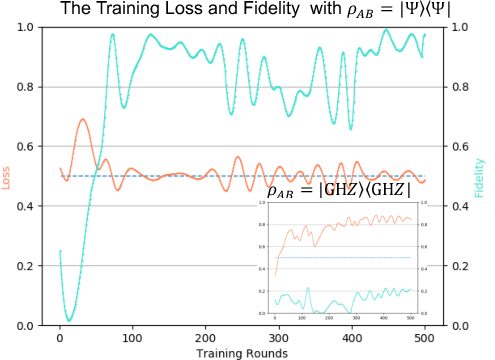 *Figure 2: The outer plot is the simulation result of QuGAN when the input is ∣Ψ⟩. The inner plot is the simulation result of QuGAN when the input is $\ket{\text{GHZ}$. *
Conclusion
The study advances a structured approach for integrating online learning with quantum generative models, demonstrating both theoretical insights and practical applications for near-term quantum computing devices. The proposed QMMW and improved QuGAN methods offer promising avenues for reducing computational overhead in quantum machine learning applications and establishing more efficient protocols for quantum information tasks.
Further directions for research include refining these algorithms for broader classes of quantum problems and optimizing their performance on actual quantum hardware, ensuring alignment with both short-term and long-term goals of quantum computational advantage.