- The paper presents a novel decentralized routing approach using a base-graph structure to map entangled quantum networks.
- It leverages local node information and inverse power law distributions to efficiently determine shortest paths in multi-level networks.
- The method minimizes quantum memory usage and communication delays, enhancing long-haul quantum key distribution and experimental setups.
Decentralized Base-Graph Routing for the Quantum Internet
Introduction
The concept of a quantum Internet relies fundamentally on entangled quantum repeater networks, facilitating long-distance quantum communication through entangled links. This research introduces a decentralized routing method for entangled quantum networks, capitalizing on locally available node information to efficiently determine shortest paths within these networks. The proposed strategy focuses on managing heterogeneous, multi-level entangled networks by embedding them into a base-graph structure, optimizing pathfinding without requiring global knowledge.
Entangled Quantum Networks
Quantum nodes within this Internet model are interrelated through a spectrum of entanglement levels, forming a complex, multi-layered network architecture. The key determinant of inter-node hop distances and link probabilities is the degree of entanglement. The routing challenge is compounded by the absence of centralized knowledge, which necessitates a decentralized solution utilizing only local node interactions. The association of nodes involves quantum repeaters which act as intermediaries in this communication pathway.
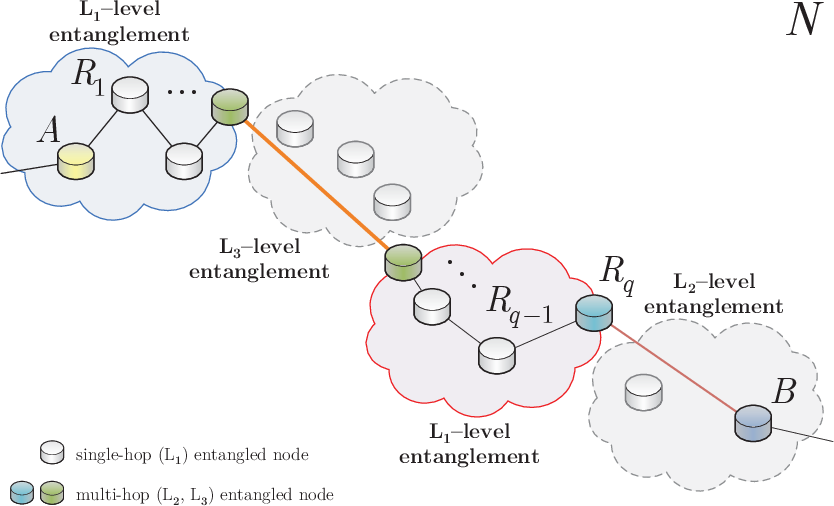
Figure 1: Entangled overlay quantum network N=(V,E) with heterogeneous entanglement levels.
Decentralized Routing Strategy
The novel routing approach proposed uses a base-graph Gk where each node in the quantum network is mapped onto this underlying structure. This base-graph representation preserves the probabilistic nature of the entangled links and provides a scalable framework for efficient routing. The probability that specific entanglement levels exist in any edge of this graph is inversely correlated with the L1 distance of nodes, enabling decentralized decision-making for path selection.
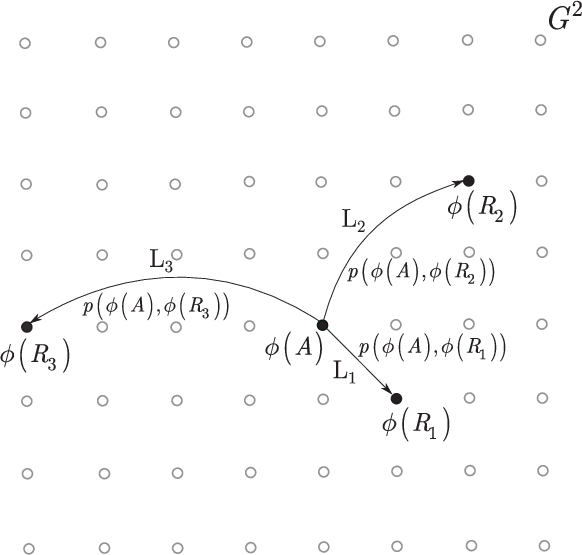
Figure 2: G2 base-graph of an overlay quantum network N, with entangled nodes ϕ(A), ϕ(Ri).
Quantum Base-Graph Construction
Embedding an entangled network on a base-graph involves modeling the quantum topology in a manner that reflects both node positioning and entanglement probabilities. In this framework, we deploy a probabilistic approach to infer connections between quantum nodes via an inverse power law distribution embedded in the base graph. This technique is rooted in statistical estimation methodologies, offering a practical means to achieve an optimal, network-wide mapping for efficient routing.
Implementation and Practical Benefits
The practical applicability of this approach lies in its low-complexity routing, which promises resource efficiency within quantum nodes by minimizing both quantum memory usage and auxiliary node communications. The resulting reductions in path decision-making delays render this routing scheme notable for experimental quantum networking endeavors.
Moreover, the proposed decentralized method supports long-distance quantum key distribution and facilitates advancements in experimental quantum communication frameworks by minimizing the need for complex transmission infrastructure.
Conclusion
This study contributes a feasible and efficient decentralized routing methodology for quantum Internet architecture, emphasizing the potential for practical application in long-haul quantum communication. Future quantum networks, empowered by such routing frameworks, stand to benefit from increased scalability, robustness, and reliance on resource-efficient routing strategies. This positions decentralized base-graph routing as a crucial component in the evolving landscape of quantum networking.

