- The paper presents an entanglement-gradient metric to evaluate the efficiency of links and paths in quantum repeater networks.
- It employs swarm intelligence to dynamically explore and select optimal quantum routes based on real-time entanglement measurements.
- Numerical analyses demonstrate that the decentralized routing method adapts effectively to variations in entanglement fidelity and decay rates.
Entanglement-Gradient Routing for Quantum Networks
Introduction
The paper "Entanglement-Gradient Routing for Quantum Networks" (1710.02779) presents an advanced framework for routing in quantum repeater networks by leveraging concepts from swarm intelligence and quantum Shannon theory. The entanglement-gradient routing scheme is designed to find the shortest path in quantum networks by quantitatively analyzing the feasibility of entangled links and paths. This approach facilitates decentralized routing with moderate complexity, which is essential for the development of the quantum Internet and long-distance quantum communication.
Entanglement-Gradient Routing Scheme
The entanglement-gradient routing scheme is founded upon the principles of swarm intelligence combined with quantum Shannon theory. Swarm intelligence involves the collective behavior of decentralized, self-organized systems, typically inspired by the natural behaviors of insects like ants or bees. This framework is applied to quantum networks to enhance routing efficiency by utilizing parallel threads to explore the network and determine optimal paths based on entanglement gradients.
In this scheme, the entanglement gradient coefficient serves as a metric to assess the attractiveness of entangled links. It is derived from the characteristics of entanglement transmission and distributions in the network. The method seeks the path with the highest entanglement gradient or lowest inverse entanglement gradient, akin to swarm optimization strategies.
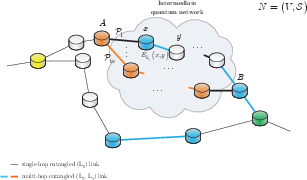
Figure 1: A quantum network with source node A and destination node B, and m entangled paths P1,...,Pm.
Definitions and Metrics
The core innovation in this work is the definition of the entanglement utility and gradient coefficients. The entanglement utility coefficient quantifies the usefulness of a link based on its level and ability to transmit entanglement with certain fidelity. The link and path entanglement gradients are determined by updating mechanisms that take decay rates into account, affecting how well the path maintains usable entanglement as time progresses.
The paper defines methods for updating these metrics using swarm intelligence principles, ensuring that routing decisions reflect real-time conditions of quantum states in the network. Notably, the entanglement gradient is subject to decay influenced by the history of entanglement throughput—capturing dynamic network conditions.
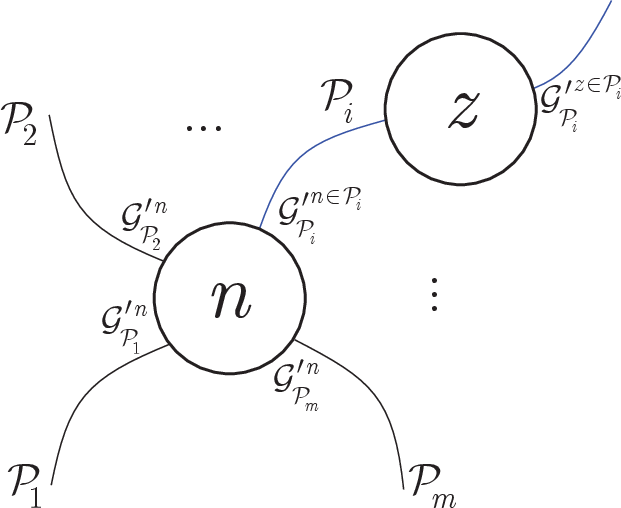
Figure 2: A model of m paths P1,...,Pm between nodes, illustrating entanglement gradients.
Routing Methodology
Routing in this framework is accomplished through multiple threads exploring potential paths within the quantum network. Each thread independently evaluates paths based on entanglement gradients, choosing connections that maximize the gradient while observing decay and utility metrics. This parallel, decentralized mechanism enhances scalability and robustness against errors or interruptions in the quantum network.
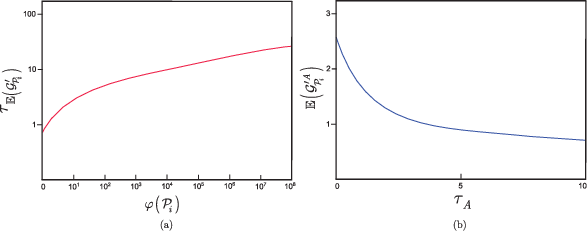
Figure 3: (a): The decay rate τE(G′) is shown on a logarithmic scale. (b): The mean entanglement gradient as a function of decay rate τA.
The paper incorporates numerical analyses to validate the efficiency of the routing method. It demonstrates that the proposed metrics lead to robust path selection under various network conditions, adjusting to fluctuations in entanglement fidelity and throughput. The ability to dynamically adjust path selection based on real-time entanglement measurements represents a significant advancement in quantum networking.
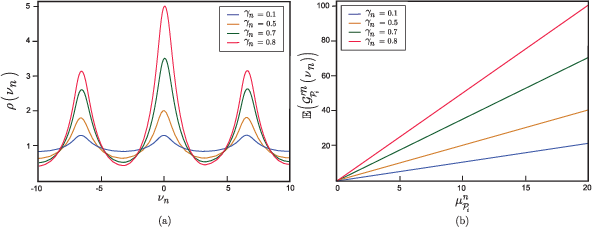
Figure 4: (a): The values of ρ(νn) function. (b): Mean E(G′) as a function of μPin.
Conclusions
The entanglement-gradient routing framework offers a significant advancement for quantum networks, enabling decentralized, efficient routing that is crucial for the operation of a quantum Internet. By combining swarm intelligence and quantum information theory, this method provides a practical approach to the complex problem of routing in quantum networks, paving the way for further experimental and practical applications in quantum communication.
The method's adaptability, scalability, and reliance on experimentally realizable quantum devices suggest promising potential for future deployments in real-world quantum networks. Additionally, the framework's integration with quantum machine learning tools highlights its potential for future developments in AI-driven quantum communications.

