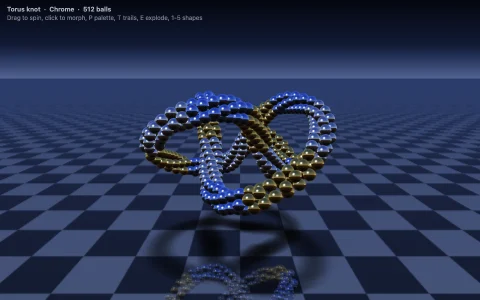
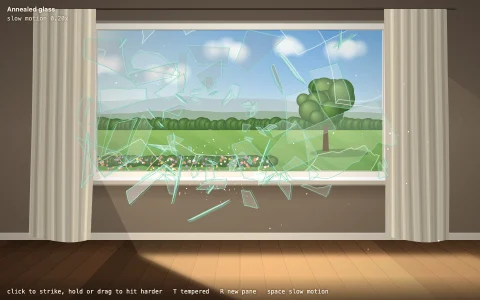
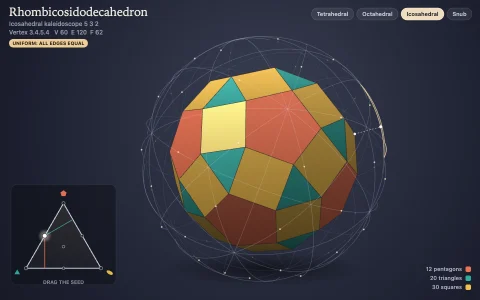
Nested glassy checkered polyhedra bounce on a glossy floor, then shatter and rebuild.
Glenz vectors were the Amiga demoscene's glass objects: solids whose faces alternate between tinted and see-through. Here every face of two nested solids is drawn back to front, the faces turned away first as dim glass, then the front faces added with additive blending, so a blue facet over a white one mixes to pale blue exactly where they overlap. The inner solid spins the other way and breathes between a flat polyhedron and a spiky stellation (the dodecahedron is built as the dual of the icosahedron). The pair sways and bounces with squash and stretch on a floor that mirrors it, under a banded copper sky. Fracturing turns every face into a rigid shard that tumbles and bounces under gravity, then each shard flies up and locks into a face of the next pair of solids.
Try it. Drag to spin the solids, click (or press Space) to fracture them into the next polyhedron, press 1 to 6 to pick one, use the arrow keys to give them a spin, and press C to change the colors.
Paste this into Claude Code, Codex or any coding agent to get a simple version running, then take it wherever you like.
Build the classic Amiga "glenz vectors" effect, a spinning glassy polyhedron, with JavaScript and the HTML canvas element. Put everything in a single index.html file with no libraries or build step, so I can open it directly in a browser.

Start simple:
- Make a canvas that fills the window, stays sharp on high-DPI screens (scale by devicePixelRatio), and resizes with the window. Paint a dark background with a vertical gradient.
- Define an octahedron (six vertices, eight triangular faces). Turn it into a star by adding a point above the middle of each face and replacing each face with three triangles that meet at that point.
- Each frame, rotate the vertices, project them with a perspective divide, and draw every triangle, including the ones facing away. Give the triangles two alternating colors, like a checkerboard: one a solid-ish blue and one a faint, see-through white.
- Use the 2D cross product of each projected triangle to tell front faces from back faces. Sort all faces by depth, draw the back faces first and darker, then the front faces with globalCompositeOperation = "lighter", so overlapping glass adds up.

Once that works, make it beautiful:
- Put a smaller polyhedron inside in different colors, spinning the other way.
- Make the pair bounce on a checkered floor with simple gravity, squash it a little on each landing, and draw a faded mirror image below the floor line for a reflection.
- Let the mouse drag the rotation, and add horizontal copper bars of color sweeping through the sky.

Explain the key ideas in short code comments. When you're done, tell me how to open it and suggest three directions I could take it next, such as more polyhedra (a checkered cube, a geodesic sphere), shattering the faces into tumbling shards, or a breathing spike height.