Weighted Bayesian Conformal Prediction
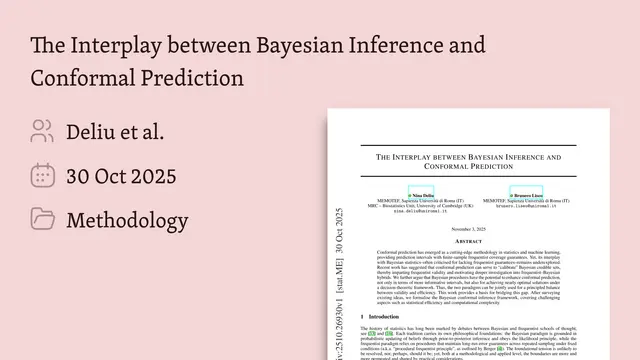
This presentation introduces Weighted Bayesian Conformal Prediction (WBCP), a novel method that unifies Bayesian meta-uncertainty quantification with distribution-shift robustness in conformal prediction. By replacing the uniform Dirichlet prior with a weighted variant calibrated to effective sample size, WBCP provides data-conditional coverage guarantees that adapt spatially to local data density while quantifying the reliability of each prediction interval through posterior distributions over thresholds.Script
Conformal prediction gives you a threshold with no sense of how reliable it is. Weighted conformal handles distribution shift but still outputs just one number per location. What if you need both a measure of meta-uncertainty and robustness to covariate shift at the same time?
The authors replace the uniform Dirichlet prior from Bayesian Quadrature conformal prediction with a weighted variant whose concentration parameter equals Kish's effective sample size. This effective sample size tells you how many independent observations your weighted data is worth, calibrating posterior variance to match the true uncertainty of importance-weighted quantile estimation.
Each weight profile yields its own posterior over thresholds. In data-rich regions, large effective sample size produces tight posteriors near the weighted quantile. In sparse regions, small effective sample size automatically widens the posterior, delivering conservative thresholds exactly where you need them. The posterior standard deviation scales as one over the square root of effective sample size, with a proven concentration bound that makes this spatial adaptivity rigorous.
On Seattle house prices, urban locations with over 240 effective samples show posterior standard deviations below 1.8, while peripheral locations drop below 120 effective samples with standard deviations exceeding 2.4. The adaptive bandwidth variant operates at a mean effective sample size of just 13, yet maintains 95 percent coverage where standard geographic conformal prediction falls to 87.7 percent. The posterior conservatism compensates for sparse data without any manual tuning.
The method preserves weighted conformal prediction's finite-sample marginal coverage guarantee while adding per-profile conditional bounds. When weights are correctly specified and the score density is smooth, the highest posterior density threshold improves conditional coverage at a rate inversely proportional to the square root of effective sample size. The key limitation is that spatial correlation in residuals can inflate effective sample size, requiring design-effect corrections that the paper sketches but does not fully develop.
Weighted Bayesian Conformal Prediction makes uncertainty visible where standard methods stay silent, turning spatial prediction into a diagnostic tool that tells you not just what to predict but how much to trust it. Explore the full technical details and create your own research videos at EmergentMind.com.