Spark-H3: Adaptive Block Sparse Attention for Video Diffusion Models
This lightning talk presents Spark-H3, a training-free method that dramatically accelerates video diffusion transformers by replacing quadratic all-pairs attention with adaptive block-sparse attention. The system combines preference-aware token regrouping with anchor-calibrated compression to achieve 2.49× speedups while preserving high fidelity to dense-attention outputs. We explore how the method addresses two distinct error sources in prior sparse-attention designs and demonstrate substantial improvements in both computational efficiency and output quality across multiple video generation models.Script
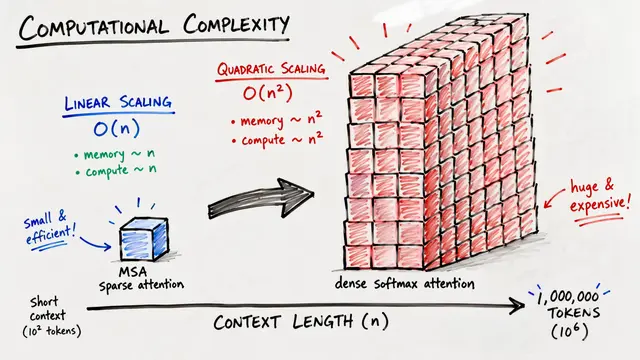
Video diffusion transformers face a brutal computational bottleneck: self-attention cost grows quadratically with every spatiotemporal token, and FlashAttention can't change that fundamental complexity.
Prior block-sparse methods fail in two distinct ways: fixed layouts combine tokens with mismatched attention preferences, and uniform block averaging systematically underestimates softmax mass because the exponential of an average score is smaller than the average of exponentiated scores.
Spark-Reblock solves the routing problem through recursive partitioning that groups tokens by attention preference rather than spatial proximity, producing uniformly sized tiles where similarly preferring tokens occupy the same block in order N log N time.
Spark-Reweight corrects compressed-block mass by anchoring the approximation at the global mean query, where it exactly matches both the tile mass and its gradient, then contributing through a shared softmax normalization that lets unselected blocks still influence the final probability distribution.
At 10 percent exact-block density, Spark-H3 reaches 24.81 decibel PSNR with a 2.49 times speedup on MiniMax-H3, improving fidelity over PISA by 4.61 decibels while running faster, and ablations confirm that preference-aligned grouping captures more attention mass than simply doubling the block budget.
The method leaves one important question open: reported speedups exclude text encoding, VAE decoding, and dense warm-up steps, so the actual application-level acceleration depends on sequence length, resolution policy, and the relative cost of components outside the attention layers. Explore the full technical details and create your own video summaries at EmergentMind.com.