Sampling Discrete Distributions with Temporal Point Processes
This presentation introduces a continuous-time Monte Carlo framework that represents discrete samples as event counts in a sliding temporal window. The method constructs a multivariate point process where events persist for a fixed duration before departing, creating a momentum-like effect that reduces backtracking compared to traditional birth-death chains. The framework separates equilibrium statistics from temporal dynamics, enabling both reversible and non-reversible samplers, and demonstrates measurable efficiency gains across diverse target distributions including stochastic neural networks with biologically plausible refractory periods.Script
Traditional discrete samplers jump between states by adding or removing counts one at a time. This paper asks: what if we instead track when each event arrives and let it persist for exactly m time units before it disappears?
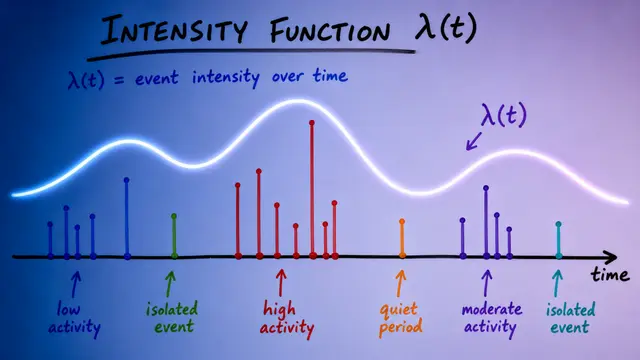
The construction is elegantly simple. Each component is an infinite-server queue with deterministic service time. Arrivals happen according to an intensity that depends on current counts and the target distribution. Every event stays active for exactly m time units, then departs automatically.
Here is the key insight. A birth-death process is actually a degenerate version of this richer construction. If you repeatedly redraw service times at faster and faster rates, the temporal information vanishes and you recover the familiar birth-death sampler with its exponential waiting times.
The empirical results are decisive. Across 63 tested distributions, the point-process sampler outperforms the birth-death baseline every single time. Effective sample size per CPU second is between 1.9 and 3.6 times higher, with the advantage strongest in weakly coupled regimes.
One compelling application is a stochastic spiking network that samples from a Boltzmann-like distribution over spike counts. The model incorporates relative refractoriness directly into the target function, something earlier constructions could not achieve while preserving the exact equilibrium distribution.
What makes this framework powerful is its separation of concerns. The target function f specifies which count vectors are probable at equilibrium, while the temporal density g controls dynamics, scan order, and even non-reversible probability currents. To dive deeper into temporal samplers and create your own lightning talks, visit EmergentMind.com.