Regular Black Holes from Baryonic to Quark Phase Transitions
This presentation explores how controlling the phase transition from baryonic matter to quark-gluon plasma during gravitational collapse can produce regular black holes—spacetime geometries that avoid the central singularities predicted by classical general relativity. We examine the physical mechanisms behind these singularity-free solutions, the role of strange quark matter and inhomogeneous transition rates, and how Event Horizon Telescope observations might constrain these exotic models.Script
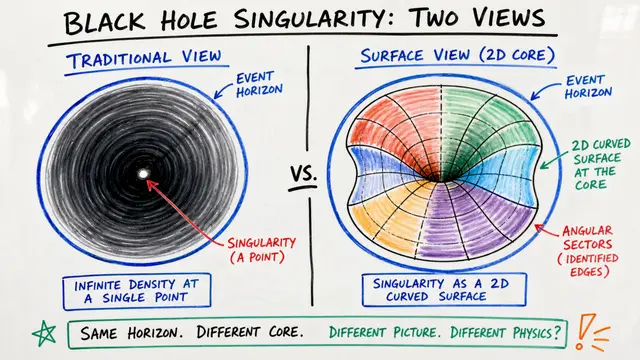
At the heart of every black hole, classical general relativity predicts a singularity—a point where spacetime curvature becomes infinite and the theory breaks down. But what if the most extreme conditions in the universe, where baryonic matter transforms into quark-gluon plasma, could erase that singularity entirely?
General relativity has been spectacularly successful, but it fails at the center of black holes where curvature invariants diverge. Regular black hole models—pioneered by Bardeen—propose smooth, singularity-free cores, but they've historically required exotic physics like violations of the strong energy condition or nonlinear electrodynamics.
This paper takes a different approach, grounded in the extreme physics of collapsing matter itself.
The authors model gravitational collapse using an inhomogeneous phase transition rate, where ordinary baryonic matter gradually transforms into strange quark matter described by the MIT bag equation of state. By carefully controlling this transition rate, the spacetime geometry smoothly evolves into a regular black hole with a nonsingular core—no exotic fields required, just extreme nuclear physics.
These models aren't just theoretical curiosities. The presence of a regular core subtly alters the black hole's shadow radius—the dark circle we see in Event Horizon Telescope images. This gives us a potential observational test, turning abstract geometry into something we might actually measure with current instruments.
This work demonstrates that the most extreme state of matter in the universe—quark-gluon plasma—might fundamentally reshape what we think happens inside black holes. The challenge ahead is matching these theoretical predictions to precision measurements, and determining whether nature actually exploits this escape route from infinite curvature.
When matter crosses the boundary between the familiar and the utterly extreme, it may rewrite the rules of spacetime itself. To explore more cutting-edge physics research and create your own explanatory videos, visit EmergentMind.com.