The Maxwell Conjecture is False
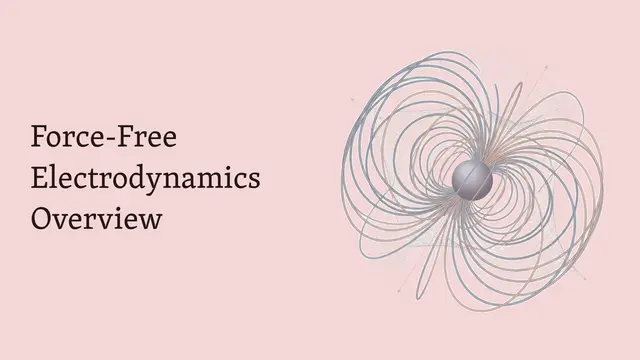
For nearly 150 years, physicists believed Maxwell's conjecture: that n point charges could produce at most n-1 equilibrium points in their electrostatic field. This presentation reveals how a carefully constructed configuration of just five charges shatters that bound with 24 equilibria, and how recursive methods can drive the ratio of equilibria to charges far beyond anyone expected. The result transforms our understanding of electrostatic complexity and opens new questions about the topology of symmetric potentials.Script
A 150-year-old belief in electrostatics just fell. Maxwell claimed that five point charges could have at most four equilibrium points in their electric field, but a simple configuration proves him wrong with 24.
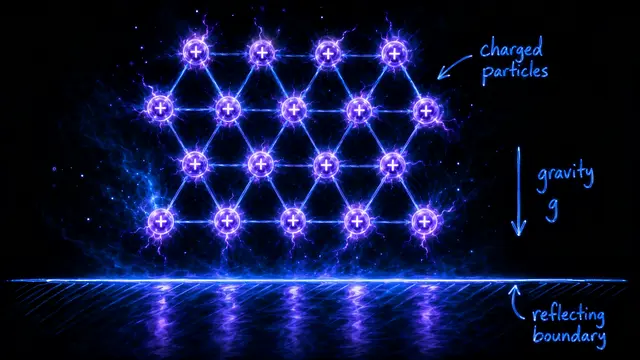
Start with three equal charges at the corners of an equilateral triangle. This symmetry naturally creates four equilibria: one at the center where all forces balance, and three more along the edges where opposing charges meet.
When the authors placed two tiny charges symmetrically above and below this triangle, something remarkable happened. The central equilibrium didn't just shift; it exploded into 21 distinct equilibria through a bifurcation, while the three edge equilibria remained intact.
Taylor expansions in cylindrical coordinates confirmed all 24 equilibria are non-degenerate, each with a distinct signature captured by its Morse index. Computer algebra verified what the implicit function theorem promised: these equilibria persist under small perturbations and lie entirely within the convex hull of the charges.
The construction generalizes beautifully. By recursively adding pairs of infinitesimal charges along symmetry axes, the authors achieve configurations with 3 plus 2m charges and at least 4 plus 20m equilibria. As the number of charges grows, the ratio of equilibria to charges approaches 10, obliterating the Maxwell bound and exceeding all prior constructions.
Maxwell's intuition, grounded in an era of simple symmetries, missed the combinatorial richness hidden in carefully perturbed configurations. These counterexamples reshape our understanding of electrostatic topology and hint at broader lessons for nonconvex landscapes in machine learning and beyond. Explore the full proof and recursive constructions at EmergentMind.com, where you can create your own video explainers of cutting-edge research.