Open Horn Type Theory: Formalizing Structured Failure
Open Horn Type Theory introduces a radical expansion of constructive type theory by adding gap witnesses as primitive elements, dual to traditional coherence witnesses. This allows the system to make rigorous, proof-relevant statements not just about what can be proven, but about structured reasons for failure of derivability. The theory creates a three-state logic—coherent, gapped, and open—that goes beyond classical and intuitionistic frameworks to capture obstruction-theoretic phenomena across mathematics, programming languages, and formal semantics.Script
Most logical systems tell you what you can prove. Open Horn Type Theory does something different: it gives you formal certificates for why something cannot be proven, treating structured failure as a first-class mathematical object.
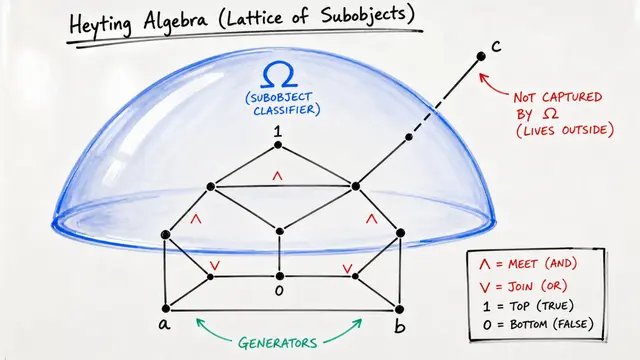
The system rests on a structural trichotomy. A judgment can be coherently witnessed with proof-relevant data, it can be witnessed as gapped with an obstruction certificate, or it can be open where neither witness exists. This is not classical logic with excluded middle, nor intuitionistic logic where gap means negation.
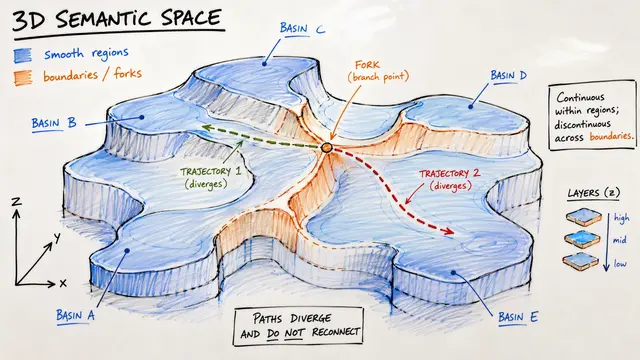
Horn types formalize where local compositional success does not guarantee global closure. You might have coherent witnesses for J to K and K to L, yet possess a gap witness for J to L directly, capturing semantic drift or cumulative obstruction that standard type theories cannot express.
The semantics use ruptured Kan complexes, generalizing the simplicial sets of Homotopy Type Theory. In topology, this captures monodromy: a path in the base that fails to lift not through absence, but through positive obstruction, like the deck transformation preventing a consistent lift around the Möbius strip.
Open Horn Type Theory makes obstruction theory internal to the type system itself. Characteristic classes, cohomological invariants, resource failures in programming languages, and systematic semantic gaps in natural language all become expressible as gap witnesses, not external annotations. In decidable theories every judgment becomes coherent or gapped; in undecidable settings, the open class remains and carries formal meaning.
By treating both existence and structured non-existence as proof-relevant primitives, Open Horn Type Theory fundamentally reframes how we reason about failure, obstruction, and potentiality across mathematics and computation. To dive deeper into this work and generate your own research videos, visit EmergentMind.com.