Latent Lattice Language Models
This lightning talk introduces Latent Lattice Language Models, a new architecture that adds persistent computational states to language models. Instead of relying solely on greater width, depth, or memory, the Lattice maintains layer-wise horizontal latents that evolve recurrently across tokens and condition how the model reads and writes to memory. Experiments show consistent improvements across Transformer and recurrent backbones at 400M to 600M parameters, with gains that compound with other architectural enhancements and persist through mathematical fine-tuning.Script
Language models have traditionally scaled by going wider, deeper, or caching more context. This paper asks: what if we gave each layer its own persistent memory that evolves across tokens?
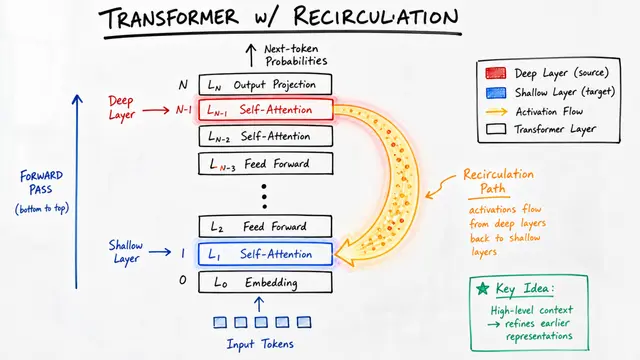
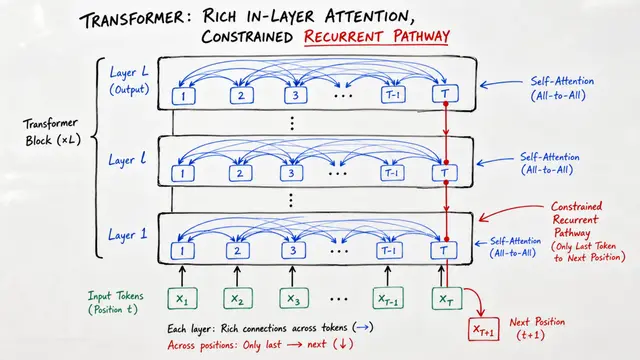
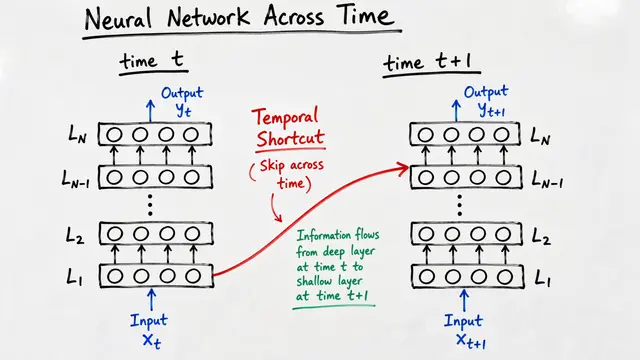
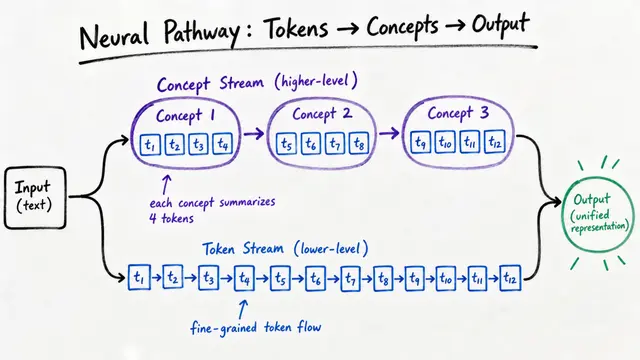
In standard transformers, the residual stream does everything: it queries memory, gets transformed by MLPs, and supplies the output representation. The Lattice separates these roles by introducing horizontal latents that persist across tokens and control how each layer interacts with the KV cache.
Each horizontal state updates through an input-dependent recurrence that can be computed in parallel during training. The state then modulates attention queries, keys, and values through learned transformations, shifts MLP activations, and optionally contributes to decoding.
At 400 million parameters trained on 20 billion tokens, the Lattice reduces perplexity by 5.6 percent compared to the transformer baseline. More striking: a 600 million parameter lattice outperforms both a wider 24-layer transformer and a deeper 40-layer transformer at similar compute cost.
The lattice is not just a reparameterization of wider or deeper models. It composes with hyper-connections, value residuals, and input residuals, with effects that compound rather than substitute, reaching 11.7 percent below the plain transformer when combined.
By treating temporal persistence as a distinct computational axis, the Lattice demonstrates that model capacity is not exhausted by width, depth, or memory size alone. To explore more research like this and create your own videos, visit EmergentMind.com.