Kani: A Model Checker for Rust
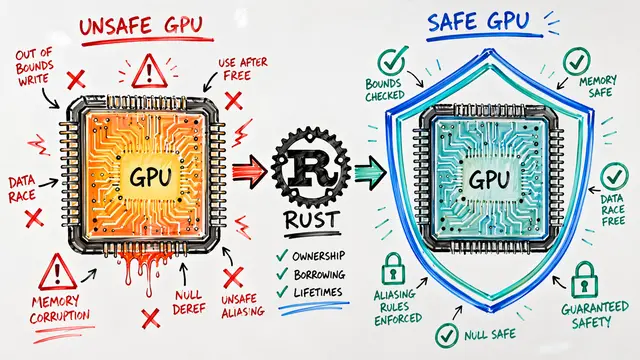
Kani is an open-source model checker that brings exhaustive verification to Rust codebases, bridging the gap between automated bug-finding and unbounded correctness proofs. Operating at the MIR level and integrating seamlessly with cargo, Kani provides both bounded model checking for safety properties and lightweight contracts for functional correctness, scaling to industrial CI workflows while catching bugs that extensive testing and fuzzing miss.Script
Testing and fuzzing can only sample a program's behavior, leaving entire regions of the state space unexplored. Kani is a model checker for Rust that exhaustively analyzes all possible executions, catching bugs that millions of test runs miss and proving properties that no amount of sampling can guarantee.
Kani hooks directly into the Rust compiler, extracting the Mid-level Intermediate Representation where all type information and ownership semantics remain intact. This MIR is transformed with safety checks and contract logic, then lowered to GOTO programs that CBMC analyzes using state-of-the-art SAT and SMT solvers.
Kani offers a smooth path from automation to proof. Bounded model checking verifies safety properties automatically by exhaustive symbolic execution. When you need unbounded guarantees, lightweight function and loop contracts written in ordinary Rust let you prove functional correctness without the proof-engineering burden of traditional deductive verifiers.
Across industrial codebases like Firecracker, s2n-quic, and Hifitime, Kani found 11 bugs that extensive fuzzing missed entirely. Fuzzers explored millions of executions but couldn't reach sparse corner cases like integer encoding boundaries or time-dependent rounding errors. Kani's symbolic analysis saturated the entire input space and produced concrete counterexamples for each defect.
In Hifitime's aerospace time library, initial harnesses frequently timed out on complex loops, but adding function and loop contracts transformed verification from intractable to routine. Over 150 harnesses now prove both safety and functional correctness properties like normalization invariants and encode-decode identities, with verification times reduced by orders of magnitude through compositional abstraction.
Kani runs in continuous integration for major Rust projects, verifying over 16,000 harnesses per change in the standard library alone with latency practical for industrial workflows. Model checking has moved from the domain of verification specialists into routine software development, delivering exhaustive guarantees at the speed of modern engineering. Learn more and create your own verification videos at EmergentMind.com.