Hybrid Reasoning Agents
This presentation introduces HybridAgent, a new architecture that dynamically alternates between continuous latent reasoning and text-based interaction within a single autoregressive agent. By conducting internal computation in latent space while preserving text output for tool use and monitoring, HybridAgent achieves substantial efficiency gains—reducing token usage by up to 54.7%, accelerating inference by up to 2.6x, and cutting estimated costs by up to 3.7x—while improving accuracy across 11 reasoning and agentic benchmarks by an average of 10.4% and maintaining full tool-use capability and external auditability.Script
Most language agents pay the computational cost of decoding every intermediate reasoning step into text, even when those steps serve no external function. HybridAgent solves this by letting internal computation remain latent while exposing only the decisions that matter for tool use and monitoring.
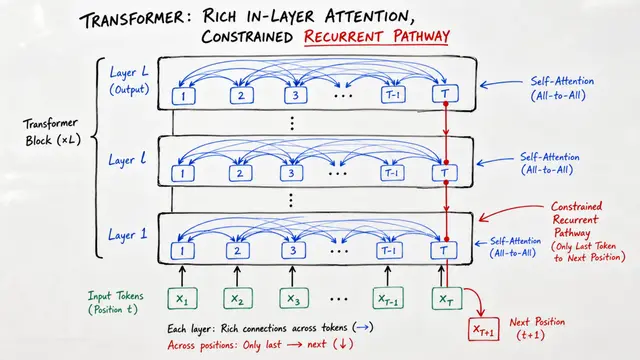
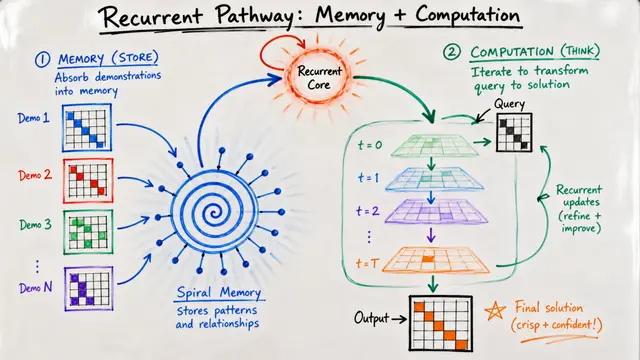
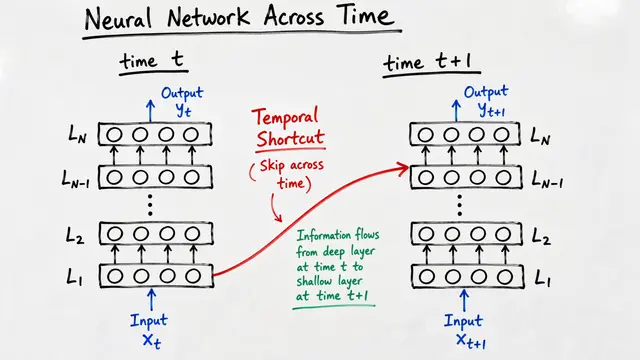
The key mechanism is HybridLink, a lightweight residual adapter that transforms hidden states so they can be fed back as continuous inputs without distributional mismatch. The model enters latent mode by generating a special anchor token, then reasons recurrently in hidden space. It exits when the latent state aligns closely with the embedding of the exit anchor, making mode transitions learned rather than imposed.
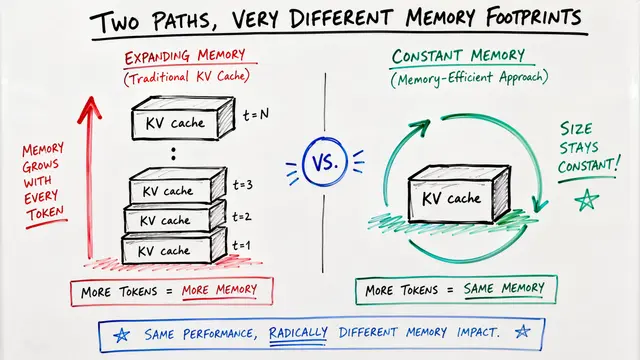
Multi-turn interaction creates a memory challenge because latent vectors cannot be reconstructed from ordinary text. HybridAgent solves this by retaining Transformer key-value entries as continuous working memory, directly appending new text, latent states, and tool observations without converting the hybrid history back into tokens. The authors prove this continuation is lossless under exact KV preservation, though the guarantee depends on maintaining all cache entries and inference settings.
Training a hybrid agent creates an exposure-bias problem. The backbone learns on ground-truth embeddings, but at inference it consumes HybridLink's own continuous predictions. The authors introduce HybridSFT, a three-stage procedure that activates format anchors, aligns the adapter, and then critically performs self-conditioned training where the model learns on its own latent outputs. This final stage improves accuracy by 30.5% over adapter training alone.
The empirical results are striking. HybridAgent reduces token usage by up to 54.7%, accelerates inference by up to 2.6 times, and improves accuracy by an average of 10.4% across 11 benchmarks. Test-time scaling also improves: as the number of sampled trajectories increases, the hybrid model shows stronger gains than text-only agents. These efficiency improvements come without sacrificing tool-use capability, which maintains a 99.7% execution-success rate.
Despite exposing 43 to 49% fewer text tokens, HybridAgent preserves external auditability. Visible traces contain more key reasoning steps per 100 tokens, and monitoring performance matches or exceeds text baselines. Yet important questions remain open: whether nearest-token readouts faithfully represent the latent computation, how the system behaves when decision-critical steps are incorrectly hidden, and what the true deployment cost of persistent hybrid memory looks like at scale. Visit EmergentMind.com to explore these open questions and create your own video explanations of cutting-edge research.