Gamer: A Real-Time Generalist Game Agent
This presentation explores Gamer, a vision-language-action foundation model that plays diverse video games using only screen observations and keyboard-mouse controls. The talk examines how the model achieves cross-game transfer through staged training—continued pre-training on gameplay data, supervised fine-tuning with sparse reasoning and persistent memory, and online reinforcement learning with real-time feedback. We'll see how the system completes complex 55-milestone quests at over 80% success while maintaining sub-100ms inference latency, and discuss the composition-dependent limits of gameplay scaling.Script
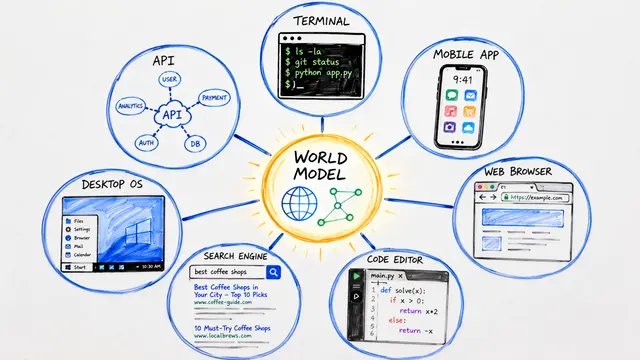
Most game AI agents are specialists, trained for one environment with privileged access to game state. What if a single model could play dozens of different games using only what a human sees on screen, controlling them in real time through an ordinary keyboard and mouse?
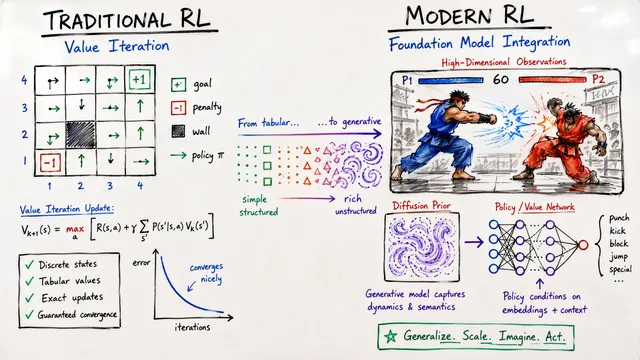
Gamer learns through three stages. Continued pre-training on thousands of gameplay hours teaches the model to translate screen observations into keyboard and mouse commands. Supervised fine-tuning adds task-conditioned reasoning and memory summaries. Then online reinforcement learning refines long-horizon execution using verifiable feedback from the game environment itself.
The model completed two side quests in Honkai Star Rail, one with 30 milestones and another with 55, involving navigation, dialogue, combat, and repair puzzles. After all three training stages, success rates reached 80% and 84% respectively. Task conditioning and memory were not auxiliary features, they drove a 38 percentage point improvement on the first quest when added during supervised fine-tuning.
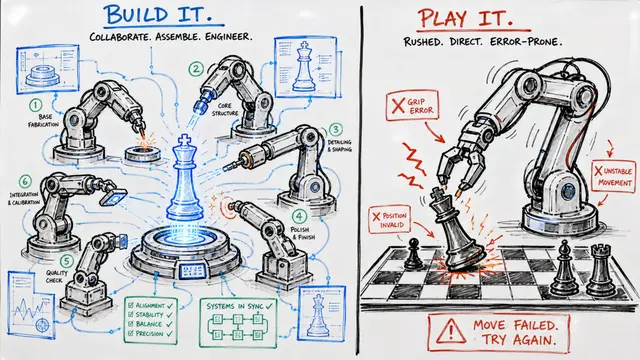
Real-time inference is not just about speed, it is part of the learning loop. When actions arrive late, the game state has already changed and feedback becomes misaligned with what the policy actually observed. Streaming inference reduced latency from 1.3 seconds to 65 milliseconds, allowing the model to act before its observations went stale and producing more stable reinforcement learning trajectories.
The composition-aware scaling law fit the training distribution with R-squared above 0.98, but for distant unseen games the fit collapsed to 0.08. Adding more gameplay hours without adding new types of interaction does not guarantee transfer. This means generalist game control depends critically on behavioral diversity, not just trajectory volume.
Gamer demonstrates that a single policy can learn real-time control across diverse games through shared device-level interfaces and staged training. Yet the results also expose hard limits: scaling helps only when the data covers relevant behaviors, segment-level rewards do not reveal causal credit, and long-horizon planning in truly unseen games remains open. If you want to explore more research at the intersection of vision, language, and embodied control, visit EmergentMind.com to learn more and create your own video summaries.