When Vision Models Think Out Loud: The Hidden Cost of AI Reasoning
This presentation examines a rigorous investigation into the internal reasoning traces of Google's Gemini 2.5 vision-language models during large-scale video scene understanding. By benchmarking four model configurations across 100 hours of diverse video data, the research reveals critical insights about reasoning token budgets, output faithfulness, and a phenomenon called compression-step hallucination—where severely constrained models generate structured outputs containing facts absent from their own reasoning traces. The findings challenge assumptions about the value of extended reasoning and demonstrate that careful budget calibration is essential for cost-effective, reliable deployment of vision models at scale.Script
What happens when you ask a vision model to explain its reasoning before making a decision? The authors of this paper discovered something unsettling: models with severely limited reasoning budgets hallucinate facts in their final outputs that never appeared in their own thought processes.
The researchers benchmarked Gemini 2.5 Flash and Flash Lite models on 100 hours of video, sampling frames at 1 frame per second with a maximum of 10 frames per scene. Each model variant received identical scene prompts but operated under different reasoning token budgets, from a constrained 128 tokens up to dynamic allocation exceeding 1000 tokens.
The primary cost driver across configurations was the thought stream itself. While input and output tokens remained stable, thought token usage varied dramatically, with high-budget variants consuming over 1000 tokens per scene yet delivering only modest quality improvements beyond 700 tokens.
Quality metrics revealed a striking pattern: output alignment and coverage improved rapidly in the first 700 tokens, then plateaued sharply. Contentfulness—the proportion of scene-relevant facts versus meta-commentary—continued rising linearly, but the translation into better structured outputs stalled. Flash 128, the most constrained variant, showed a dangerous gap where output facts frequently appeared without any basis in the reasoning trace.
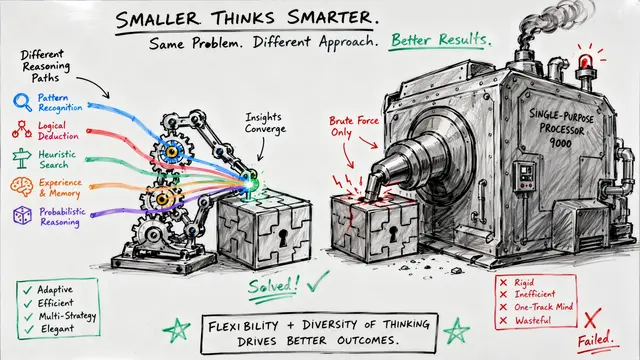
Perhaps most surprising: Flash Lite variants matched or exceeded the quality of their higher-tier Flash counterparts while using 30 percent fewer thought tokens. Cross-tier reasoning similarity scores reached 0.88 to 0.90, nearly as high as within-tier comparisons, suggesting that architectural differences matter less than reasoning budget allocation when models are forced to verbalize their process.
The lesson is clear: extended reasoning helps, but only up to a point, and severe budget constraints create a reliability crisis where models drift from their own logic. For high-volume video understanding tasks, the sweet spot sits around 700 tokens, balancing interpretability, cost, and output faithfulness. To explore more research like this and create your own video summaries, visit EmergentMind.com.