When Stringy Hodge Numbers Break: A Counter-Example to Batyrev's Conjecture
This lightning talk presents a decisive counter-example to Batyrev's longstanding conjecture that stringy Hodge numbers for varieties with Gorenstein canonical singularities are always non-negative. Using the moduli space of rank 2 semistable vector bundles over a genus 3 curve, the authors construct a seven-dimensional projective variety with Gorenstein terminal singularities whose stringy Hodge number h^{2,5} equals negative 1. This result invalidates the universal non-negativity assertion, highlights limitations in extending cohomological intuitions to singular varieties, and prompts fundamental questions about the geometric meaning of stringy invariants in birational geometry and mirror symmetry.Script
For decades, mathematicians believed that certain invariants called stringy Hodge numbers, which measure hidden symmetries in singular geometric spaces, should always be non-negative. This paper shatters that belief with a concrete counter-example.
Batyrev's conjecture emerged from mirror symmetry and motivic integration, proposing that stringy Hodge numbers for varieties with Gorenstein canonical singularities must be non-negative when the stringy E-function is polynomial. The conjecture held for spaces with finite quotient singularities and complete toric varieties, inspiring decades of research.
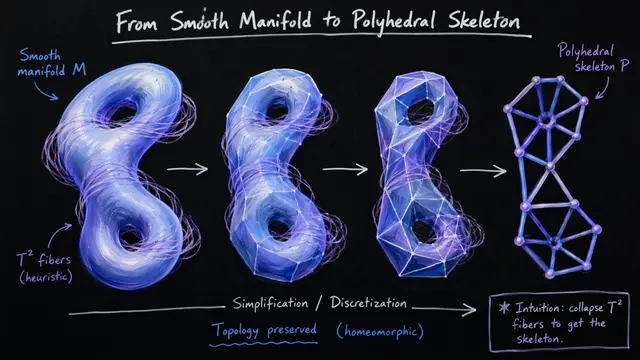
The authors construct their counter-example using the moduli space M naught of rank 2 semistable vector bundles with trivial determinant over a genus 3 curve. The product of this moduli space with the projective line yields a seven-dimensional variety with Gorenstein terminal singularities and a polynomial stringy E-function.
By computing the coefficient of u squared v to the fifth in the explicit polynomial, the researchers find that the stringy Hodge number h to the 2 comma 5 equals negative 1. This single negative value demolishes the conjecture's universal claim.
This result reveals fundamental limitations in extending cohomological intuition to singular varieties. It precludes any general pure cohomological realization for stringy Hodge numbers on arbitrary Gorenstein singularities and forces mathematicians to reckon with negative contributions in motivic invariants.
This counter-example opens fundamental questions about where positivity holds, what negativity means geometrically, and how motivic integration must adapt. To explore how this reshapes singularity theory and birational geometry, visit EmergentMind.com and create your own video diving deeper into these mathematical frontiers.