When Averages Don't Commute: A Flaw in Testing Gravity at Cosmic Scales
This presentation examines a critical technical comment on a claimed 3.3-sigma exclusion of deep MOND gravity using the kinematic Sunyaev-Zeldovich effect. The comment reveals that a subtle mathematical error in how nonlinear transformations are averaged can completely invalidate a statistical constraint, transforming an apparent exclusion into a null result and demonstrating why the order of operations matters when testing fundamental physics.Script
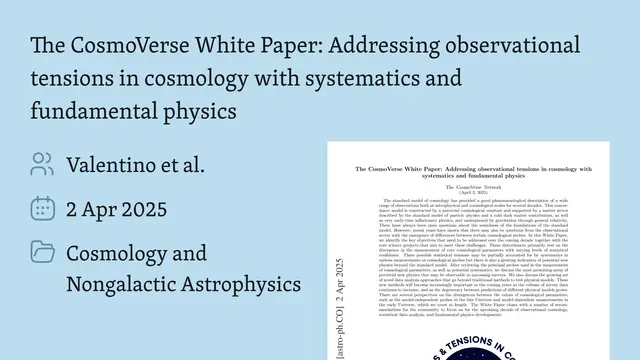
A 2024 analysis claimed to have ruled out a version of modified gravity with 3.3 sigma confidence by measuring how galaxy pairs move through the cosmic microwave background. The measurement itself was solid, but a new comment reveals the template used to interpret it contained a hidden mathematical flaw.
The disputed force law transforms the local gravitational acceleration through a nonlinear square-root relation before you observe the pair-averaged motion. The original analysis instead averaged the Newtonian acceleration first, then applied the nonlinear transformation. For linear operations these are the same, but nonlinear functions do not commute with averages.
The difference is not academic. The published template for deep MOND predicts the signal should vary by a factor of 3.3 across the measured separations. When the author performs the calculation in the correct order, the deep-MOND prediction stays nearly proportional to Newtonian gravity at every scale, differing by less than 2 percent.
The comment proves this result exactly for Gaussian fields with linear bias, then validates it numerically in more realistic tracer selections using simulated cosmological boxes. Even when tracers are selected as density peaks rather than through linear weighting, the proportionality holds to within measurement noise across all tested configurations.
Refitting the kinematic Sunyaev-Zeldovich data with the corrected template produces a chi-squared of 20.1, identical to the Newtonian fit. The originally reported chi-squared of 33.8 for deep MOND, and the resulting 3.3 sigma exclusion, came entirely from the artificial scale dependence introduced by averaging in the wrong order.
The published constraint on the force-law exponent remains valid as a fit to a phenomenological template family, but it cannot be interpreted as a test of the underlying pointwise gravity law. This episode illustrates how a single subtle choice in a data-analysis pipeline can transform a null result into an apparent discovery. You can explore the full technical derivation and create your own video summaries at EmergentMind.com.