Ambient LLMs: Temperature Matching for Data-Efficient Fine-tuning
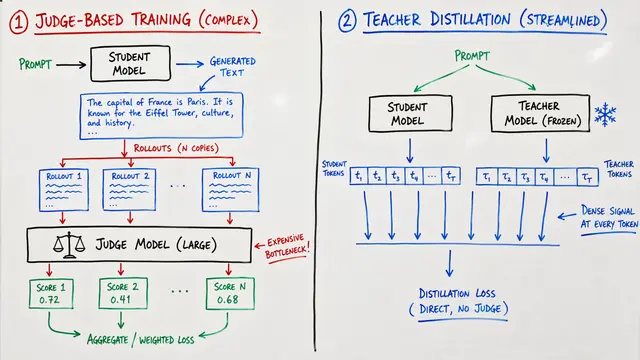
This lightning talk presents Ambient SFT, a regularized supervised fine-tuning method that uses the pre-trained model itself as a frozen teacher. By matching temperature-scaled distributions rather than sharp predictions, the method preserves broad structural knowledge while learning task-specific behavior. We explore the theoretical foundations, including identifiability at high temperature and bias-variance trade-offs, then examine empirical gains across domain adaptation, instruction tuning, and reasoning tasks where supervision is limited.Script
Standard supervised fine-tuning uses tiny datasets compared to pre-training, and it routinely erases capabilities the model already had. The researchers behind Ambient SFT propose a simple fix: use the pre-trained model itself as a frozen teacher, but match it only after temperature smoothing.
Temperature is the control knob. At temperature equals 1, you recover ordinary knowledge distillation. As temperature rises toward infinity, both teacher and student distributions flatten, and the method converges back to standard fine-tuning. The sweet spot lies in between, where the teacher supplies coarse structural constraints without forcing sharp, task-specific predictions.
The theory backs this up with a bias-variance analysis. High temperature contracts the gap between pre-trained and post-trained models at rate proportional to temperature squared. In data-limited regimes, the variance reduction dominates the regularization bias, so an intermediate temperature can beat both ordinary fine-tuning and the frozen teacher.
In domain adaptation experiments with 225 million tokens per target, Ambient SFT matched or beat the best baseline on every domain. The largest win came on News, where validation loss dropped from 1.99 to 1.68, a 26.7 percent relative perplexity improvement. The gains correlated strongly with how well the base model already understood each domain, with a Spearman correlation of minus 0.90.
Instruction tuning revealed the forgetting problem most clearly. Vanilla fine-tuning on 21,000 examples improved instruction following but degraded math, code, and reasoning. Ambient SFT reduced that trade-off, with average relative improvements up to 20 percent at the smallest model scale. Across additional epochs, it maintained stability where vanilla fine-tuning continued to degrade non-instruction capabilities.
The method works best when supervision is scarcest, and it depends on the teacher retaining useful information about the target domain. Temperature is not just a confidence dial; it changes the geometry of the regularizer across different directions in parameter space. To learn more about Ambient SFT and create your own research video, visit EmergentMind.com.