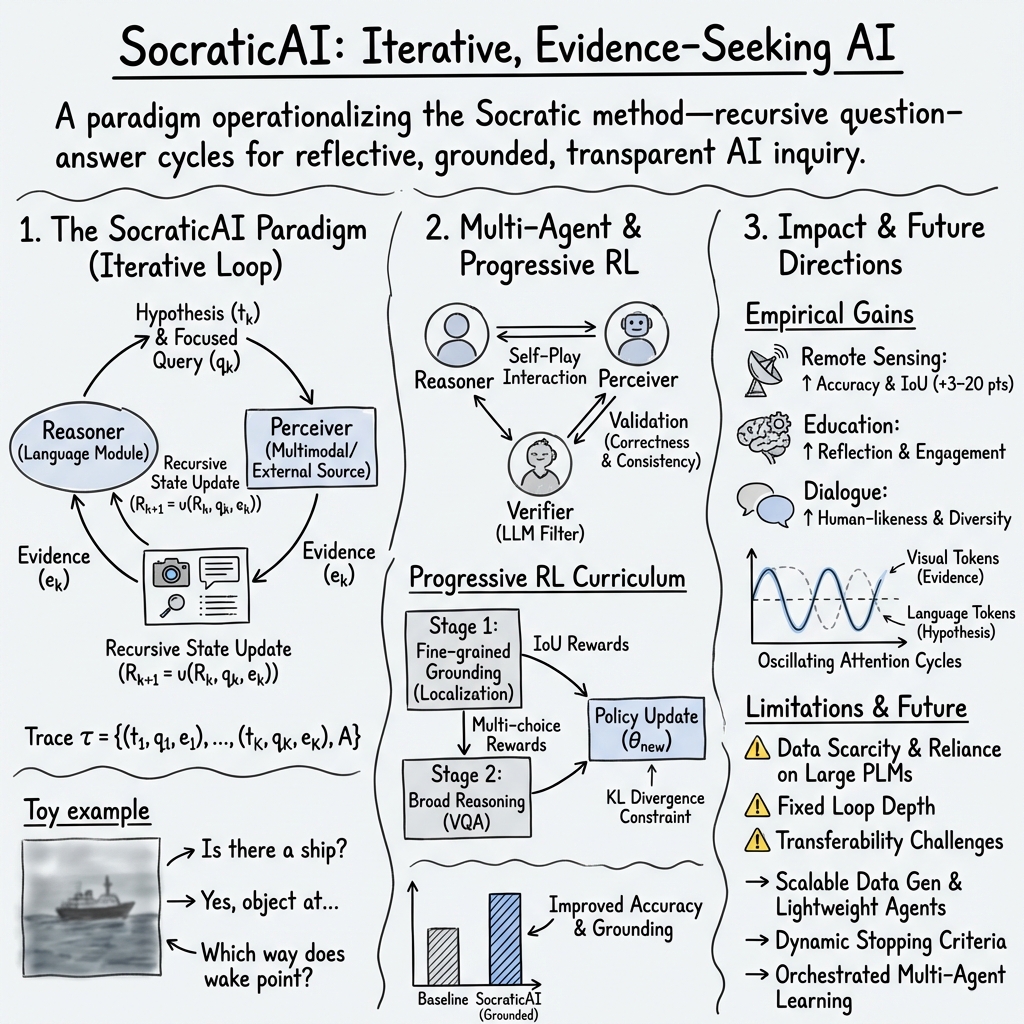
SocraticAI: Iterative, Transparent Reasoning
- SocraticAI is a paradigm that uses iterative, evidence-seeking question–answer cycles to decompose complex tasks with clear, verifiable reasoning.
- It integrates multi-agent systems and reinforcement learning curricula to enhance metacognitive engagement and mitigate shortcut inferences.
- Empirical studies demonstrate significant improvements in remote sensing, educational tutoring, and dialogue simulation, highlighting its versatility and accuracy.
SocraticAI refers to a paradigm in artificial intelligence that operationalizes the Socratic method—iterative, evidence-seeking question–answer cycles—within AI architectures for reasoning, instruction, and collaboration. Unlike direct-answering models, SocraticAI systems decompose complex tasks into recursive dialogues that prioritize reflective, grounded, and transparent forms of AI inquiry. Recent advances have instantiated this paradigm across multimodal reasoning, educational tutoring, collaborative annotation, and adaptive agent design, exhibiting improved performance, metacognitive engagement, and human–AI co-agency.
1. Defining the SocraticAI Paradigm
SocraticAI formalizes AI-driven, dialogic reasoning via iterative question and evidence-examination loops, as opposed to one-shot or pseudo-justificatory outputs. The core pattern is an alternation between hypotheses—articulated as natural language proposals or sub-tasks—and targeted queries to information sources (e.g., visual, textual, or experiential modules). This approach yields multi-step, verifiable traces of reasoning, supporting transparency and robustness to early errors.
A canonical instantiation is the RS-EoT (Remote Sensing Evidence-of-Thought) paradigm, where a "Reasoner" agent iteratively generates thoughts and focused questions about an image , a "Perceiver" returns evidence , and the internal state is recursively updated. The complete trace maximizes an evidence-grounded reward through policy under RL, formalized as (Shao et al., 27 Nov 2025).
2. Multi-Agent Architectures and Self-Play Trace Synthesis
Advanced SocraticAI systems, such as SocraticAgent, employ self-play among specialized agents:
- Reasoner: Language module generating speculative hypotheses and queries based on meta-data, not direct observation.
- Perceiver: Multimodal LLM with direct access to perception (images, diagrams, or states), returning compact, evidence-based answers.
- Verifier: LLM-based filter evaluating answer correctness and consistency.
Label data for SocraticAI are generated by alternating reasoner and perceiver interactions, validated by the verifier. Agents are prompted to treat one another as potentially unreliable, encouraging granular decomposition and critical evidence-seeking. Complete traces are recorded only when the output meets the verifier's correctness criteria, populating datasets such as RS-EoT-4K with explicit reasoning steps: e.g., "Is there a ship-like object?," "Which way does its wake point?" (Shao et al., 27 Nov 2025).
Other domains leverage similar scaffolds: Tutoring systems decompose student interactions into PROB (probing), DEC (decomposition), and REFL (reflection) prompt types, while dialogue models for collaborative annotation simulate Socratic users to produce human-like, critical questions for multi-round conversation finetuning (Sunil et al., 3 Dec 2025, Kong et al., 2023).
3. Reinforcement Learning and Progressive Curriculum
SocraticAI benefits from staged reinforcement learning curricula. In RS-EoT-7B, the progressive two-stage RL setup first optimizes fine-grained grounding (object localization via IoU-based rewards with format regularizers), then broadens to RS-VQA (Remote Sensing Visual Question Answering) tasks using multi-choice reward structures. All stages regularize updates by a Kullback–Leibler divergence constraint (e.g., GRPO-style policy update):
The staged approach enables evidence-seeking skills to generalize from localization to complex reasoning, systematically mitigating the "Glance Effect": the tendency of models to make plausible but ungrounded inferences from a coarse holistic view (Shao et al., 27 Nov 2025).
Similarly, in educational SocraticAI systems, adaptive feedback and proficiency estimation are iteratively refined via policy updates tied to student performance and metacognitive engagement metrics (Sunil et al., 3 Dec 2025, Gupta et al., 16 Mar 2025).
4. Empirical Performance and Analytical Findings
Empirical studies demonstrate state-of-the-art results and behavioral improvements across evaluation domains:
- Remote sensing: RS-EoT-7B improves RS-VQA accuracy and grounding IoU by absolute margins of 3–20 points over Qwen2.5VL and specialist models (e.g., Geo-R1, VHM-RL), exceeding p<0.01 significance under bootstrap analysis (Shao et al., 27 Nov 2025).
| Model | Task/Metric | Ours | Baseline |
|---|---|---|---|
| RSFG-VQA | Avg@5 | 67.85 | 62.45 |
| RSVQA | Avg@5 | 75.16 | 67.20 |
| DIOR-RSVG | IoU@50 | 47.00 | 35.40 |
- Education: Reflection rates, decomposition sophistication, and precision of queries increased substantially after SocraticAI deployment (e.g., reflection rate R≈75% after 3 weeks, ΔP=+45 points), with corresponding reductions in low-level debugging requests (~60%) and emergence of chain-of-thought engagement (Sunil et al., 3 Dec 2025, Hashmi et al., 20 Aug 2025).
- Dialogue simulation and multi-turn QA: User-simulator-trained SocraticChat datasets yield significant improvements in MT-Bench and Alpaca-Eval for LLaMA-based models, with question diversity and human-likeness positively correlating with answer quality (r=0.85–0.89). (Kong et al., 2023)
- Learning analytics: Question specificity correlates with projected course performance (Pearson r=0.43, p<0.0001), and SocraticAI platforms provide granular analytics for learning processes (Hashmi et al., 20 Aug 2025).
5. Mechanistic Interpretability and Attention Dynamics
SocraticAI enforces oscillating cycles of attention between modalities and reasoning stages. Fine-grained attention analysis in RS-EoT models reveals periodic peaks for visual tokens during evidence-gathering and for language tokens during hypothesis formation, directly confirming the iterative evidence-of-thought loop. Case studies show SocraticAI proactively issues differentiable, localizing queries (e.g., "Where is the wake?") rather than defaulting to global, unverifiable answers, reducing mis-localization and pseudo reasoning (Shao et al., 27 Nov 2025).
6. Limitations, Scalability, and Cross-Domain Potential
Current limitations include:
- Data scarcity and reliance on large PLMs: Label trace synthesis depends on a limited number of SFT traces and powerful pretrained models (e.g., GPT-5-mini, Gemini-2.5), curbing scalability. Lighter agents and richer trace datasets remain future work (Shao et al., 27 Nov 2025).
- Fixed loop depth: Most implementations use a bounded number of iterative turns (e.g., 6 rounds), restricting adaptability; dynamic or learned stop criteria are open problems.
- Transferability: The SocraticAgent architecture, and the evidence-of-thought principle, are well-posed for transfer to other domains reliant on iterative inquiry (medical imaging, pathology, complex systems), but generalization and grounding mechanisms require domain-specific adaptation.
Extensions may leverage domain-agnostic scaffolding for open-ended research (e.g., motivational knowledge graph–integrated dual-agent ideators), or port multi-agent, iterative Socratic dialogues to orchestrated multi-agent learning ecosystems supervised by human orchestrators (Lei et al., 26 Sep 2025, Degen et al., 7 Aug 2025).
7. Synthesis and Future Directions
SocraticAI constitutes an explicit paradigm in AI system design, characterized by:
- Enforced alternation between reasoning and evidence-seeking, implemented via multi-agent exchange and explicit prompt scaffolds.
- Reinforcement learning curricula tailored to multi-level skill generalization and robustness against shortcut "Glance Effects."
- Demonstrable improvement in both accuracy and metacognitive depth across remote sensing, education, collaborative reasoning, and annotation.
- Transparent, analyzable traces supporting interpretability, learning analytics, and systematic error detection.
Future progress will target scalable data generation for trace-rich RL, lightweight and domain-tailored agent deployment, dynamic adaptive stopping, and integration within orchestrated, modular multi-agent learning environments capable of supporting, not supplanting, human inquiry and judgment (Shao et al., 27 Nov 2025, Sunil et al., 3 Dec 2025, Degen et al., 7 Aug 2025).