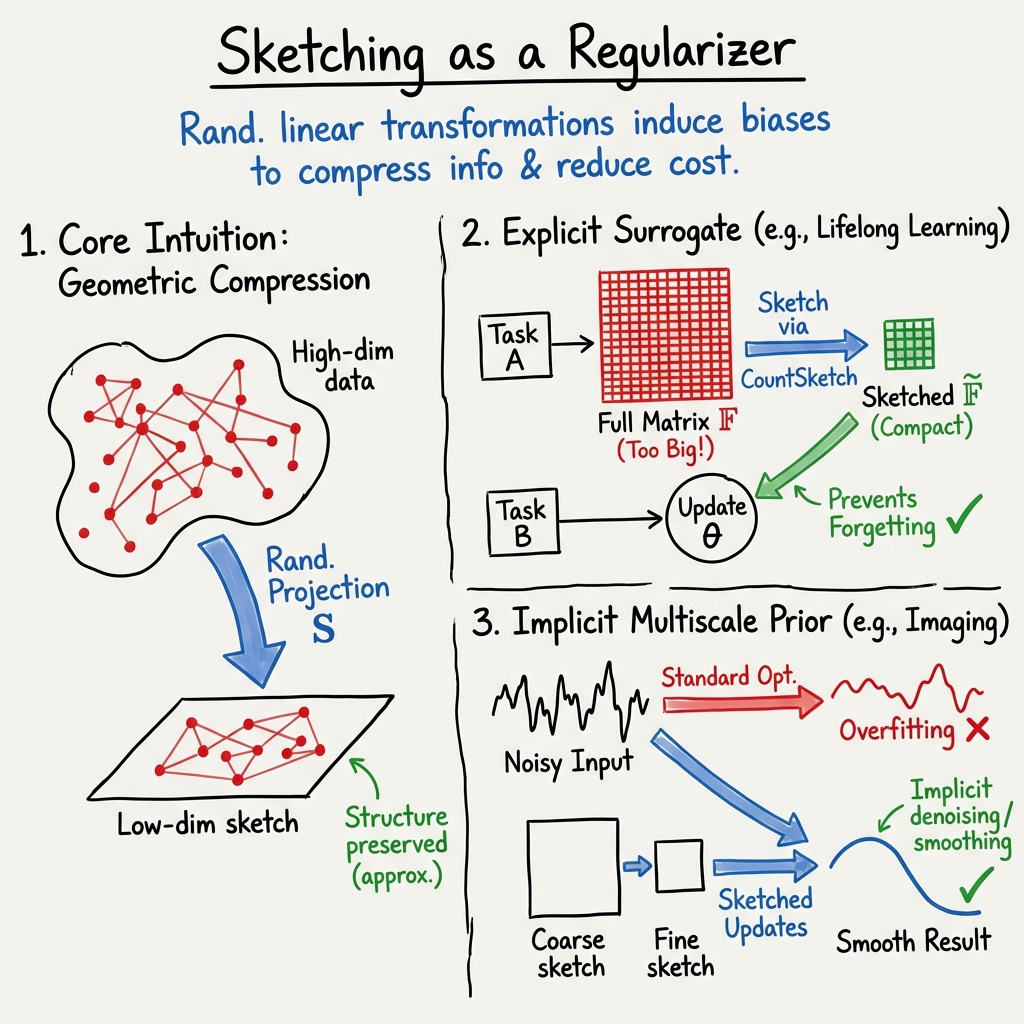
Sketching as a Regularizer
- Sketching as a regularizer is a technique that uses randomized projections, such as JL transforms and CountSketch, to compress high-dimensional data while nearly preserving its geometric structure.
- It serves as an explicit surrogate for conventional regularizers in applications like continual learning, deep representation, and inverse imaging, achieving competitive performance with lower memory and computation.
- Empirical and theoretical results demonstrate that sketched regularization maintains error bounds and convergence rates, offering a scalable and adaptive approach in complex optimization problems.
Sketching as a regularizer refers to the practice of employing randomized linear transformations—known as sketches—to compress information, reduce computational cost, and/or induce explicit or implicit inductive biases in optimization and learning problems. This approach harnesses sketching’s classical ability to preserve geometric structure under random projections (e.g., Johnson–Lindenstrauss lemma) in order to regularize high-dimensional statistical, neural, and inverse problems. Recent developments have demonstrated that sketching can function as an explicit surrogate for standard regularizers, as a mechanism for memory-efficient replay in continual learning, as an inductive bias for structure in vision representations, and as an implicit multiscale prior in stochastic optimization for imaging applications.
1. Mathematical Foundations of Sketching as a Regularizer
Randomized sketching typically involves projecting high-dimensional vectors or matrices onto a low-dimensional subspace using a random matrix , with . Sketching matrices are constructed to satisfy -subspace embedding properties: for any in a subspace,
with high probability.
Key instantiations include:
- CountSketch matrices for row-space compression and efficient matrix product approximation.
- Johnson–Lindenstrauss (JL) transforms, such as Gaussian or Fast JL matrices (FJLT), to preserve pairwise distances.
- Multiresolution operators in imaging, which are block-averaging/downsampling-upscaling compositions.
Sketching thus induces a new, lower-dimensional geometry in which quadratic forms, distances, (co-)variance, and loss landscapes are only slightly distorted—this underpins its application as a regularizer across different domains.
2. Structural Regularization in Lifelong Learning
Structural regularization (SR) methods in continual learning penalize deviation of current neural network parameters from parameters learned on previous tasks, modulated by a (typically quadratic) importance matrix : In "Lifelong Learning with Sketched Structural Regularization" (Li et al., 2021), a sketched SR approach compresses via CountSketch, such that 0, where 1 (with 2 the sketching matrix and 3 the Jacobian matrix of per-sample gradients).
Algorithmic aspects:
- Building 4 costs 5 time and 6 memory for 7 "buckets".
- The sketched penalty preserves off-diagonal information ignored by diagonal-SR, but at drastically reduced storage versus the full 8 matrix.
Theoretical guarantees:
Let 9 be the stable rank of 0. For 1, with high probability,
2
uniformly over 3, and 4.
Empirical results:
Sketched SR outperforms diagonal-only SR in standard lifelong learning benchmarks (Permuted-MNIST, CIFAR-100). For instance, Sketch-EWC achieves 93.6% on CIFAR-100 distribution-shift (vs. 90.8% for diagonal EWC), matching full-matrix EWC accuracy at a small fraction of computational cost (Li et al., 2021).
3. Sketch-Based Regularization in High-Dimensional Optimization
Sketching has been extended to high-dimensional regularized least-squares with arbitrary convex or nonconvex penalties. The Sketching for Regularized Optimization (SRO) framework (Yang et al., 2023) analyzes the following: 5 and its sketched version,
6
where 7 is a JL-type sketch matrix.
Theoretical results:
- For convex 8, with 9 a 0 subspace embedding,
1
- For sparse estimators (convex and also nonconvex, e.g., SCAD/MCP), iterative SRO achieves optimal minimax rates,
2
for sketch size 3.
Interpretation:
Sketching reduces the effective problem dimension and noise, akin to explicit penalization (e.g. ridge/Lasso). The amount of regularization is controlled by the sketch dimension 4: small 5 yields stronger shrinkage.
Empirical validation:
SRO and iterative SRO yield prediction error and statistical rates on par with full-data solvers in Lasso, Ridge, and subspace clustering tasks, but with reduced computational load (Yang et al., 2023).
4. Sketching as Inductive Bias in Deep Representation Learning
Sketching can serve as an architectural or loss-level inductive bias. In Learning by Sketching (LBS) (Lee et al., 2023), images are embedded into a compact set of parametric Bézier strokes using a Transformer decoder, with end-to-end training governed by CLIP-based geometric and semantic perceptual losses, as well as guidance and embedding losses.
Architectural elements:
- Depth-constrained explicit representations: e.g., 6 strokes per image.
- Losses imposed on both geometric (low-level) and semantic (high-level) CLIP embeddings of the stroke rendering.
Theoretical analysis:
- Affine-equivariance: The stroke generation and rasterization pipeline is provably equivariant under 7 transformations, ensuring the learned representation is geometry-aware.
- Bottleneck of limited strokes imposes a capacity constraint that prioritizes global shape over fine, potentially noisy, details.
Implications and empirical evidence:
- LBS yields greater spatial reasoning and generalization capacity than standard contrastive or self-supervised methods in tasks such as rotMNIST, CLEVR attribute probing, and domain transfer. For instance, LBS achieves 81.8% on leftmost-color CLEVR attribute linear probe, compared to 76.7% (CE) and 70.1% (E(2)-CNN) (Lee et al., 2023).
- Sketching regularizes the model to focus on essential, interpretable structure rather than pixel-level variation.
5. Sketch-Based Regularization for Continual and In Situ Learning
Memory-efficient continual learning is enabled by sketch-based replay. In neural compressors for in situ scientific simulation (Simpson et al., 4 Nov 2025), only low-dimensional random projections (“sketched snapshots”) of previous data are retained in memory, and the replay loss is computed in the sketch space.
Theoretical underpinning:
- The Johnson–Lindenstrauss lemma and its manifold variant guarantee that the sketched loss 8 tightly controls the full-space error 9 up to 0 multiplicative slack.
Algorithmic protocol:
- For each new data snapshot, store the full data in a small buffer, store multiple sketched projections (1) in a larger buffer, and minimize a combined loss: 2
Empirical performance:
- On large-scale 2D/3D simulation tasks (Ignition, Neuron, Channel-flow), in situ training with FJLT-based sketching achieves relative Frobenius error (RFE) 3, nearly matching offline baselines, whereas omitting sketching leads to catastrophic forgetting (RFE4) (Simpson et al., 4 Nov 2025).
Benefits:
- One-pass, architecture-agnostic, mesh-agnostic, and minimal memory increase, with theoretical control of regularization strength via 5. The method is especially effective for preventing forgetting in long sequence training.
6. Implicit Multiscale Regularization via Sketching in Inverse Imaging
In stochastic multiresolution sketching for image reconstruction (ImaSk) (Perelli et al., 2024), sketching acts as an implicit multiscale regularizer by interleaving updates at different spatial resolutions within each iteration.
Algorithmic innovation:
- Introduce random “sketch” operators 6, where 7 down-samples by 8 and 9 up-samples by nearest neighbor.
- The update uses a SAGA-type variance-reduction framework, sampling the resolution at each step.
Theoretical result:
- Linear convergence rate in strongly convex settings: 0 with contraction rate 1 improving with increased number of sketch resolutions 2.
Effect on regularization:
- Coarse-resolution updates emphasize smoothing and denoising by suppressing high-frequency details, while fine resolutions refine boundaries. Multiscale stochasticity implicitly regularizes against overfitting high-frequency noise.
Computational and empirical impact:
- On clinical CT, ImaSk with four resolutions reduces per-iteration computation by approximately a factor of two and reaches convergence 3-4 faster than single-resolution SAGA, with final reconstructions matching full-resolution solvers in PSNR and error (Perelli et al., 2024).
7. Synthesis: Interpretations, Advantages, and Limitations
The use of sketching as a regularizer unifies explicit surrogate penalties, implicit memory- and information-bottlenecks, and multiscale or geometric priors. Key mechanisms include:
- Explicit compression, yielding control over noise and overfitting analogous to 5-type shrinkage, but tunable via the sketch size.
- Inductive biases for geometry, compactness, and equivariance, robust to domain shifts and transformations.
- Memory- and computation-efficient replay and optimization strategies for high-dimensional, streaming, or online scenarios.
Chief advantages are theoretical transparency (explicit error bounds), structural flexibility for diverse problem settings, and strong empirical efficacy in both statistical and deep learning regimes. Principal limitations include the stochastic nature of the error guarantees, necessity of careful sketch dimension choice, and occasional reliance on mild curvature or manifold assumptions for JL-type results. A plausible implication is the potential for further gains via adaptive, data-driven, or deterministic sketches tailored to domain-specific structure or learned low-rank representations.
Sketching as a regularizer thus constitutes a fundamental toolkit for scalable, geometry-aware, and provably robust statistical learning, optimization, and continual adaptation across a broad spectrum of applications.