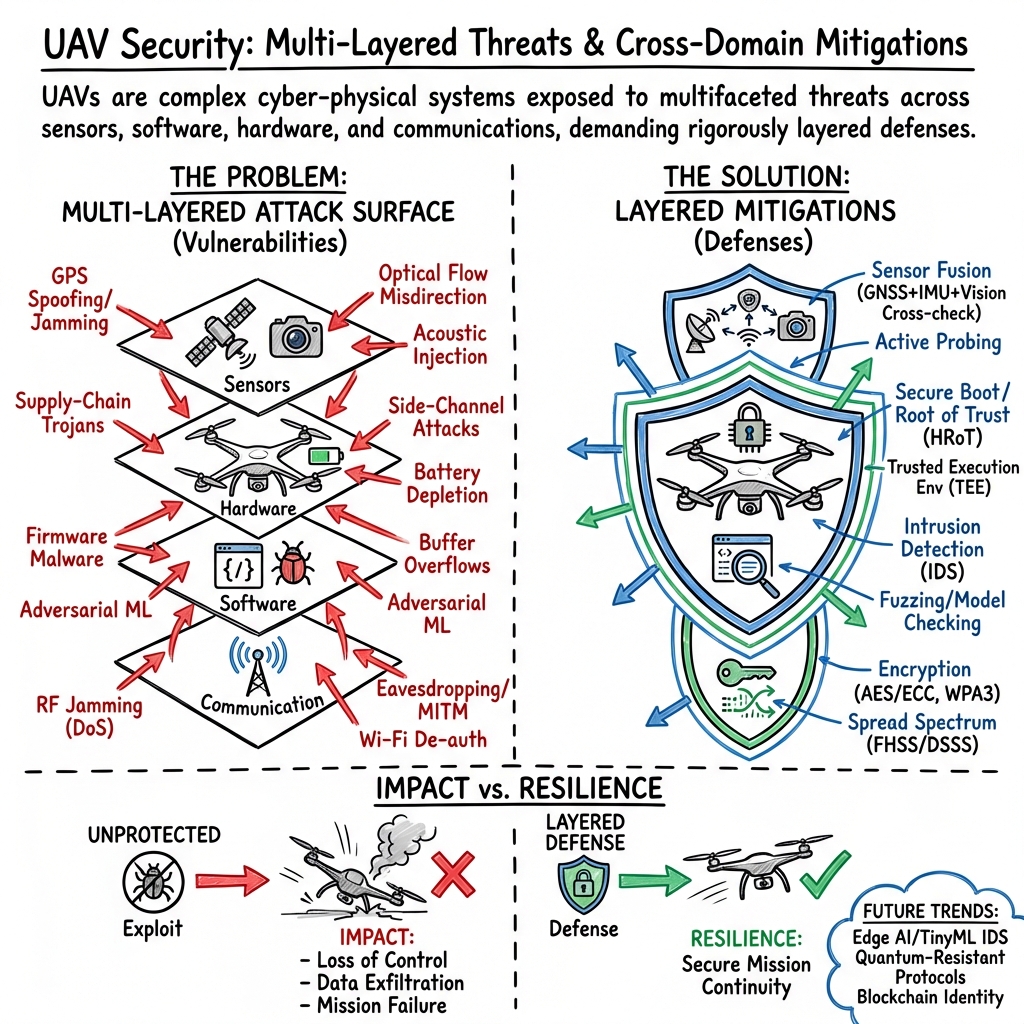
UAV Security Threats Analysis
- Security Threats to UAVs are diverse, encompassing sensor, hardware, software, and communication vulnerabilities that risk mission integrity.
- Research highlights that attacks like GPS spoofing, firmware exploits, and jamming cause significant deviations and control losses in UAV operations.
- Effective mitigation relies on layered defenses including encryption, sensor fusion, IDS, and regulatory measures to safeguard UAV missions.
Unmanned Aerial Vehicles (UAVs) comprise an expanding category of cyber-physical systems that execute civilian, commercial, and military missions. Their reliance on distributed embedded software, commodity sensors, commodity RF hardware, and open wireless protocols exposes them to multifaceted security threats spanning all classical computer security dimensions: confidentiality, integrity, availability, and privacy. Modern attacks routinely exploit vulnerabilities in UAV sensor input, onboard software, hardware, and radio links; compromise may result in loss of flight control, data exfiltration, mission derailment, or physical destruction. Research underscores that UAV security cannot be assured by securing any single subsystem, but rather demands rigorously layered, cross-domain mitigation spanning physical, cryptographic, and cyber defenses (Rout et al., 3 Dec 2025, Patel et al., 2022, Mekdad et al., 2021).
1. Threat Taxonomy: Multi-Layered Attack Surfaces
Security threats to UAVs are best described by a taxonomy capturing principal attack surfaces:
- Sensor-level: GPS spoofing/jamming, IMU/gyroscope acoustic injection, optical flow sensor misdirection, camera-based physical adversarial attacks.
- Hardware-level: Hardware Trojans in flight controllers, supply-chain manipulation, battery depletion attacks, side-channel key extraction.
- Software-level: Firmware malware (“Maldrone”), buffer overflows, insecure bootloaders, code injection, data and model poisoning in on-board ML.
- Communication-level: Unencrypted link eavesdropping, Wi-Fi de-authentication, RF jamming, protocol replay/flooding, man-in-the-middle (MITM), routing attacks in ad hoc networks (blackhole, wormhole, Sybil, flooding).
- Application-level and Coordination: Ground-station impersonation, command injection, regulatory bypass, multi-drone coordination and swarm attacks, insider threats.
- Physical-layer (PHY) Security: Eavesdropping and jamming leveraging UAV air-to-ground LoS, adaptive trajectory attacks, cooperative adversarial UAVs.
This stratification is reflected in surveys that classify over 40 attacks according to the confidentiality/integrity/availability (CIA) triad, the STRIDE model, and by precise attack vectors with references to exploited mechanisms and their operational metrics (Rout et al., 3 Dec 2025, Patel et al., 2022, Mekdad et al., 2021, Ceviz et al., 2023).
2. Principal Attack Mechanisms and Quantitative Impact
Sensor and Navigation Attacks:
- GPS/GNSS spoofing is executed by overpowering satellite signals so the UAV receiver calculates a false location; particularly damaging due to widespread absence of civil signal authentication (Rout et al., 3 Dec 2025, Sorbelli et al., 2021). Attack impact is quantified as path deviation and drop in mission success rate; experimental studies show that lateral drifts exceeding 10–30 m and full mission aborts are typical (Khazraei et al., 2023, Rudo et al., 2020).
- IMU and vision spoofing leverages physical signals/acoustic energy or coordinated falsification (e.g., adversarial camera marker shifts), yielding off-target landings and path deviation while remaining undetectable to standard anomaly detectors (Khazraei et al., 2023).
Software and Control-Flow Attacks:
- Firmware exploits—including buffer overflow, code injection, and persistent malware—allow remote or insider adversaries to exert arbitrary code execution, hijack flight control, or trigger drone loss (Alhawi et al., 2019). Model checking and fuzzing uncover specific vulnerabilities such as UDP datagram overflows and concurrency deadlocks; successful penetration is facilitated by lack of secure boot and insufficient bounds-checking (Alhawi et al., 2019).
- Adversarial ML attacks can poison perception stacks, leading to misclassification and operational misguidance at high rates (Rout et al., 3 Dec 2025).
Communication-Layer Attacks:
- Jamming at control (2.4/5.8 GHz), telemetry, or GNSS bands renders links unavailable when jamming-to-signal ratio exceeds critical thresholds; denotes denial, with loss-of-link probability approaching 1 for (Yu et al., 10 Apr 2025, Rout et al., 3 Dec 2025, Wang et al., 2020).
- Eavesdropping and MITM injection are made feasible by persistent plaintext links or broken authentication.
- Wi-Fi de-authentication (DoS): Commodity attacks leveraging 802.11 management-frame injection can break pilot–UAV association within 10 s; attacks using Raspberry Pi platforms achieve 100% link loss success in lab studies (Abdulrazak, 2024).
- Routing-layer attacks such as blackhole and flooding in ad hoc UAV networks cause step-changes in packet delivery ratio (e.g., PDR dropping from ≈94% to ≈62% with 25% attackers in flooding scenarios) and can partition networks in real time (Ceviz et al., 2023, Fotohi, 2020).
Cyber-Physical and Coordinated Attacks:
- Swarm and formation attacks: Adversarial nodes in formations exploit vulnerability in consensus/formation-maintenance protocols; trimmed-mean or W-MSR algorithms are required for provably resilient operation (Negash et al., 2020).
- ADS-B/TCAS spoofing and flooding: Attackers inject ghost aircraft or craft message collisions, raising near-miss (NMAC) and loss-of-separation probabilities by orders of magnitude (Yu et al., 10 Apr 2025, Behzadan, 2017).
- Battery depletion, fault-injection, and sensor deprivation attacks employ resource exhaustion or physical manipulation to trigger fail-safe or catastrophic drone loss (Rout et al., 3 Dec 2025, Ceviz et al., 2023).
3. Analytical Models and Empirical Metrics
Attack effectiveness and UAV resilience are routinely quantified using closed-form expressions and simulation-derived metrics:
| Attack Type | Metric/Model | Example Value |
|---|---|---|
| Jamming | , | requires only 30–50 W at 200 m for C2 denial (Yu et al., 10 Apr 2025) |
| GPS Spoofing | (capture probability) | >90% with +3 dB power at GNSS antenna (Yu et al., 10 Apr 2025) |
| Packet Loss | , PDR | PDR fell to ≈62% at 25% flooding attackers (Ceviz et al., 2023) |
| Software Exploit | Fuzzing/BMC discovered mean(Δd) ≈12.3 m GPS error | (Rudo et al., 2020) |
| Stealth Attacks | under coordinated sensor+vision falsification | (Khazraei et al., 2023) |
Detection mechanisms are benchmarked using:
- Detection/False Positive Rate: , FPR similarly defined (Fotohi, 2020, Choudhary et al., 2018).
- Processing Overhead & Latency: Cryptographic operations add 1–20 ms/packet for AES/ECC (Rout et al., 3 Dec 2025), ML detection incurs ~2 ms/sample (Yu et al., 10 Apr 2025).
- Resource Impact: IDS, EKF, and cryptography collectively raise onboard CPU or battery usage by 5–15% in typical evaluated scenarios (Rout et al., 3 Dec 2025, Mekdad et al., 2021, Yu et al., 10 Apr 2025).
4. Mitigation Strategies: Prevention, Detection, and Active Response
Mitigation of UAV threats spans multiple layers and defense types:
Encryption & Authentication:
- AES-128 and ECC, PKI, hash-based/zero-knowledge authentication schemes (Yu et al., 10 Apr 2025, Rout et al., 3 Dec 2025, Patel et al., 2022).
- WPA2-PSK/WPA3 on links, TLS/DTLS for command/telemetry, 802.11w management frame protection to block de-auth attacks (Abdulrazak, 2024).
Multi-Modal and Sensor Fusion Defenses:
- GNSS+IMU+camera cross-validation in EKF detects GPS spoofing, acoustic attacks, and vision spoofing (Mekdad et al., 2021, Khazraei et al., 2023).
- Active-probing (random maneuvers/yaw) to force physical-dynamics/visual inconsistency (Khazraei et al., 2023).
Intrusion Detection Systems (IDS):
- Signature-based (fixed rules), anomaly-based (ML/statistical/one-class SVM), and hybrid IDS for both host-based (flight stack) and network-based (communication) monitoring (Choudhary et al., 2018, Fotohi, 2020, Mekdad et al., 2021, Ceviz et al., 2023).
- Notably, immune-inspired IDSs (e.g., SUAS-HIS) attain average detection rates ≈94% at FPR ~5.6% with overheads acceptable in simulation on 400-node swarms (Fotohi, 2020).
Physical-Layer Security:
- Spread spectrum (DSSS/FHSS), adaptive null-steering, and cooperative jamming (mobile-friendly jammers) to defeat narrowband jamming and eavesdropping (Yu et al., 10 Apr 2025, Sun et al., 2019, Wu et al., 2019).
- Multi-UAV beamforming and 3D trajectory/power co-optimization provide empirical secrecy-rate gains up to 30–60% over straight-line baselines (Sun et al., 2019, Wu et al., 2019).
Firmware and Supply-Chain Protections:
- Secure bootloaders, hardware root of trust (HRoT), trusted execution environments (TEEs), and signed OTA update processes (Rout et al., 3 Dec 2025, Ceviz et al., 2023).
Regulatory and Protocol Enhancements:
- Blockchain-anchored logging, real-time geo-fencing, regulatory frameworks enforcing unique drone identities and policy orchestration (e.g., dynamic no-fly zones) (Rout et al., 3 Dec 2025).
- Consensus/formation control protocols with guaranteed resilience (r-robustness, W-MSR algorithms) in multi-UAV formations (Negash et al., 2020).
5. Trade-Offs, Limitations, and Research Gaps
- Performance vs Security: Strong(er) cryptography and EKF-based fusion raise computational and energy requirements, reducing endurance and possibly imposing mission delays (Mekdad et al., 2021, Rout et al., 3 Dec 2025).
- Detection Efficacy: Many anomaly-based IDS and sensor-fusion mechanisms yield high detection rates (≈0.9–0.95), but fail under sophisticated, coordinated, or ML-driven attacks (Khazraei et al., 2023).
- SWaP Constraints: Small UAVs cannot accommodate heavyweight IDS or cryptography without tailored implementation and energy-aware adaptation (Patel et al., 2022, Ceviz et al., 2023).
- Open issues:
- Security of supply chain and hardware-firmware co-design (Rout et al., 3 Dec 2025, Ceviz et al., 2023).
- Enterprise−grade, post-quantum cryptography, and cross-vendor regulatory enforcement (Rout et al., 3 Dec 2025).
- Realistic, high-speed, 3D FANET/formation simulation benchmarks and testbeds (Ceviz et al., 2023).
- Defenses for adversarial ML, federated IDS/FL, resilient in-flight update frameworks (Rout et al., 3 Dec 2025, Yu et al., 10 Apr 2025).
6. Trends and Future Directions
Recent literature identifies the following as critical to future UAV security architectures:
- Edge AI and TinyML: Lightweight onboard ML for sub-10 ms anomaly detection; federated learning frameworks for distributed IDS models with privacy preservation (Yu et al., 10 Apr 2025, Ceviz et al., 2023).
- Distributed Ledger and Blockchain: Used for identity, logging, and key management at massive scale (Rout et al., 3 Dec 2025, Patel et al., 2022).
- Quantum-Resistant Protocols: BB84 QKD and lightweight post-quantum schemes to mitigate key compromise.
- Energy-aware dynamic adaptation: Online security-level modulation to extend UAV operating life (Yu et al., 10 Apr 2025, Ceviz et al., 2023).
- Swarm and Network-Level Defense: Byzantine-resilient IDS, cooperative localization, and jamming-aware reconfiguration in UAV formations (Negash et al., 2020, Ceviz et al., 2023).
- Standardization and Regulatory Orchestration: Integration of formal security standards analogous to DO-178C, with onboard enforcement (policy engines, secure boot, certificate-based ID) (Patel et al., 2022, Rout et al., 3 Dec 2025).
7. Comparative Summary Table: Attack Vectors and Corresponding Defenses
| Attack Vector | Typical Exploit/Impact | Defense(s) |
|---|---|---|
| GPS/GNSS Spoofing/Jamming | Path deviation, mission abort | GNSS+IMU+Vision cross-checks, AoA arrays, FHSS |
| Wi-Fi Deauth/Flooding | Link loss, C2 hijack | WPA3/802.11w, link-layer anomaly IDS |
| Buffer Overflow/Firmware Bugs | Code execution, DoS, full hijack | Secure Boot, Fuzzing/BMC, Sandboxing |
| Blackhole/Flood Routing Attacks | PDR drop, formation partition | Authenticated AODV, IDS, blockchain routing |
| ML Data/Model Poisoning | Control misguidance, misclass | Robust training, model-invalidation, challenge-response patterns |
| Physical-Layer Jamming/Eavesdropping | Telemetry/cmd denial, data theft | DSSS/FHSS, multi-UAV relay, 3D beamforming |
| Adversarial Video Replacement | Mission compromise, stealth hijack | Sun-shadow forensics, GPS-video consistency |
Research substantiates that secure-by-design UAV operations necessitate continuity of cryptographic, physical, and regulatory measures, in a resource-sensitive manner, with coordinated network- and formation-level resilience to defeat both isolated and coordinated adversaries (Rout et al., 3 Dec 2025, Yu et al., 10 Apr 2025, Patel et al., 2022, Ceviz et al., 2023, Mekdad et al., 2021).