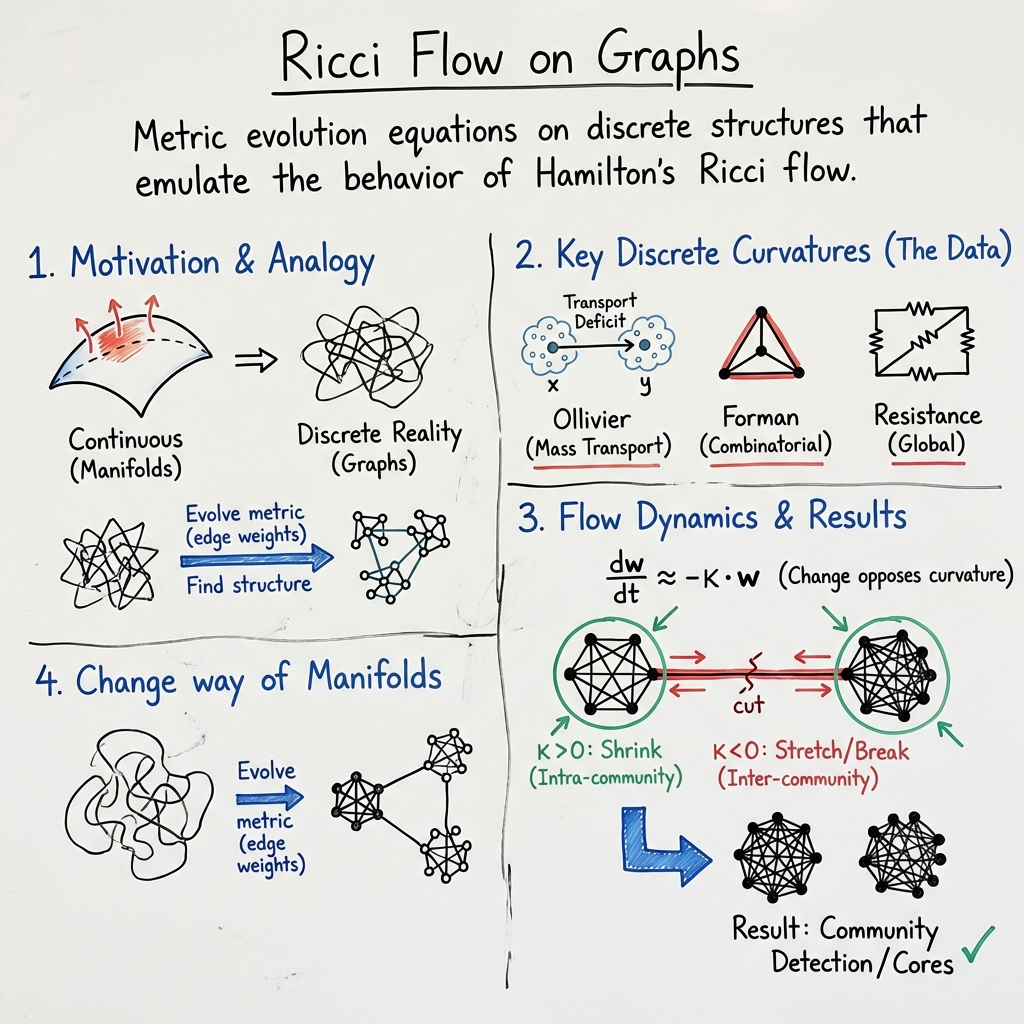
Ricci Flow on Graphs
- Ricci Flow on Graphs is a discrete analog of Hamilton’s Ricci flow that evolves edge weights on graphs based on various curvature measures.
- It employs discrete curvatures such as Ollivier, Forman, and Bakry–Émery to quantify network geometry and analyze convergence, blow-up, and fixed-point behaviors.
- Its algorithmic implementations aid in community detection, graph embedding, and enhancing graph neural networks, while posing rich theoretical challenges.
Ricci flow on graphs refers to the class of metric evolution equations on discrete structures, specifically graphs or networks, that emulate the geometric and analytic behavior of Hamilton's Ricci flow for Riemannian manifolds. This paradigm makes discrete curvature notions computationally tractable tools for understanding graph geometry, network structure, machine learning on graphs, and combinatorial analogues of classical differential geometric phenomena. Recent developments have established well-posedness, convergence, and algorithmic realizations of Ricci flow in various discrete curvature frameworks, including Ollivier, Lin–Lu–Yau, Forman, Bakry–Émery, Foster (effective resistance), and their extensions to directed graphs.
1. Discrete Ricci Curvature Notions on Graphs
A multitude of discrete Ricci curvatures provide the geometric data for flow equations:
- Ollivier–Ricci curvature measures "mass transport deficit" between one-hop random walks at and using the Wasserstein metric:
with the -lazy probability measure supported at and its neighbors, and the shortest-path metric. The Lin–Lu–Yau (LLY) curvature refines this by setting:
(Bai et al., 2020, Fathi et al., 2022, Naama et al., 2024).
- Forman–Ricci curvature invokes an explicit combinatorial formula in terms of vertex and edge weights:
0
for 1, with 2 vertex/edge measures (Bai et al., 6 Jan 2026).
- Ricci–Foster curvature uses effective resistance 3 and encodes global network effects:
4
where 5 denotes the edge resistance (Dawkins et al., 2024).
- Bakry–Émery curvature is defined via a discrete Bochner inequality encoding properties of the Laplacian acting on functions, with curvature 6 extracted as the minimum eigenvalue of a curvature matrix at 7 (Hua et al., 2024).
- All above notions are extensible to directed graphs with necessary technical adaptations (lazy random walks with node-wise bias, asymmetric optimal transport), yielding curvature and associated flow (Bai et al., 24 Sep 2025, Zhao et al., 5 Dec 2025).
2. Ricci Flow Equations on Graphs
The discrete Ricci flow evolves edge weights (or other metric data) in analogy with Hamilton’s equation 8. Typical evolution equations include:
- Ollivier–Ricci flows (unnormalized and normalized):
9
or, normalized,
0
with 1 the time-dependent edge weight (Bai et al., 2020, Ma et al., 2024, Bai et al., 6 Jan 2026).
- Modified Ricci flows ("Rho"):
2
with 3 the current shortest-path distance between edge endpoints (Ma et al., 2024).
- Piecewise-linear Ricci flows: Use constancy of curvature within time slices, punctuated by "surgery" operations when edge-weight disparities cross a threshold. Within 4,
5
and after each interval, edges with extreme ratios are removed and components are recomputed (Ma et al., 21 May 2025).
- Forman and Ricci–Foster flows:
6
for 7 the relevant curvature (Dawkins et al., 2024, Bai et al., 6 Jan 2026).
- Bakry–Émery flow: Evolves the vertex measure 8:
9
holding edge weights fixed (Hua et al., 2024).
- Directed Ricci flows: Edge weights on digraphs evolve similarly, using left/right (0-lazy, node-biased) measures and possibly normalization to preserve total weight (Bai et al., 24 Sep 2025, Zhao et al., 5 Dec 2025).
3. Existence, Uniqueness, and Analytic Properties
For all major flow types, under mild initial positivity and local Lipschitz conditions, one obtains existence and uniqueness (Picard–Lindelöf theorem) for short and, in many cases, global time intervals:
- Ollivier/Lin–Lu–Yau and modified flows: Global solutions for all 1 (no blowup or collapse), controlled by a-priori upper/lower bounds on weights (Bai et al., 2020, Ma et al., 2024, Ma et al., 2024, Ma et al., 21 May 2025).
- Piecewise-linear flows with surgery: Each surgery splits components with tightly clustered edge weights; post-surgery, each component evolves to constant curvature (Ma et al., 21 May 2025).
- Bakry–Émery flow: Only local existence is guaranteed. On trees and small cycles, solutions exhibit finite-time blow-up, while for longer cycles, global existence and convergence to uniform states holds (Hua et al., 2024). The normalized version preserves total measure.
- Foster’s Ricci flow: Short-time existence and uniqueness always hold. The sum of curvatures is conserved, leading to decay of total length at unit rate (Dawkins et al., 2024).
- Directed Ricci flows: Uniqueness and global existence for strongly connected digraphs, with explicit exponential bounds on weight trajectories. Weakly connected cases are handled by artificial edge addition and subsequent removal ("surgery") (Bai et al., 24 Sep 2025, Zhao et al., 5 Dec 2025).
4. Qualitative Behavior: Convergence, Surgery, and Fixed Points
Critical phenomena under Ricci flow on graphs include:
- Curvature Preservation: Ricci–Foster flow preserves nonnegative (or positive) edge curvature along the evolution via monotonicity principles (Dawkins et al., 2024).
- Collapse, Blow-up, and Convergence: Flows can induce collapse of edge weights to zero (e.g., leaves in trees) leading to "flow with surgery" as edges are contracted or removed. On cycles, the evolution is homothetic with simultaneous vanishing of all edge lengths (Dawkins et al., 2024, Hua et al., 2024).
- Constant Curvature Limiting States: Both continuous and piecewise-linear flows (with appropriate removal of imbalanced edges) drive each component to uniform (constant) curvature ("discrete Einstein manifolds"). Classification of graphs admitting such weightings is an active area (Ma et al., 21 May 2025).
- Finite-Time Singularities and Surgery: Certain graphs (e.g., trees, cycles with 2) exhibit finite-time singularities; surgical procedures result in subgraphs each attaining uniform curvature (Ma et al., 21 May 2025, Alsing et al., 2017).
- Community Structure: Under flow, intra-community (positive curvature) edges contract, inter-community (negative curvature) edges lengthen and may be eliminated, yielding natural multiscale decompositions or cores (Zhao et al., 2 Aug 2025, Feng et al., 2024).
5. Algorithmic Realizations and Applications
Discrete Ricci flows underpin algorithms for network analysis, embedding, and learning:
- Community and Core Detection: After discrete Ricci flow evolution, thresholding the edges with largest weights isolates communities or "cores" of a network with superior modularity, cohesion, and robustness compared to classical centrality-based methods (Ma et al., 2024, Zhao et al., 2 Aug 2025, Ma et al., 21 May 2025, Zhao et al., 5 Dec 2025).
- Graph Embedding: The dRfge algorithm establishes, via contraction mapping, that discrete Ricci flow converts any connected graph into a metric consistent with constant-curvature manifolds, enabling rigorous geometric inference (e.g., angles, bottlenecks) (Naama et al., 2024).
- Graph Neural Networks: Ricci-flow–informed pooling layers (ORC-Pool) enhance multiscale coarsening for GNNs, integrating both geometry and node attributes (Feng et al., 2024). Neural feature geometry evolution during training of deep ReLU networks empirically tracks Ricci flow dynamics, offering criteria for early stopping and optimal network depth (Hehl et al., 26 Sep 2025).
- Directed Graph Analysis: Ricci flow on digraphs (incorporating balancing factors or node-biased random walks) reveals structural asymmetry, community cores, and dynamic backbone structures (Bai et al., 24 Sep 2025, Zhao et al., 5 Dec 2025).
- Surgery Algorithms: Practically, surgery is performed after flow convergence to split components with large edge-weight disparities; this limits the need for online component tracking and enhances scalability (Ma et al., 21 May 2025).
- Scalability: Efficient parallelizations (SSMD Dijkstra, task grouping) make Ricci flow computation feasible for graphs with tens of thousands of nodes (Naama et al., 2024).
6. Connections to Smooth and Synthetic Geometric Flows
Discrete Ricci flows mirror essential features of their continuous counterparts:
- Bochner Inequality Analogues: Discrete Bakry–Émery and super Ricci flows capture gradient estimates, entropy convexity, and transport contraction, paralleling Sturm–Lott–Villani theory for metric measure spaces (Hua et al., 2024, Erbar et al., 2018).
- Geometrization via Discrete Ricci Flow: In piecewise-linear settings (PL-Regge), Ricci flows with surgical decomposition realize Thurston’s geometrization paradigm for 3-manifolds, including explicit Type-I singularity resolution (Alsing et al., 2017).
- Convergence and Uniqueness: Discrete contraction mappings and Banach fixed-point arguments guarantee unique convergence to constant curvature analogues, a property absent in generic Riemannian settings except for closed, homogeneous spaces (Naama et al., 2024, Ma et al., 21 May 2025).
7. Open Problems and Future Directions
Key areas for ongoing research include:
- Classification of Discrete Einstein Graphs: Determining the graphs and edge weightings that admit exact constant-curvature states (including nontrivial edge-transitive and inhomogeneous graphs) remains unresolved (Dawkins et al., 2024).
- Continuous vs. Piecewise Linear Flows: Rigorous convergence (without surgery) for general continuous flows with inhomogeneous curvature is open (Ma et al., 21 May 2025).
- Higher-Order Generalizations: Extending Ricci flow concepts to directed hypergraphs, time-dependent graphs, and multi-layer networks is under active exploration (Zhao et al., 5 Dec 2025).
- Learning and Hybrid Models: Integrating curvature-driven flows into modern geometric deep learning frameworks, optimizing curvature approximations for scalability, and designing hybrid geometric–data-driven algorithms represent emerging frontiers (Hehl et al., 26 Sep 2025, Feng et al., 2024, Naama et al., 2024).
- Theoretical Comparison: Precise quantitative and qualitative relations among the diverse discrete Ricci curvatures and their induced flows, especially across data-analytic and physical regimes, are not fully established (Hua et al., 2024, Ma et al., 21 May 2025).
In summary, Ricci flow on graphs offers a rigorous, unified, and algorithmically potent framework for evolving, analyzing, and exploiting discrete geometric structures with deep connections to classical differential geometry, combinatorics, probability, and machine learning. Continued development is expected to yield further theoretical insight and practical advances across disciplines.