Quantum Spatio-temporal Dynamics
- Quantum Spatio-temporal Dynamics is a framework that treats space and time as intrinsic quantum degrees of freedom, allowing for the integrated study of entanglement and dynamics.
- It employs operator formulations and tensor-network methods to simulate unitary, dissipative, and chaotic regimes across many-body and field-theoretic systems.
- The approach extends to developing quantum closure models for classical dynamics and underpins breakthroughs in quantum gravity, photonics, and turbulence analysis.
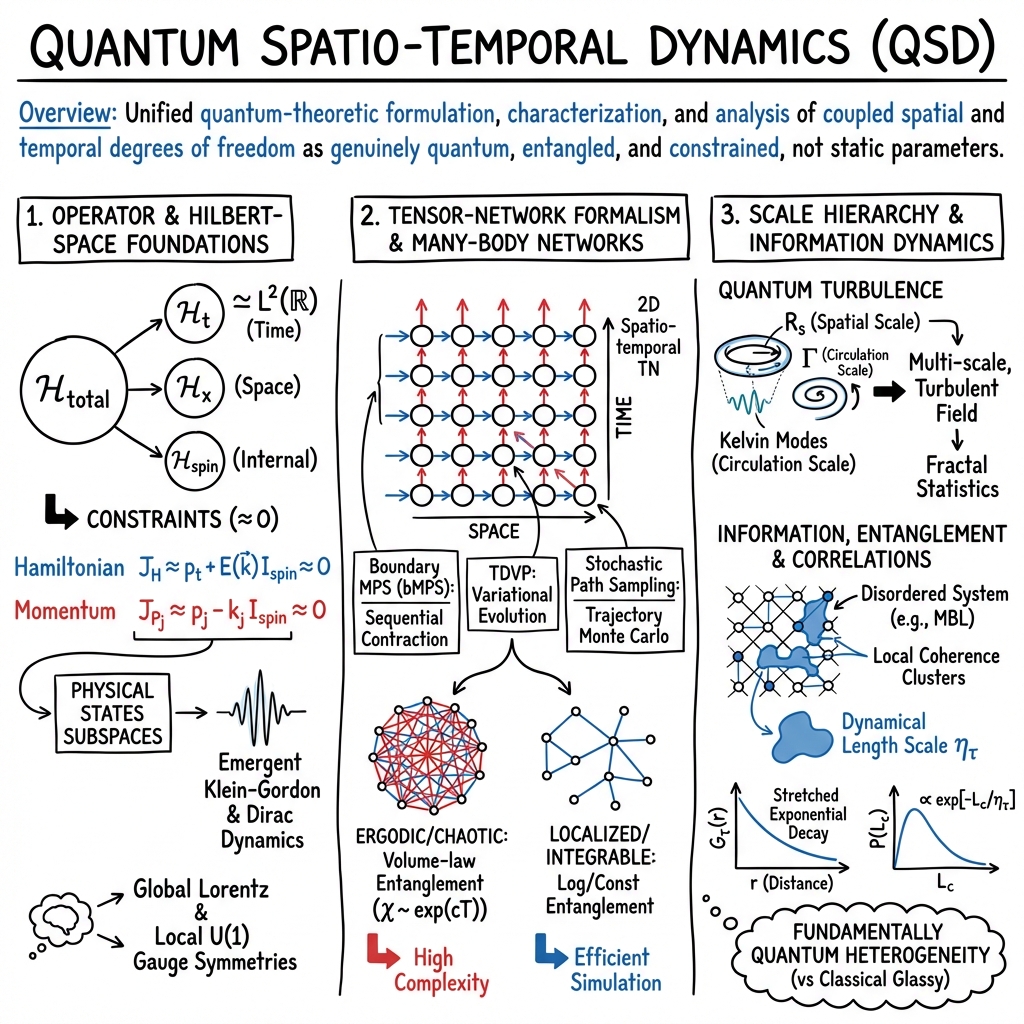
Quantum Spatio-temporal Dynamics (QSD) is the discipline concerned with the unified quantum-theoretic formulation, characterization, and analysis of coupled spatial and temporal degrees of freedom in quantum systems, ranging from elementary particles to many-body, field-theoretic, and emergent condensed-matter contexts. Under QSD, space and time are conceptualized as genuine quantum degrees of freedom subject to entanglement, constraint, and operator structure, rather than as static parameters or classical backgrounds. This framework accommodates the full spectrum of quantum dynamical regimes, including unitary, dissipative, integrable, localized, and strongly chaotic systems, and provides a quantitative language for describing scale hierarchy, correlation, and information processing across space and time.
1. Operator and Hilbert-space Foundations of QSD
In foundational approaches to QSD, both temporal and spatial coordinates are promoted to bona fide quantum degrees of freedom. For a single relativistic particle, the total Hilbert space is decomposed as , with for the quantum time degree, for spatial degrees, and for internal (spinor) structure (Singh, 2020). Covariant quantum operators and are then defined, obeying the canonical commutation relations .
Physical states are selected via a system of first-order linear constraints: a single Hamiltonian constraint,
and momentum constraints,
which project onto the subspace compatible with the correct relativistic dispersion and spatial translation properties. This construction unifies the emergence of Klein–Gordon and Dirac dynamics, with the respective equations arising as consequences of the constraint algebra acting on . Global Lorentz and local gauge symmetries are realized as unitary transformations and local phase redefinitions of the full Hilbert space (Singh, 2020).
2. Tensor-network Formalism and Quantum Many-body Spatio-temporal Networks
In many-body and open quantum systems, QSD is formulated using spatio-temporal tensor network (TN) representations (Cerezo-Roquebrún et al., 27 Feb 2025). For a one-dimensional chain, the Suzuki–Trotter decomposition of the quantum propagator yields a 2D "brick-wall" TN over space and time. All dynamical objects—quantum states, operators, reduced process tensors, and environments—arise as partial contractions or projections of this TN. Methods for simulating QSD in this paradigm include:
- Boundary Matrix Product States (bMPS): Sequential contraction and compression of the temporal boundary TN with spatial transfer matrices, with bond dimensions determined by temporal entanglement.
- Time-dependent Variational Principle (TDVP): Variational evolution within the class of MPS or MPO-structured TNs, adapted to the spatio-temporal geometry.
- Stochastic Path Sampling: Monte Carlo sampling of system trajectories, applicable when the memory kernel decays rapidly.
Quantum ergodic regimes exhibit volume-law growth of both operator and state entanglement, necessitating bond dimensions that scale exponentially with the spatio-temporal cut. Highly localized or integrable systems yield far more efficient, typically logarithmic or constant bond-dimension scaling (Cerezo-Roquebrún et al., 27 Feb 2025). The inclusion of process tensors, influence functionals, and transfer matrices within the unified TN framework provides a disciplined approach to QSD contraction and complexity management.
3. Spatio-temporal Scale Hierarchy and Quantum Turbulence
Quantum vortex systems exemplify QSD by admitting a hierarchical set of coupled spatial (, ring radius), temporal (Kelvin mode periods), and dynamical (circulation eigenvalues) scales (Talalov, 2023). Vortex ring dynamics, modeled via the perturbed Local Induction Equation and subsequent quantization, lead to a spectrum of circulation eigenvalues,
with and highly non-uniform, quasi-fractal spacing determined by the ring's quantized helical and core modes. The onset of quantum turbulence is realized via random Hamiltonian methods acting in a Fock space of vortex loops, leading to a driven, multi-scale field exhibiting turbulent spectral properties and fractal statistics. The emergent behavior is fundamentally quantum and described only at the level of spatio-temporally entangled multi-loop states (Talalov, 2023).
4. Quantum Spatio-temporal Dynamics in Open and Driven Systems
Spatio-temporal QSD is directly manifest in quantum transport and light–matter interaction contexts:
- Carrier capture in nanostructures: The Lindblad single-particle (LSP) master equation provides a fully quantum, positive-definite, and computationally efficient description of carrier capture, relaxation, and coherence phenomena on ultrashort spatial and temporal scales (Rosati et al., 2017). The approach enables quantitative prediction of localized density evolution, energy redistribution, and capture probabilities for wave packets incident on quantum dots, incorporating phonon-induced dissipation while capturing essential non-Markovian effects.
- Quantum emitters and nanophotonics: The full spatio-temporal dynamics of chiral emitters in nanophotonic environments is modeled by coupling density-matrix–based quantum dynamics with finite-difference time-domain (FDTD) solutions of Maxwell’s equations, including rotating-wave approximations, macroscopic back-coupling, and polarization resolution (Olthaus et al., 2022). Explicit time-resolved simulations reveal position- and polarization-dependent unidirectional excitation and emission, establishing QSD as the relevant framework for emergent spatio-temporal photonics phenomena.
5. Information, Entanglement, and Dynamical Correlations
QSD provides a basis for analyzing the spatial and temporal heterogeneity of quantum information and entanglement dynamics. In disordered quantum many-body systems, especially in the many-body localized (MBL) regime, local measures (e.g., the concurrence ) reveal a broad, power-law distributed spectrum of local relaxation times that are spatially correlated over a growing dynamical length scale (Artiaco et al., 2021). This scale sets the size of dynamically coherent clusters, with quantum spatio-temporal correlation functions displaying stretched exponential decay and cluster-size distributions . The behavior closely parallels classical glassy dynamical heterogeneity but is fundamentally quantum, with localization enforced by local integrals of motion.
6. Quantum Closure Models for Macroscopic Dynamics
QSD has been deployed as a rigorous closure scheme for coarse-grained spatio-temporal dynamics governed by classical partial differential equations (PDEs) (Vales et al., 12 May 2025). The approach embeds the unresolved degrees of freedom in a quantum state space, representing macroscopic observables as quantum expectation values,
with a quantum state associated to spatial cell and observable . Evolution and prediction are implemented via a data-driven, kernel-based discrete quantum propagator, and measurement/conditioning steps enforce physical constraints and symmetry. This framework ensures positive-definite, symmetry-preserving closure for systems such as the shallow water equations and can be generalized to higher-dimensional or more complex PDEs. It achieves high-fidelity predictions of macroscopic wave features, robust to out-of-sample initial conditions.
7. Unification: Quantum Space-Time Actions and Geometric Approaches
Advanced QSD frameworks employ treatments wherein both space and (potentially multi-dimensional) time are tensor-product degrees of freedom in an extended Fock space, with physical states defined as the kernel of global quantum action constraints (Diaz et al., 2020). This allows for the emergence of conventional quantum dynamics, relativistic covariance, and spacetime entanglement structure, with physical time evolution arising via consistent slicing or foliation.
In quantum gravity, QSD principles underlie intrinsic-time geometrodynamics, where the spatial metric and unimodular components are quantized, commutation relations are determined by an underlying SU(3) structure, and quantum arrows of time are enforced by the dominance of the Cotton–York term at early intrinsic times (III et al., 2015). Einstein’s general relativity emerges as a low-energy zero-point contribution, and fundamentally, can be eliminated from the algebra, emphasizing quantum structure over classical parameters.
Quantum Spatio-temporal Dynamics systematizes the study of how quantum matter, fields, and information evolve across both space and time when these coordinates are treated as entangled, operator-valued degrees of freedom and when dynamical, many-body, non-equilibrium, and information-theoretic effects are fully integrated within the quantum formalism. This encompasses foundational approaches to quantum gravity, high-precision models of transport and photonics, and algorithmic schemes for the closure of effective dynamics in complex classical and quantum systems (Singh, 2020, Cerezo-Roquebrún et al., 27 Feb 2025, Talalov, 2023, Artiaco et al., 2021, Olthaus et al., 2022, Rosati et al., 2017, Vales et al., 12 May 2025, Diaz et al., 2020, III et al., 2015, Jago et al., 2019).