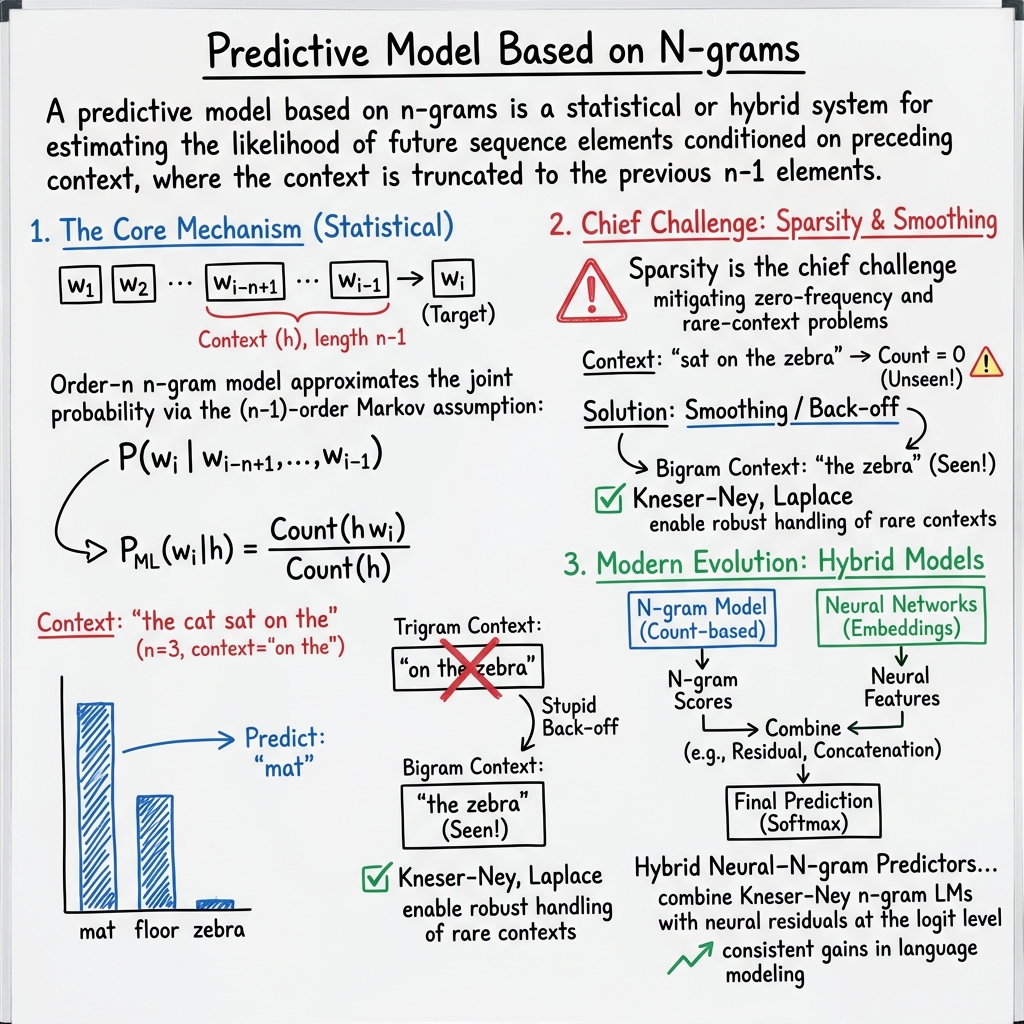
Predictive n-Gram Models
- Predictive n-gram models are statistical or hybrid systems that estimate the likelihood of future sequence elements based on the preceding n-1 tokens.
- They employ efficient data structures and smoothing techniques like Laplace and Kneser-Ney to address data sparsity and enhance prediction accuracy.
- These models are widely applied in natural language processing, time-series forecasting, and malware analysis, ensuring scalable and adaptive performance.
A predictive model based on n-grams is a statistical or hybrid system for estimating the likelihood of future sequence elements (e.g., words, tokens, bytes, items) conditioned on preceding context, where the context is truncated to the previous elements. N-gram-based prediction underpins a vast range of applications, including natural language and acoustic modeling, malware detection, time-series forecasting, and knowledge graph link prediction. The predictive power, efficiency, and extensibility of n-gram models make them foundational in computational linguistics and data-driven sequence analysis.
1. Mathematical Foundations of N-Gram Prediction
Given a finite vocabulary and a sequence , an order- n-gram model approximates the joint probability via the (n-1)-order Markov assumption: Conditional probabilities are estimated empirically as
where is the -gram context. When is unseen, back-off or interpolation methods recursively descend to shorter histories. Smoothing schemes such as Kneser-Ney, Laplace, deleted interpolation, and “stupid back-off” are central for mitigating zero-frequency and rare-context problems (Zhang et al., 2019, Haque et al., 2016, Dasgupta et al., 2024, Hamarashid et al., 2020).
2. Implementation Paradigms and Efficient Data Structures
N-gram predictive models are realized as either count-based statistical systems or neural/statistical hybrids:
- Count-based Statistical Models: Precompute and store n-gram frequencies in hash maps, tries, or database tables. Efficient incremental updates and pruning maintain tractable memory even for 0 (Dasgupta et al., 2024, Burdisso et al., 2019).
- Neural or Hybrid Models: Incorporate n-gram features into neural architectures, e.g., by concatenating n-gram counts with embedding-based word histories (Damavandi et al., 2016), predicting n-grams as supervised targets in embedding construction (Li et al., 2015), or learning a neural residual on top of fixed n-gram scores (Li et al., 2022). Specific hybrid systems can forgo the output softmax for efficiency, using noise-contrastive estimation for training (Damavandi et al., 2016).
- Trie-based Dynamic Stream Models: SS3/t-SS3 maintains per-class tries to dynamically detect arbitrary k-grams during incremental, streaming classification, providing both efficient early prediction and enhanced interpretability (Burdisso et al., 2019).
- Large-n Feature Extraction: For malware and binary application, high-order (1, 2 up to 3) n-gram extraction is performed in linear time using hash-based filters and Space-Saving sketches, providing scalable feature vectors for gradient-boosted trees (Raff et al., 2019).
3. Smoothing, Back-Off, and Regularization
Sparsity is the chief challenge for n-gram predictive modeling. Smoothing strategies are essential:
- Add-one (Laplace):
4
widely used in resource-constrained deployments (Dasgupta et al., 2024).
- Kneser-Ney: Subtracts a context-dependent discount, allocates this mass to lower order, enabling robust handling of rare contexts, with precise interpolation weights tuned on validation sets (Zhang et al., 2019, Haque et al., 2016).
- Stupid Back-off:
5
used for high-throughput or low-memory cases with fixed decay 6 (e.g., 7) (Hamarashid et al., 2020).
- Regularized likelihood ratio estimation: Combines itemized independence-style ratios with dependency-restoring corrections, using two tunable regularizers 8, 9 that interpolate between independence and full-N-gram dependency (Kikuchi et al., 2021).
4. Evaluation, Performance Metrics, and Empirical Findings
Prediction accuracy, perplexity, BLEU, and downstream classification F1 are principal evaluation criteria:
- Word/Next-token Prediction: Metrics include top-0 accuracy (fraction with true next word among top 1), mean reciprocal rank (MAP), and saved keystrokes/characters for keyboard input recommendation (Zhang et al., 2019, Hamarashid et al., 2020, Haque et al., 2016).
- Sequence Reconstruction and Representation: BLEU-clip for sentence reconstruction, F1/accuracy for word/phrase content and order, precision@K for input recommendation (Huang et al., 2018).
- Time-series Forecasting: Empirical error (e.g., RMSE, MAE) for predicting real-valued sequences quantized to symbolic sequences (Lande et al., 2022).
- Malware Classification: ROC-AUC, balanced accuracy using n-gram feature vectors, with maximal predictive power at 2--3 for binary files (Raff et al., 2019).
- Document Embeddings: Classification accuracy as a function of n-gram order/method (e.g., DV-tri, bag-of-bigram, ensemble models), with trigrams and embeddings leading to superior performance in long context modeling (Li et al., 2015).
5. Application Domains and Extensions
- Natural Language Processing: Next-word prediction, text completion, document classification, sentiment analysis, and recommendation tasks, with explicit characterization of trade-offs between statistical and neural approaches (Zhang et al., 2019, Li et al., 2015).
- Multilingual and Morphologically Rich Languages: N-gram models for under-resourced languages (Bangla, Kurdish) using tailored preprocessing and application-specific smoothing, achieving high accuracy despite inflectional complexity (Haque et al., 2016, Hamarashid et al., 2020).
- Malware and Binary Analysis: Extraction of large 4-gram features for interpretable, signature-based detection, compatible with systems like Yara; statistical n-gram signatures outperform heuristic-based approaches in false-positive reduction and family-level discrimination (Raff et al., 2019).
- Time-series Forecasting: Quantized n-gram models provide automated forecasting for non-stationary series, requiring minimal parameter tuning and naturally adapting to trends and cycles via context similarity measures (Lande et al., 2022).
- Knowledge Graphs: Hierarchical character n-gram graphs (HNZSLP) capture expressive representations for OOV relations in zero-shot link prediction, outperforming word-based embedding strategies by encoding compositional and adjoin dependencies via GramTransformer layers (Li et al., 2022).
6. Advances and Theoretical Insights
- Hybrid Neural–N-gram Predictors: Models such as NgramRes combine Kneser-Ney n-gram LMs with neural residuals at the logit level, enabling adaptive domain adaptation by swapping n-gram models without retraining neural components, yielding consistent gains in language modeling, MT, and summarization (Li et al., 2022).
- N-gram Rule-based Model Analysis of Transformers: Empirical investigations show that simple N-gram rulesets explain a majority of LLM next-token decisions; as context length increases (5 grows), rule-based top-1 agreement approaches 78% on TinyStories and 65% on Wikipedia, with dynamic shifts in model variance and statistical rule exploitation during training (Nguyen, 2024).
- Word Difference Representations (WDR): In causal LM, N-gram-prediction is extended to the simultaneous prediction of future tokens, with WDR as surrogate targets. Ensemble inference across “future” predictions yields lower perplexity and higher BLEU than conventional CLM, with increased gradient diversity and better generalization (Heo et al., 2024).
- Dynamic Streaming and Early Risk Detection: τ-SS3 achieves phrase-level, streaming n-gram representation and extraction, yielding improved early risk detection in text streams and richer visual explanations of classifier decisions, outperforming bag-of-words and deep learning baselines (Burdisso et al., 2019).
7. Limitations, Trade-Offs, and Best Practices
- Contextual Sparsity: Predictive accuracy saturates at moderate 6 (7–8 for words, 9–0 for bytes), with higher 1 resulting in sparsity and diminishing returns unless the corpus is very large (Raff et al., 2019, Huang et al., 2018).
- Model Selection: Unigrams and bigrams excel in word presence and order detection; trigrams and higher-order n-grams are necessary for phrase content and longer-range dependencies (Huang et al., 2018, Li et al., 2015).
- Resource Constraints: Efficient hash-based, trie-based, and incremental update mechanisms (e.g., HITgram) enable production-ready n-gram predictors in low-memory environments, supporting Laplace smoothing and context-weighting (Dasgupta et al., 2024).
- Interpretability and Adaptability: Large n-grams in binary analysis provide human-readable, direct signatures, and plug-and-play adaptation is possible with neural residual models, making predictive n-gram systems versatile and interpretable in operational deployment (Raff et al., 2019, Li et al., 2022).
- Hybridization: Convex linear interpolations between statistical and neural LM scores systematically improve typing accuracy, MAP, and recall, with optimal weights determined by validation (Zhang et al., 2019).
In summary, n-gram-based predictive models, through their statistical tractability, extensibility to neural hybrids, and interpretability, remain central tools for sequence modeling, input recommendation, classification, time-series forecasting, malware analysis, and knowledge representation. State-of-the-art systems leverage efficient storage, advanced smoothing, hybrid architectures, and dynamic adaptation to maximize predictive performance while maintaining operational scalability and explanation fidelity.