Permafrost ML Dataset for Arctic Risk
- Permafrost ML Dataset is a curated collection of 2.9M spatiotemporal observations integrating satellite, in situ, and climate data for robust permafrost forecasting.
- It employs an ensemble of random forest, gradient boosting, and elastic net models hybridized with physics-based constraints to ensure reliable and interpretable predictions.
- The dataset underpins operational risk assessments by providing detailed uncertainty quantification and permafrost fraction forecasts across over 171,000 Arctic sites.
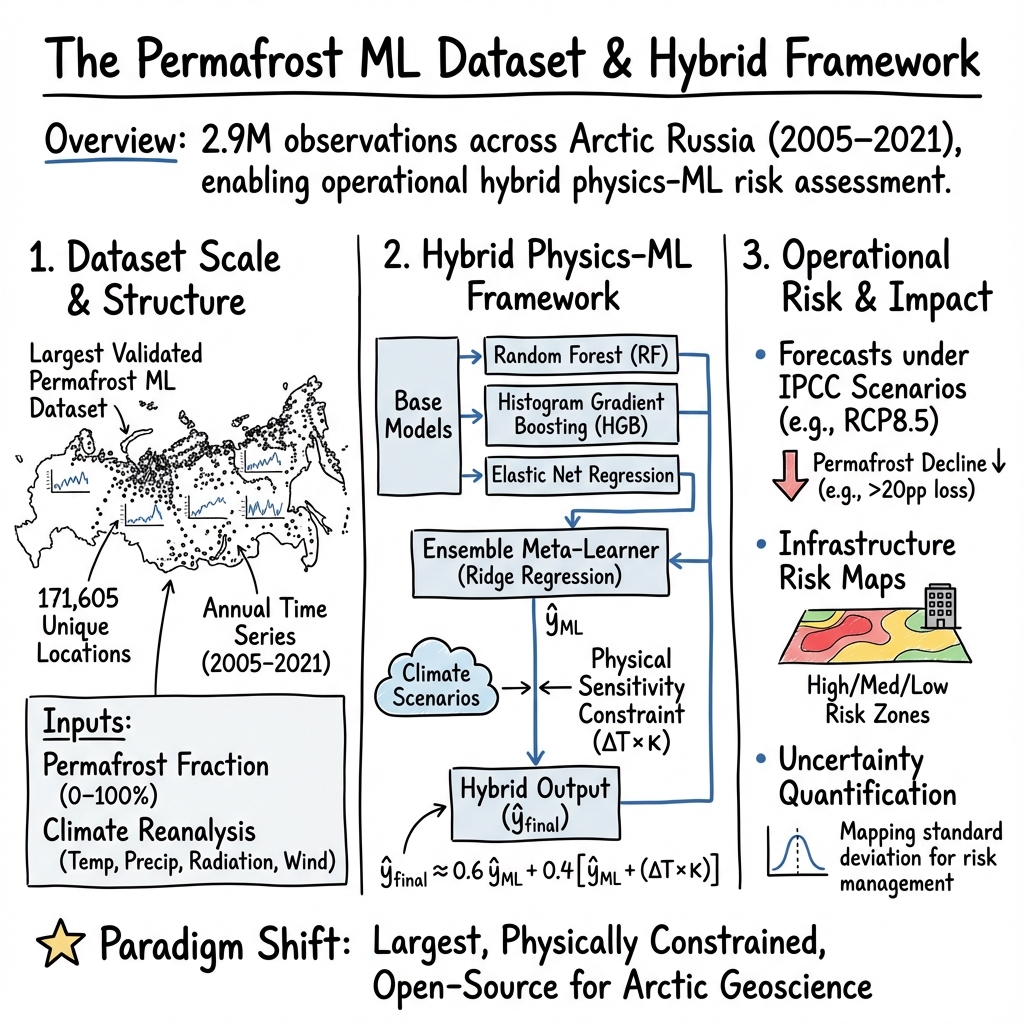
The Permafrost ML Dataset refers to a collection of machine learning–ready data products and curated benchmark datasets developed for the problem of monitoring, mapping, and forecasting permafrost extent, thaw, and related landscape features across Arctic regions. These datasets integrate satellite remote sensing, in situ ground observations, biophysical covariates, and simulated outputs, and they have been crucial in enabling the first operational hybrid physics–ML risk assessment frameworks for permafrost infrastructure at pan-Arctic scale. Notably, the term encompasses the 2.9-million-observation dataset underpinning the open-source hybrid model detailed in (Kriuk, 2 Oct 2025), representing both a methodological advance and the largest validated permafrost ML dataset to date.
1. Dataset Scale, Content, and Structure
The dataset described in (Kriuk, 2 Oct 2025) comprises 2,917,285 spatiotemporal samples, distributed across 171,605 unique Arctic Russian locations and spanning annual measurement intervals from 2005 to 2021. Each location includes a contiguous 17-year time series. For every annual record, the following variables are provided:
- Permafrost fraction (continuous, 0–100%)
- Climate reanalysis parameters: temperature, precipitation, solar radiation, wind speed, among others
The dataset integrates multiple external and model-derived data sources, ensuring comprehensive coverage of both environmental drivers and permafrost state. The unprecedented spatial (hundreds of thousands of unique sites) and temporal (nearly two decades) breadth enable the dataset to support statistically robust, regionally diverse, and temporally resolved modeling, essential for risk assessment and forecasting applications.
2. Integration in Hybrid Physics-Machine Learning Frameworks
The Permafrost ML Dataset serves as the input to a stacked ensemble learning framework. The ensemble is comprised of three classes of base models:
- Random Forest (RF): robust to non-linearities and capable of capturing threshold effects in climate–permafrost responses
- Histogram Gradient Boosting (HGB): scalable learning on large datasets with discretized feature input
- Elastic Net Regression: regularized linear modeling offering interpretability
Model training is performed via rigorous spatiotemporal cross-validation using spatial folds, which strictly separates data by contiguous regions. Specifically, each model is trained on four folds and evaluated on the fifth, rotating this held-out region through all possibilities, thereby ensuring all predictions are out-of-fold and free from data leakage.
In a second stage, the predictions from these three base models are combined using a meta-learner (ridge regression) to optimize the weights given to each component, yielding the final ensemble prediction:
where represents the output of each component.
3. Hybridization with Physics-Based Constraints
To overcome the lack of extrapolative reliability commonly found in purely statistical models—especially under out-of-sample climate conditions—the framework hybridizes ML-driven predictions with physical permafrost sensitivity constraints. The adjustment operates as a weighted sum:
- 60%–80% of the output is attributed to the ML ensemble forecast
- 20%–40% is contributed by a physical permafrost sensitivity relationship (e.g., –10 percentage points per °C of warming)
A simplified representation of the adjustment is:
Here, denotes the temperature anomaly under a given climate scenario and the sensitivity coefficient.
This ensures outputs remain physically plausible, particularly for climate scenarios outside the historical training regime. The incorporation of explicit physical knowledge addresses a core challenge in data-driven approaches: unreliable extrapolation under non-stationary environmental forcings.
4. Operational Forecasting and Risk Assessment
The dataset and modeling framework enable direct, scenario-dependent inference for infrastructure risk and climate adaptation by means of:
- Permafrost fraction forecasts under IPCC RCP scenarios (e.g., under RCP8.5, mean permafrost fraction decline of –20.3 percentage points [pp], with 51.5% of Arctic Russia experiencing >20 pp loss over ten years at +5°C warming)
- Infrastructure risk classification, where spatial thresholds partition the domain into low-, medium-, and high-risk classes (e.g., 15% of the domain identified as high-risk, 25% as medium-risk)
- Uncertainty quantification: mapping the standard deviation across ensemble models at every spatial location to inform risk management
These products are specifically designed to be actionable for engineering, infrastructure planning, and policy, supporting probabilistic design codes and adaptation strategies directly tied to physical site conditions and projected climate changes.
5. Methodological Advances and Generalizability
The Permafrost ML Dataset is accompanied by open-source tools (see https://github.com/sparcus-technologies/Arctic25) to enable community adoption. The methodological structure—namely, the ensemble stacking, physical-ML hybridization, and strict cross-validated benchmarking—facilitates extension to other permafrost regions or analogous environmental forecasting domains. Adapting the approach requires:
- Incorporation of region-specific climate and terrain covariates
- Calibration of physical sensitivity parameters to local ground truth
- Maintenance of strict spatial and temporal holdout protocols for validation
This design provides a framework resistant to overfitting, with robust uncertainty quantification and operational practicality for climate-exposed infrastructure.
6. Impact and Role within Permafrost Research
The Permafrost ML Dataset, as instantiated in (Kriuk, 2 Oct 2025), represents a paradigm shift in scale and integration for Arctic geoscience applications:
- It is the largest validated permafrost ML dataset globally to date, supporting accurate, physically constrained, and uncertainty-aware machine learning for a permafrost region at continental to pan-Arctic scale.
- The hybrid approach directly addresses infrastructure risk and climate adaptation, two of the most pressing challenges facing permafrost-dependent societies.
- Its methodological transparency and open-source philosophy set a new standard for reproducibility and community engagement in Arctic remote sensing and data-driven environmental risk modeling.
7. Limitations and Future Prospects
The accuracy and generalizability of the Permafrost ML Dataset depend on the representativeness and quality of historical climate and permafrost data. While the hybrid approach mitigates extrapolation risk, subject-matter calibration remains essential when porting the methodology to non-Russian Arctic regions. Additionally, systematic biases in observational or reanalysis input data, if present, will propagate through the modeling chain.
A plausible implication is that, as larger and more diverse permafrost and climate datasets are acquired, hybrid physics–ML frameworks of this type will continue to improve, offering increasingly granular and reliable predictions for infrastructure risk, carbon cycle modeling, and climate adaptation planning in cold-region environments.