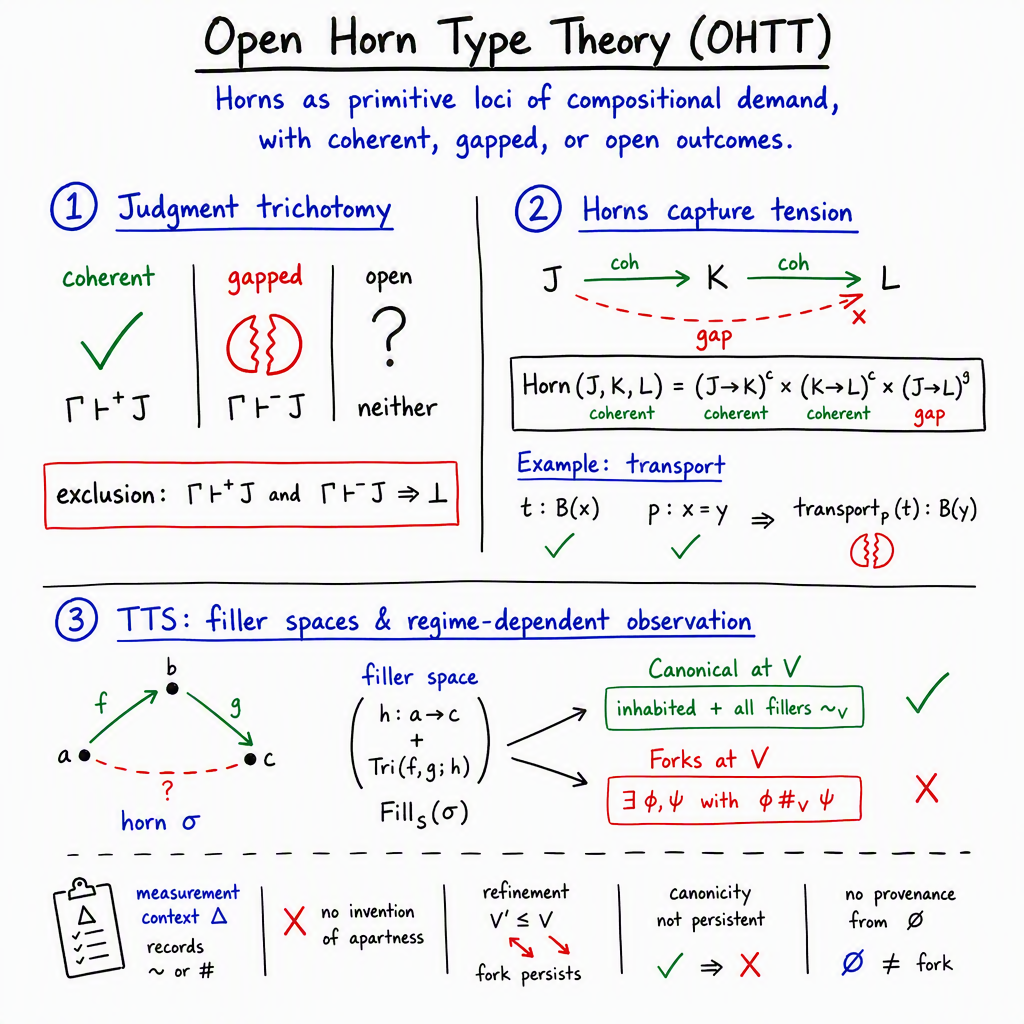
Open Horn Type Theory Overview
- Open Horn Type Theory is an extension of dependent type theory that introduces a trichotomy of judgments: coherent, gapped, and open.
- It formalizes compositional tension by using horn types to record both successful compositions and explicit failures as proof-relevant data.
- The TTS realization applies measurable regimes to classify filler spaces, refining global Kan assumptions with local, graded observations.
Searching arXiv for the specified papers and closely related work on Open Horn Type Theory. Open Horn Type Theory (OHTT) is an extension of dependent type theory in which horns, rather than globally fillable Kan cells, are the primitive loci of compositional demand, and in which both successful composition and witnessed failure are represented as proof-relevant structure. In the formulation of "Open Horn Type Theory" (Poernomo, 30 Dec 2025), the theory introduces primitive coherence and gap judgments subject to a mutual exclusion law, together with open judgments that are neither coherent nor gapped. In "A Type Theory of Sense: Witnessed Choice in Stratified Semantic Spaces" (Poernomo, 10 Jun 2026), a dependent type theory called TTS realizes what is described as an “Open-Horn Type Theory” by treating filler spaces as first-class, declining to assume global Kan-style composition, and classifying horns by regime-indexed canonicity and measured forks.
1. Primitive judgments, exclusion, and openness
The basic judgmental innovation of OHTT is the introduction of two distinct proof-relevant modes for a generic judgment form . A coherence judgment has the form
read as “ is witnessed coherent in context ,” while a gap judgment has the form
read as “ is witnessed gapped in context .” These forms are primitive; gap is not defined as or , but as a positive witness to non-coherence (Poernomo, 30 Dec 2025).
The two judgment forms are constrained by the exclusion law:
This mutual-exclusion principle is central. It ensures that proof of coherence and proof of gap cannot coexist for the same judgment in the same context, while preserving the proof relevance of both.
OHTT also admits a third status. A judgment is open in 0 when neither 1 nor 2 is derivable. The resulting trichotomy is therefore:
- coherent;
- gapped;
- open.
This trichotomy generalizes the ordinary binary distinction between derivable and underivable. A common misconception would be to identify gap with ordinary negation or open judgments with mere epistemic incompleteness. The formalism resists both reductions: gap is explicit positive structure, and openness is a distinct judgmental condition rather than a hidden form of derivability failure (Poernomo, 30 Dec 2025).
2. Horns as compositional tension
In OHTT, horns record compositional tension. Given a compositional relation 3, the horn type 4 is inhabited by coherent witnesses of 5 and 6 together with a gap witness for 7:
8
This makes the failure of composite coherence into first-class data rather than a metatheoretic absence (Poernomo, 30 Dec 2025).
The central example is the transport horn. In ordinary HoTT, given a type family 9 over 0, a term 1, and a path 2, transport is guaranteed:
3
OHTT permits the coherent premises to coexist with a gap in the transported conclusion:
4
The corresponding inhabitant
5
is a formal record that “the term exists, the path exists, but they fail to meet” (Poernomo, 30 Dec 2025).
This construction isolates a class of obstructions that HoTT cannot express under its global Kan discipline. The point is not merely that some composites fail, but that their failure can be named, transported through the calculus, and used as positive explanatory structure.
3. Filler spaces and the TTS realization of open horns
TTS presents a more specialized dependent type-theoretic realization of the open-horn idea. Let 6 be a semantic type. An inner 7-horn in 8 is boundary data
9
The filler space of 0 is defined by
1
so an inhabitant 2 is a composite 3 together with its warrant 4. There are no primitive horn-introduction or elimination rules other than those for 5 and the warrant type 6, and composition is not assumed Kan-style (Poernomo, 10 Jun 2026).
TTS then grades each horn relative to a fixed poset of regimes 7, where each regime is described as “one instrument at one resolution.” For each regime 8, there are two relations on fillers over a semantic type: an h-propositional indiscernibility relation 9, which is symmetric and transitive, and an apartness relation 0, which is symmetric and cotransitive, with irrefl, mono, and ext structure. These support two local horn classifications:
1
and
2
A horn is canonical at 3 when the filler space is merely inhabited and all fillers are 4-indiscernible; it forks at 5 when two fillers are measurably apart (Poernomo, 10 Jun 2026).
This shifts the focus from a binary fillable/non-fillable distinction to a local classification of filler spaces. A plausible implication is that OHTT, in the TTS realization, is not principally about lack of fillers, but about the fine structure of multiple warranted fillers and their regime-relative comparability.
4. Measurement contexts, provenance, and regime dependence
A distinctive feature of TTS is that apartness witnesses enter the calculus only through a measurement context 6, a finite list
7
with a corresponding 8-axiom for retrieving recorded witnesses. No primitive rule can invent apartness; every 9-term in a derivation traces back to the ambient 0. TTS is therefore described as a logic of consequence from measurement data (Poernomo, 10 Jun 2026).
The metatheory formalizes several consequences of this design. For a fixed regime 1, there is a clash theorem
2
and therefore an id-clash corollary
3
At the level of horn grades, canonicity and fork are mutually exclusive:
4
Forks persist under refinement: if 5, then
6
By contrast, canonicity is not persistent: there is a model and horn 7 with 8 but 9 for some 0. A horn may therefore appear canonical at coarse resolution yet fork at finer resolution (Poernomo, 10 Jun 2026).
TTS also characterizes cross-regime coexistence. If 1, then
2
but if 3, the record 4 is consistent. In addition, there is no closed derivation of 5, and if 6 is derivable, then every model realizing 7 exhibits that fork. These are stated as the no-fork-from-the-empty-record and provenance results (Poernomo, 10 Jun 2026).
A common misunderstanding would be to treat the regime index as an optional annotation. In TTS it is structurally decisive: disagreement across regimes is legitimate exactly in patterns governed by the partial order 8, and the logic tracks when measured separation is stable, when it refines, and when it cannot be asserted at all.
5. Simplicial semantics and the relation to HoTT
The semantic model proposed for OHTT is given by ruptured simplicial sets. A ruptured simplicial set is a tuple 9 in which 0 is an ordinary simplicial set, 1 marks coherent witnesses, and 2 marks gap-witnessed horns, subject to an exclusion condition: no horn in 3 can be filled by a coherent 4-simplex in 5 (Poernomo, 30 Dec 2025).
A ruptured Kan complex is then a ruptured simplicial set in which every horn is in exactly one of three states:
- it admits a filler 6;
- it is marked as a gap in 7;
- it is open.
The semantic trichotomy thus mirrors the judgmental trichotomy. Likewise, a ruptured Kan fibration 8 has, for each coherent lifting problem, either a coherent lift, a gapped witness, or openness (Poernomo, 30 Dec 2025).
Within this framework, HoTT appears as the coherent fragment of OHTT. One drops all rules introducing 9, retains ordinary MLTT/HoTT rules introducing 0, and does not add an axiom of totality. This fragment is stated to be conservative over HoTT: any purely coherent derivation in OHTT is valid in HoTT, and any sequent derivable in HoTT can be derived in OHTT’s coherent fragment. Semantically, Kan complexes embed as ruptured Kan complexes with 1 and 2. Imposing the extra axiom that every horn must be coherently filled recovers HoTT in full (Poernomo, 30 Dec 2025).
This relation is significant because it locates OHTT not as a rejection of HoTT, but as a strict extension that removes total transport and adds gap witnesses. TTS sharpens this shift further by replacing global canonicity with regime-indexed observational grades (Poernomo, 10 Jun 2026).
6. Obstructions, semantic interpretation, and research directions
Three classes of obstructions are developed explicitly in OHTT. The topological class includes monodromy in covering spaces, holonomy in principal 3-bundles with connection, and characteristic classes understood as coherent/gap patterns on cells. In each case, the gap witness is positive structure such as a nontrivial deck transformation, a holonomy element 4, or a cohomological obstruction (Poernomo, 30 Dec 2025).
The semantic class includes polysemy and semantic drift. In the polysemy example, a ruptured meaning fibration 5 over a simplicial lexical space supports a coherent path between two tokens of “bank” and a coherent meaning over one token, while transport of that meaning to the other token is gapped. Semantic drift is described as a failure of global functoriality: short lexical extensions may transport features coherently even when the composite extension gaps (Poernomo, 30 Dec 2025).
The logical class includes resource sensitivity in linear type theory, failures of contraction or weakening in substructural logics, and modal or refinement constraints. Here the gap witness is again structured data, such as a resource-counting proof or a modal-constraint violation, rather than silence or non-derivability (Poernomo, 30 Dec 2025).
TTS gives these themes a specifically semantic and hyperintensional interpretation. It presents a geometric account in which Fregean sense is a choice of filler, reference is the horn boundary constraining that choice, and hyperintensional difference is measured apartness. The paper also states potential applications: formalizing lexical ambiguity as horns that fork, reconstructing Frege’s informativeness of identity via cross-regime forks and identifications, and anchoring a semantic type theory to real LLM measurement protocols by interpreting regimes as embedding-plus-threshold instruments and 6 as the recording of cluster-components in an 7-sweep (Poernomo, 10 Jun 2026).
Taken together, these developments define OHTT as a theory in which horns are primitive compositional demands, fillers need not be unique, gaps or forks are positively witnessed, and global Kan assumptions are replaced by local, graded, or trichotomous judgments. This suggests a unifying perspective on obstruction: not merely as failed existence, but as first-class mathematical data governing composition, transport, and semantic discrimination across contexts and regimes.