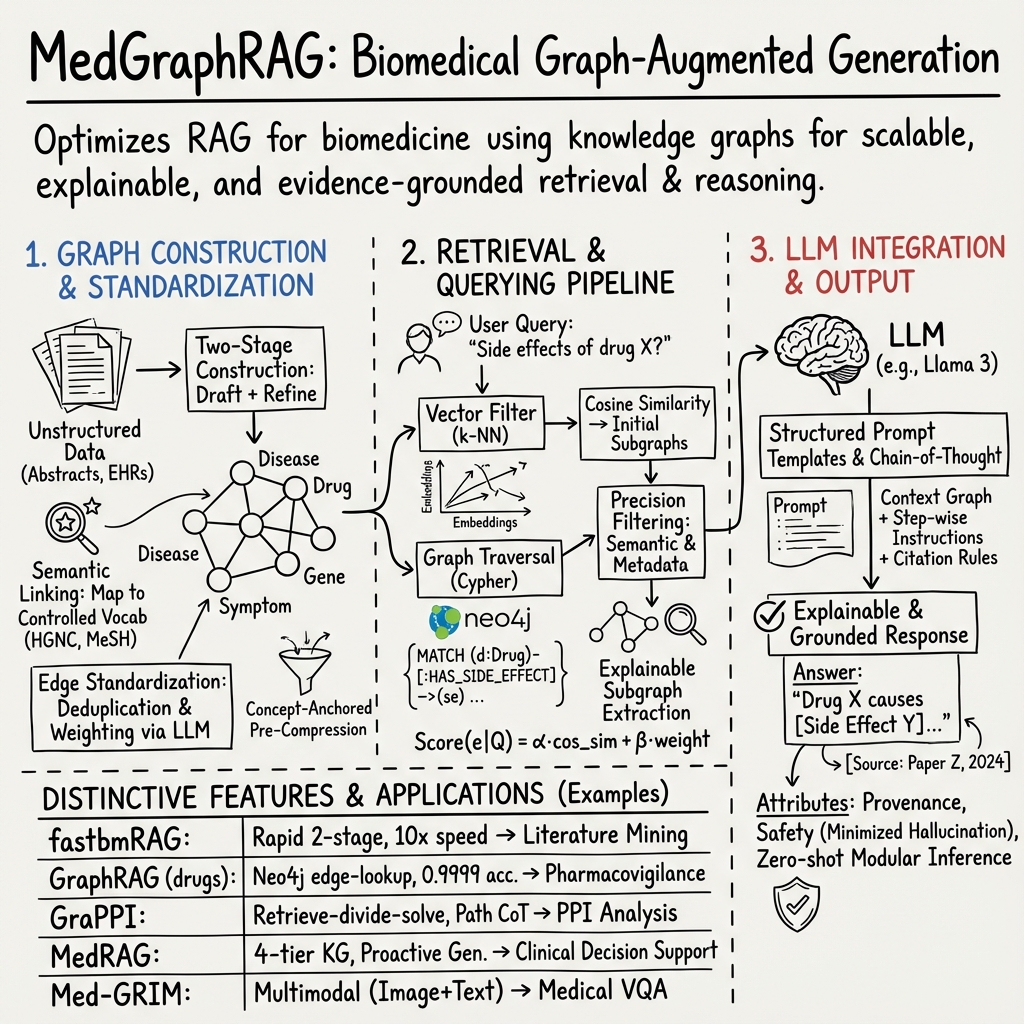
MedGraphRAG Framework
- MedGraphRAG is a framework that integrates graph-based methods with retrieval-augmented generation for structured biomedical knowledge extraction.
- It employs multi-stage graph construction with controlled vocabularies and vector-based entity linking to ensure precise, explainable retrieval and reasoning.
- Its applications span literature mining, drug safety, protein interaction analysis, and clinical decision support, offering improved efficiency and factual grounding.
The MedGraphRAG framework refers to a set of retrieval-augmented generation (RAG) and graph-based RAG (GraphRAG) methodologies optimized for biomedical and medical domains, providing scalable, explainable, and evidence-grounded knowledge retrieval and reasoning systems. These systems systematically integrate biomedical knowledge graphs, LLMs, and vector-based entity linking to support high-performance literature mining, diagnosis, pharmacovigilance, and explainable biomedical querying across varying data modalities and use cases. Multiple implementations exist, denoted as MedGraphRAG, each emphasizing structured entity-relationship extraction, multi-stage graph construction/refinement, prompt engineering, and graph-centric filtering for reliable LLM outputs (Meng et al., 13 Nov 2025, Nygren et al., 18 Jul 2025, Li et al., 24 Jan 2025, Zhao et al., 6 Feb 2025, Wu et al., 2024, Banf et al., 28 Apr 2025, Madavan et al., 20 Jul 2025).
1. System Architectures and Core Design
MedGraphRAG is realized in several related frameworks, all unified by their use of biomedical knowledge graphs to structure, augment, and control LLM-based retrieval and generation processes.
- fastbmRAG (Meng et al., 13 Nov 2025): Employs a two-stage pipeline—(1) entity and coarse relationship graph drafting from abstracts using LLMs; (2) main-text refinement via vector-based chunk retrieval and LLM-based relationship description updates. Nodes are standardized to controlled vocabularies (e.g., HGNC, MeSH). Data flows through update (graph construction) and query (focused subgraph retrieval + answer generation) pipelines.
- GraphRAG for drug side effects (Nygren et al., 18 Jul 2025): Represents drug–side-effect knowledge as a bipartite directed graph, supporting exact Cypher-based edge lookup and binary LLM answer generation. Realized with Neo4j, vector database (Pinecone), and Llama 3 8B, it emphasizes accuracy and the elimination of hallucinations common in plaintext RAG.
- GraPPI for protein–protein interaction (PPI) pathway evaluation (Li et al., 24 Jan 2025): Orchestrates a retrieve–divide–solve agent pipeline: subgraph PPI retrieval, path decomposition into edges, edge-level LLM chain-of-thought explanation generation, and coherent pathway narrative synthesis, all anchored in a large-scale PPI KG.
- MedRAG for EHR-based diagnosis (Zhao et al., 6 Feb 2025): Relies on a four-tier diagnostic hierarchy KG constructed from EHRs and LLM-augmented features. Retrieval of similar EHRs is combined with KG-elicited reasoning using a step-wise LLM prompt.
- Triple Graph/U-Retrieval MedGraphRAG (Wu et al., 2024): Implements a three-level triple graph (local chunks, scholarly entities, controlled-vocabulary nodes), top-down tag-matched graph retrieval, and bottom-up LLM response refinement ensuring both global context and precise citation.
- Tripartite-GraphRAG (Banf et al., 28 Apr 2025): Builds a tripartite knowledge graph (objects of investigation, curated concepts, text chunks) with concept-anchored pre-compression, statistical relevance estimation, and unsupervised node classification (MRF-like inference) for prompt construction.
- Med-GRIM (Multimodal GraphRAG for VQA) (Madavan et al., 20 Jul 2025): Integrates a multimodal graph (DermaGraph), contrastive BIND encoder for dense image-text embeddings, and a two-stage GraphRAG filter for medical VQA, utilizing modular small LMs for prompt-injected answer generation.
2. Graph Construction and Entity Standardization
All MedGraphRAG systems prioritize the structuring of biomedical knowledge as graphs or KGs, with the following principles:
- Two-Stage or Hierarchical Graph Construction: Draft graphs from abstracts or primary annotations are refined with full-text or expert-augmented features (Meng et al., 13 Nov 2025, Zhao et al., 6 Feb 2025).
- Semantic and Hierarchical Linking: Entities are mapped to controlled vocabularies (HGNC, MeSH, UMLS), with relationships organized in multi-level (e.g., disease–subtype–manifestation) or tripartite (object–concept–text) structures (Zhao et al., 6 Feb 2025, Banf et al., 28 Apr 2025, Wu et al., 2024).
- Concept-Anchored Pre-Compression: Instead of generic or chunk-level summaries, entity–concept or concept–text edges are annotated with LLM-extracted, concept-specific fact sets, reducing prompt length and information loss (Banf et al., 28 Apr 2025).
- Edge and Node Standardization: Deduplication is achieved via standard IDs and merged nodes; edge weights and relationship types are assigned using a combination of LLM output and embedding similarities (Meng et al., 13 Nov 2025, Wu et al., 2024).
3. Retrieval-Augmented and Graph-Augmented Querying
Retrieval pipelines leverage the structured graph for both efficiency and explanation:
- Vector-Based k-NN and Embedding Filters: Entity or relation queries are embedded and cosine similarity is used for initial filtering or ranking of relevant subgraphs/chunks (Meng et al., 13 Nov 2025, Wu et al., 2024, Nygren et al., 18 Jul 2025).
- Graph-Level Cypher and Subgraph Extraction: Exact edge-existence and neighborhood expansion is accomplished using Cypher queries in Neo4j for high precision (Nygren et al., 18 Jul 2025, Li et al., 24 Jan 2025).
- Semantic and Metadata-Based Filtering: User questions parsed into entity/relation filters enable precise subgraph retrieval. Semantic ranking is performed as (Meng et al., 13 Nov 2025).
- Explainability and Provenance: Entity–relation records are serialized with full citation and context, supporting response auditability (Meng et al., 13 Nov 2025, Wu et al., 2024, Banf et al., 28 Apr 2025).
| System | Graph Construction Layer | Retrieval Mechanism |
|---|---|---|
| fastbmRAG | Abstract→main-text, entity standardization | Vector-kNN, metadata filters |
| GraphRAG (drugs) | Bipartite, GCN (optional) | Cypher edge existence |
| GraPPI | Large-scale KG, kNN windows | Subgraph paths, chain-of-thought |
| MedRAG | 4-level diagnostic KG | Manifestation matching, KG subgraph |
| Tripartite-GraphRAG | Objects–Concepts–Chunks | Concept-anchored edge stats |
4. LLM Integration and Prompt Engineering
MedGraphRAG frameworks universally feature highly structured prompt templates, multi-step chain-of-thought prompting, and explicit context serialization:
- Structured Prompt Templates: LLMs are given explicit context graphs, step-wise instructions, and requirements for source citation (Meng et al., 13 Nov 2025, Wu et al., 2024, Li et al., 24 Jan 2025).
- Edge/Path-Level Explainers: For path-based or multi-relation queries, LLMs generate edge-centric and pathway-level narratives, reranked for global relevance (Li et al., 24 Jan 2025).
- Provenance and Safety: All answers cite relationship nodes annotated with paper/journal/year or authoritative concept definitions; hallucination is minimized by restricting the LLM to the retrieved graph context (Meng et al., 13 Nov 2025, Nygren et al., 18 Jul 2025, Wu et al., 2024).
- Zero-shot and Few-shot Modular Inference: Systems such as Med-GRIM perform modular inference with no end-to-end fine-tuning beyond encoder pretraining, relying on prompt engineering for robust answer composition (Madavan et al., 20 Jul 2025).
5. Performance Characteristics and Empirical Evaluation
Performance is evaluated across indexing speed, knowledge coverage, specificity, factual grounding, and scalability, with empirical superiority over non-graph RAG systems:
- Efficiency: fastbmRAG achieves 11.5× faster indexing than LightRAG on a biomedical literature corpus (1.78 h for 400 papers vs. 20.54 h) (Meng et al., 13 Nov 2025).
- Coverage and Accuracy: On large disease datasets, fastbmRAG retrieves ~20% more gene associations with 100% factual support, while GraphRAG achieves 0.9999 accuracy in drug–side-effect retrieval (Meng et al., 13 Nov 2025, Nygren et al., 18 Jul 2025).
- Explainability and Density: Tripartite-GraphRAG provides higher information density and consistent multi-citation prompts, outperforming chunk-based RAG in concept recovery per token (Banf et al., 28 Apr 2025).
- Benchmark Results: MedGraphRAG variants outperform standard LLaMA2/3 and GPT-4 on major clinical question-answering datasets, enabling ~65–91% accuracy depending on domain and benchmark (Wu et al., 2024).
- Diagnostic Specificity: MedRAG improves L3-level diagnosis accuracy by +11.32% (CPDD) and +1.23% (DDXPlus) over best alternative baselines, with ablations indicating critical gains from the KG-elicited reasoning layer (Zhao et al., 6 Feb 2025).
- VQA Performance: Med-GRIM achieves 83.33% accuracy and state-of-the-art semantic alignment on multimodal medical VQA with minimal compute requirements (Madavan et al., 20 Jul 2025).
6. Use Cases and Representative Workflows
MedGraphRAG frameworks are applied in a range of biomedical knowledge tasks:
- Biomedical Literature Mining: Automated context graphing of molecular entities, relationships, and mechanisms, supporting granular queries (e.g., mechanisms of disease) with fully cited answers (Meng et al., 13 Nov 2025).
- Pharmacovigilance: Real-time, near-perfect retrieval of drug–side-effect relationships using large scale, structured KGs (Nygren et al., 18 Jul 2025).
- Protein-Protein Interaction Exploration: Pathwise and edgewise explainability for complex drug-target reasoning (Li et al., 24 Jan 2025).
- Clinical Diagnosis: Differential diagnosis, treatment reasoning, and follow-up question generation from EHRs with high specificity (Zhao et al., 6 Feb 2025).
- Multimodal Medical VQA: Combining imaging and text, MedGraphRAG enables coherent, low-compute medical image question-answering (Madavan et al., 20 Jul 2025).
7. Limitations and Future Directions
Despite empirical advantages, limitations persist around KG quality, coverage, and ongoing integration challenges:
- Data Source Coverage: Underrepresentation of rare diseases or under-reported events may limit recall (noted for pharmacovigilance KGs, (Nygren et al., 18 Jul 2025); EHR coverage, (Zhao et al., 6 Feb 2025)).
- Scalability of Graph Construction: Manual curation of ontologies, node-standardization, and per-edge extraction remain bottlenecks—future work targets more automated, continual, or federated KG updates (Banf et al., 28 Apr 2025, Li et al., 24 Jan 2025).
- Broader Query Support: Current realizations sometimes restrict to single-entity or single-relation queries; expansion to class-level, multi-hop, or reverse lookups is a planned extension (Nygren et al., 18 Jul 2025).
- Integration of Multimodal Data: Multimodal KGs (Med-GRIM) suggest further advances in connecting radiology, text, genetics, and other data modalities (Madavan et al., 20 Jul 2025).
Summary Table: Distinctive Features
| Framework | Unique Features | Main Biomedical Applications |
|---|---|---|
| fastbmRAG | Two-stage graph, rapid main-text refinement, 10× speed | Literature mining, QA |
| GraphRAG | Neo4j edge-lookup, binary LLM, 0.9999 acc. | Pharmacovigilance |
| GraPPI | Retrieve-divide-solve pipeline, path CoT | PPI analysis, pathway explanation |
| MedRAG | Four-tier KG, proactive question gen. | Clinical decision support |
| Triple Graph | Tag-based U-Retrieval, full citation | QA, fact-checking, evidence QA |
| Tripartite | Concept-anchored compression, MRF | Comprehensive guidelined QC |
| Med-GRIM | Multimodal (image+text), modular agents | Medical VQA |
MedGraphRAG frameworks establish principled graph construction, efficient vector/entity-driven retrieval, structured LLM integration, and explainable, evidence-cited outputs as best practices for biomedical retrieval-augmented generation at scale (Meng et al., 13 Nov 2025, Nygren et al., 18 Jul 2025, Li et al., 24 Jan 2025, Zhao et al., 6 Feb 2025, Wu et al., 2024, Banf et al., 28 Apr 2025, Madavan et al., 20 Jul 2025).