Gaussian Process Latent Force Models (GPLFM)
- Gaussian Process Latent Force Models are hybrid frameworks that integrate physics-based dynamical models with Gaussian process priors to model and infer unmeasured inputs.
- They employ state-space representations with Kalman filtering and RTS smoothing to jointly estimate system states and latent forces from noisy measurements.
- GPLFMs are applied in digital twins, robust system identification, and virtual sensing, offering enhanced accuracy and uncertainty quantification in practical engineering tasks.
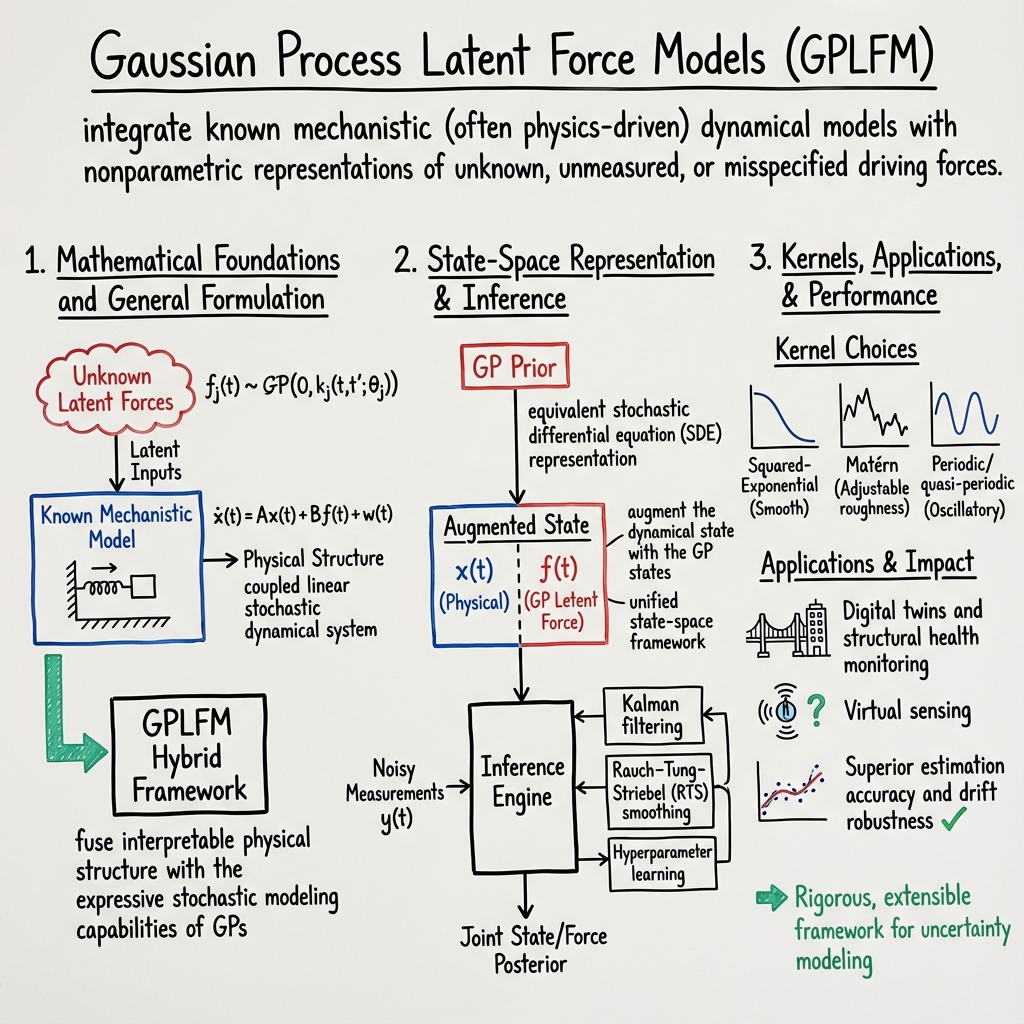
A Gaussian Process Latent Force Model (GPLFM) is a class of hybrid modeling frameworks that integrate known mechanistic (often physics-driven) dynamical models with nonparametric representations of unknown, unmeasured, or misspecified driving forces. GPLFMs parameterize uncertainty about latent inputs as Gaussian processes (GPs), thus fusing interpretable physical structure with the expressive stochastic modeling capabilities of GPs. This approach underpins a broad range of uncertainty-aware inference tasks, including joint state/input reconstruction from noisy measurements, anomaly diagnosis in digital twins, robust system identification, and structure-preserving forecasting (Kashyap et al., 27 Nov 2025, Álvarez et al., 2011, Nayek et al., 2019, Särkkä et al., 2017).
1. Mathematical Foundations and General Formulation
A standard GPLFM is constructed on the following coupled linear stochastic dynamical system:
where is the vector of system (or modal) states, is a vector of latent inputs (forces), and denotes observed outputs. are system matrices, and and are process and measurement noise, typically white (Kashyap et al., 27 Nov 2025).
Each latent force component is modelled as an independent zero-mean Gaussian process (GP): with kernel (often exponential, Matérn, or squared-exponential) and hyperparameters 0 (Kashyap et al., 27 Nov 2025, Álvarez et al., 2011).
The GPLFM augments the dynamical state with the GP states (see §3), enabling joint inference of 1 and 2 from observations 3 within a Kalman filtering/smoothing or marginal GP inference paradigm (Nayek et al., 2019, Särkkä et al., 2017).
2. State-Space Representation of Gaussian Process Priors
For GPs with stationary, rational-spectral-density kernels (e.g., Matérn-4, exponential), an equivalent stochastic differential equation (SDE) representation is available:
5
where 6 is white noise of spectral density 7 for the exponential kernel 8 (Kashyap et al., 27 Nov 2025). Analogous state-space realizations are available for higher-order Matérn and periodic kernels (Nayek et al., 2019, Vettori et al., 2023).
The GP prior can thus be embedded into an SDE system whose output matches the GP's marginal covariance, enabling the unified state-space framework for the entire system. In vector form, and after stacking the physical and GP states, the continuous-time system reads:
9
where 0, 1 is block-structured with physical and GP subblocks, and 2 assembles process and GP driving noises (Kashyap et al., 27 Nov 2025, Hartikainen et al., 2012).
3. Augmented Model, Discretization, and Inference Algorithms
For filtered and smoothed inference on discrete data, the continuous-time model is discretized over a sampling interval 3:
4
with 5, and 6 computed via the solution of a matrix Lyapunov or integral equation (Kashyap et al., 27 Nov 2025, Hartikainen et al., 2012, Nayek et al., 2019).
Inference is performed via:
- Kalman filtering: Forward sequential computation of 7 (prediction) and 8 (update).
- Rauch–Tung–Striebel (RTS) smoothing: Backward pass for 9, yielding joint posteriors for states and latent forces.
- Hyperparameter learning: Maximization of the marginal likelihood of observed data 0 with respect to kernel and noise parameters using innovation covariances 1 and residuals 2 (Kashyap et al., 27 Nov 2025, Nayek et al., 2019).
- Complexity per time step is 3, where 4 (Kashyap et al., 27 Nov 2025).
4. Kernel Choices and Modeling Expressiveness
GPLFM performance and regime-specific capabilities depend crucially on GP kernel selection. Common choices and their theoretical and practical trade-offs include (Vettori et al., 2023):
- Exponential (Matérn-1/2): Non-differentiable, ideal for abrupt or impulsive events.
- Matérn (ν): Adjustable smoothness; 5 frequently adopted for balance between physical continuity and roughness.
- Squared-Exponential: Maximally smooth, general-purpose, less suitable for discontinuities.
- Periodic/quasi-periodic: For oscillatory or cyclic latent drivers. Periodic kernels can be approximated by truncated Fourier/LBM expansions for efficient state-space embedding (Reece et al., 2013).
- Wiener (random walk): For Brownian-motion-like latent processes.
- Composite (e.g., constant + periodic): Capture static biases and time-varying effects.
The augmented SDE and discretized state-space structures adapt for each kernel class, dictating the dimension and statistical properties of the latent input process (Vettori et al., 2023, Reece et al., 2013).
5. Applications and Practical Strategies
GPLFMs have been applied to a wide spectrum of domains:
- Digital twins and structural health monitoring: Model-form errors or environmental excitations are treated as latent GPs, jointly estimated with states for robust system identification and prognosis (Kashyap et al., 27 Nov 2025, Sibille et al., 17 Jun 2025, Zou et al., 2022).
- Virtual sensing: State- or strain-estimation at uninstrumented locations, with uncertainty quantification (Zou et al., 2022).
- Building energy systems: Occupancy is modelled as a latent GP, enabling improved prediction for model predictive control (Wietzke et al., 2024).
- Patient-specific drug-response: Multi-output GPLFMs model medication effects on physiological states using causal kernels (Cheng et al., 2019).
- Nonlinear and switching systems: Nonlinearities and discontinuities (e.g., friction) are accommodated using multiple GP regimes and regime-switching latent force models, implemented as switching linear dynamical systems (SLDS) (Marino et al., 2023, Hartikainen et al., 2012).
In digital-twin settings, model-form errors are interpreted as latent forces, inferred via GPSM, and then mapped (potentially via BNNs) to pseudo-measurements for uncertainty-aware prognosis (Kashyap et al., 27 Nov 2025). In virtual sensing, GPLFM outperforms traditional random-walk input models both in accuracy and stability, with hyperparameters trained from data and minimal manual tuning (Vettori et al., 2023, Nayek et al., 2019).
6. Extensions, Computational Advances, and Theoretical Results
Recent work has extended the GPLFM paradigm in several directions:
- Efficient kernel approximations: Random Fourier feature expansions for GPLFM kernels yield scalable low-rank structures, reducing computational cost and eliminating error-function evaluations (Guarnizo et al., 2018).
- Periodic/quasi-periodic input handling: Mercer-eigenfunction or LBM approximations for periodic kernels allow state-space embedding and optimal mean-squared reconstruction for cyclic latent drivers (Reece et al., 2013).
- Multiplicative and switching regime models: Nonlinear and non-Gaussian extensions to the latent-force framework handle regime switching, geometric structure (e.g., on Lie groups), and discontinuous forces; approximate inference is via gradient-matching, mixture local approximations, or SLDS filtering/smoothing (Tait et al., 2018, Tait et al., 2018, Marino et al., 2023, Hartikainen et al., 2012).
- Control theory: GPLFM-based state-augmentation supports robust feedback control (LQG) with explicit separation of physical and GP-based unmodelled input, preserving classical control-theoretic properties such as observability, detectability, and stabilizability (Särkkä et al., 2017).
- Sensor placement and real-time operation: Sequential sensor placement algorithms (e.g., backward sequential sensor placement) leverage GPLFM sensitivity to maximize virtual-sensing accuracy with minimal instrumentation (Sibille et al., 17 Jun 2025). Forward-only filtering is recommended for real-time state/input estimation to avoid latency and drift (Vettori et al., 2023).
7. Empirical Performance and Practical Guidelines
Empirical studies on synthetic and real datasets consistently demonstrate:
- Superior estimation accuracy and drift robustness compared to classical input-augmented Kalman filter approaches and methods requiring a priori input noise tuning (Nayek et al., 2019, Zou et al., 2022, Vettori et al., 2023).
- Rapid and stable hyperparameter learning via marginal likelihood maximization, leveraging closed-form gradients through Kalman recursions (Kashyap et al., 27 Nov 2025, Nayek et al., 2019).
- Flexibility to prior knowledge: By selecting kernels mirroring expected latent force characteristics—periodic, step, impulse, random-walk, drift—the GPLFM framework provides tailored modeling for diverse regimes.
- Quantitative results: For example, state/force estimation mean relative errors of 5–10%, and frequency-domain correlations 6 for strain estimation in wind-turbine applications (Zou et al., 2022). RMSE reductions to 17% (vs non-periodic kernels) in periodic signal prediction are reported with eigenfunction-approximated GPLFMs (Reece et al., 2013).
Guidelines for practical deployment:
- Use periodic/quasiperiodic kernels for oscillatory latent drivers, exponential or Wiener for impulsive or stationary random inputs, Matérn for general smoothness with physical interpretability.
- Train hyperparameters using collocated sensor data for best online transfer.
- Prefer forward filtering for real-time estimation; backward smoothing for post hoc, offline reconstruction.
GPLFMs provide a rigorous, extensible framework for combining mechanistic system knowledge with data-driven uncertainty modeling of unknown inputs, supporting both statistical inference and robust control in complex, partially observed dynamical systems.