Critical Decay Index in MHD and Beyond
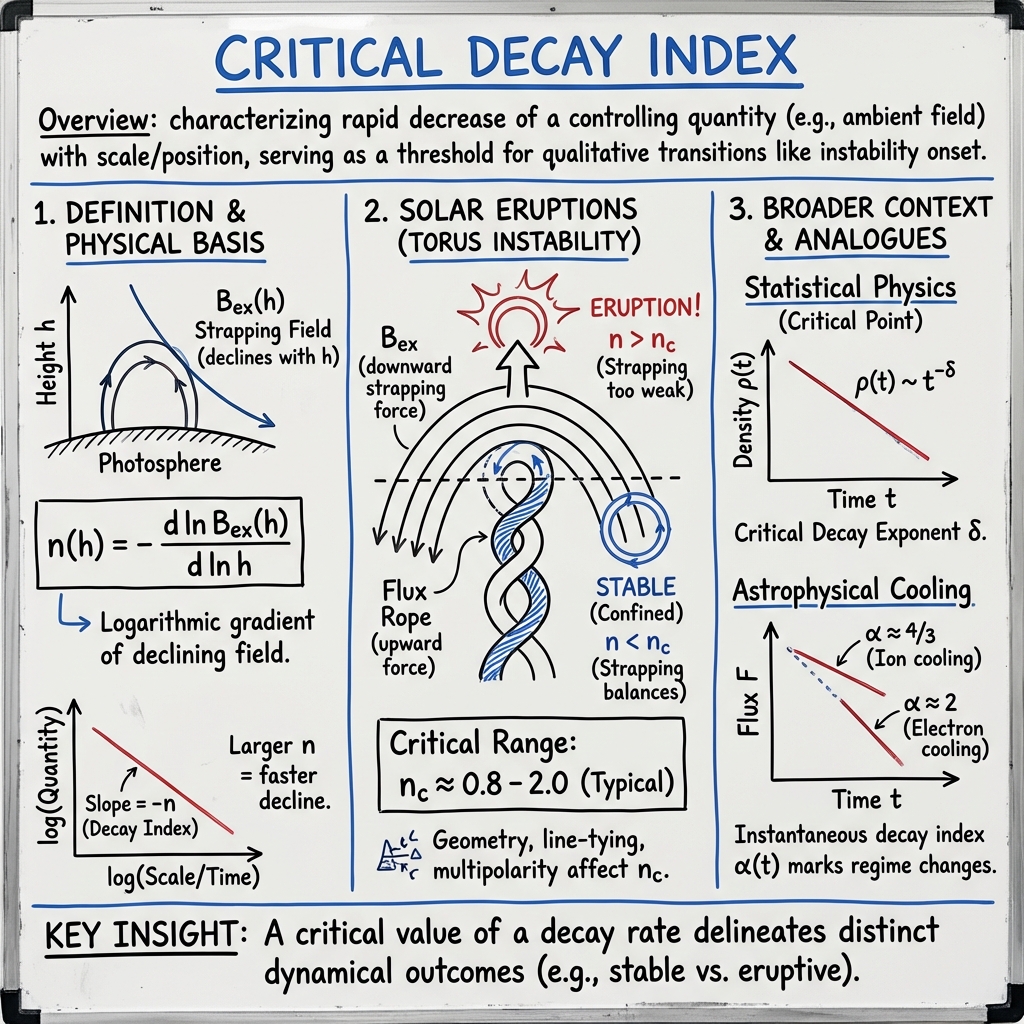
- Critical Decay Index is a parameter defined by the logarithmic gradient of a decreasing field, marking the threshold for dynamic transitions such as solar eruptions.
- It is determined through methods like potential-field extrapolation, MHD simulations, and analytic models, with critical values varying by geometry and line-tying effects.
- Beyond solar physics, analogous decay exponents in statistical systems and astrophysical transients help classify phase transitions and cooling dynamics.
The critical decay index is a parameter that characterizes how rapidly an ambient field, order parameter, or other controlling quantity decreases with spatial position, time, or scale, and serves as a threshold for qualitative transitions such as instability onset, regime change, or asymptotic scaling in a variety of physical systems. The most prominent context for the critical decay index is in solar and astrophysical magnetohydrodynamics (MHD), particularly in the theory of torus instability as a trigger for coronal mass ejections (CMEs) and prominence eruptions. Closely related concepts arise in nonequilibrium statistical physics (as a “critical decay exponent”) and astrophysical transient cooling (as a power-law slope parameter); all instantiate the same underlying notion: a critical value of a decay rate—measured, modeled, or simulated—delineates distinct dynamical outcomes.
1. Mathematical Definition and Physical Basis
The decay index quantifies the logarithmic gradient of a declining background field. In MHD and solar physics, for an overlying (strapping) magnetic field at height above the photosphere, the decay index is defined as
or equivalently,
A larger implies a more rapid weakening of the confining field with altitude, which reduces the restoring force acting on a magnetic flux rope.
In generalized statistical physics models, the term “critical decay index” (sometimes “critical decay exponent”) denotes the power-law exponent governing the asymptotic decay of the order parameter at a phase transition. For example, in the one-dimensional pair contact process with diffusion (PCPD),
with critical density decay exponent set by universality and underlying dynamics (Park, 2012).
2. Critical Decay Index in Solar Eruptive Phenomena
The solar application of the critical decay index centers on the torus instability, whereby a current-carrying flux rope will undergo catastrophic expansion (eruption) once exceeds a threshold value . This scenario is formalized in the theory of Bateman (1978) and Kliem & Török (2006), and refined in modern MHD studies.
Key relationships:
- The torus instability criterion: Eruption occurs when 0, as the downward “strapping” field can no longer balance the upward hoop force of the flux rope (Zuccarello et al., 2015, Luo et al., 2022).
- Classical models yield 1 for a thin, freely expanding ring; below unity for straight channels.
- Observational analyses and full MHD simulations demonstrate 2 is not a fixed value but falls in the range 3–4, controlled by geometry, current profile, line-tying strength, and overlying field complexity (Xu et al., 2012, Zuccarello et al., 2015, Luo et al., 2022, Vasantharaju et al., 2019, Filippov, 2021).
Notable numerical and empirical findings:
| Work | System | 5 Range | Salient Factors |
|---|---|---|---|
| (Zuccarello et al., 2015) | MHD flux ropes | 1.3–1.5 | Line-tying, reconnection effects |
| (Vasantharaju et al., 2019) | Solar prominences | 0.8–1.3 | 3D observations, field geometry |
| (Xu et al., 2012) | CME statistics | 61.0–2.2 | 38-event survey, speed correlation |
| (Filippov, 2021) | Short flux ropes | 71 (down to 0.3) | Strong line-tying, low apex height |
These values collectively define a “critical range,” rather than a universal threshold.
3. Methodologies for Determining Critical Decay Index
Determination of 8 involves a combination of observational analysis, numerical simulation, and analytic modeling:
- Potential-Field Extrapolation: Reconstruct the coronal background field above a polarity inversion line (PIL) from photospheric magnetograms (e.g., with Green’s function or PFSS methods) (Xu et al., 2012, Vasantharaju et al., 2019, Luo et al., 2022).
- Decay Index Computation: Calculate 9 at specific locations or along the PIL, typically in the height range where the flux rope apex resides (e.g., 42–105 Mm) (Xu et al., 2012).
- Critical Height Identification: For eruptions, the critical height 0 is where 1; temporal analysis of prominence or CME height evolution (e.g., via SDO/AIA and STEREO/EUVI triangulation) is used to pinpoint 2 and corresponding 3 (Vasantharaju et al., 2019).
- Simulation-Based Measurement: In MHD studies, the flux rope axis is tracked through the field evolution. The ambient field is sampled at the rope apex at eruption onset to determine 4 (Zuccarello et al., 2015).
- Analytic and Geometric Models: For idealized geometries (dipoles, quadrupoles, partial toroidal loops), analytic formulae provide 5 scaling with system parameters (e.g., critical height is about half the centroid separation in dipoles) (Luo et al., 2022).
4. Dependence on Geometry, Topology, and Physical Parameters
The critical decay index is highly sensitive to system geometry and flux distribution:
- Flux Rope Length and Anchoring: For “short” filaments (apex height 6 footpoint half-separation 7), the critical index can be 8—a consequence of line-tying and strong curvature at low heights (Filippov, 2021).
- Flux Distribution: In bipolar regions, the average critical height 9 (where 0 is centroid separation) (Luo et al., 2022).
- Multipolarity: Quadrupolar magnetic structures yield saddle-like 1 profiles that may create confinement at higher altitudes or lead to multi-stage (“two-step”) eruptions (Luo et al., 2022).
- Overlying Field Strength: Steep field gradients yield higher 2 at lower heights, increasing the likelihood of eruption if the rope apex attains that elevation (Xu et al., 2012).
- Dynamics and Current Profile: MHD simulations confirm 3 is robust to variations in boundary driving and rope morphology, as long as geometric factors are accounted for (Zuccarello et al., 2015).
5. Analogues in Statistical Physics and Astrophysics
In systems outside solar MHD, “critical decay index/exponent” arises as the exponent describing macroscopic relaxation at criticality:
- Nonequilibrium Phase Transitions: In the critical pair contact process with diffusion (PCPD), the particle density decays as 4 at the critical point. Here, the critical decay exponent 5 is universal across diffusion regimes, yet distinct from the directed percolation value 6 (Park, 2012).
- Transient Cooling in Astrophysical Bursts: The instantaneous decay index 7 of X-ray flux in thermonuclear bursts identifies regime transitions; physically significant thresholds occur at 8 (ion-dominated cooling), 9 (electron-dominated), and steep rises 0 marking rapid cooling cessation (Kuuttila et al., 2017).
- Nonlinear PDEs: In the four-dimensional energy-critical nonlinear heat equation, a "critical decay index" 1 (where 2 is the decay character of initial data) gives the algebraic decay rate in critical Sobolev norms (Kosloff et al., 2023).
6. Implications, Diagnostics, and Applications
The critical decay index enables predictive and diagnostic tools in multiple domains:
- Eruption Forecasting: Measuring 3 above observed PILs, and comparing with the altitude of flux ropes, allows quantitative assessment of eruption potential—provided the empirical 4 range is respected (Zuccarello et al., 2015, Xu et al., 2012).
- Discrimination of Event Classes: Spatial variation in 5 along the PIL can distinguish eruptive from confined or partial eruptions (Xu et al., 2012).
- Understanding Partial and Two-Step Eruptions: Saddle-like 6 profiles, especially in multipolar topologies, are implicated in multi-stage eruptions or failed events due to intervening torus-stable regions (Luo et al., 2022).
- Process Attribution: In prominence eruptions, kinematic analysis shows that torus instability initiates, but subsequent flare reconnection dominates acceleration in flare-associated events (Vasantharaju et al., 2019).
- Universality and Crossover in Stochastic Systems: The critical decay exponent provides a robust marker for universality class distinctions and phase transition scaling, resilient to corrections-to-scaling and parameter variation (Park, 2012, Kosloff et al., 2023).
- Astrophysical Composition Diagnostics: Empirical determination of critical decay indices in X-ray burst cooling curves constrains fuel composition, nuclear burning regime, and even accretion geometry (Kuuttila et al., 2017).
7. Limitations and Theoretical Extensions
- Non-Universality: The critical decay index is not a universal constant; its value adapts to geometry, system dimension, and microphysical constraints. For solar eruptions, this requires careful calibration in application.
- Topology-Induced Complexity: Multipolar configurations and line-tying lead to non-monotonic and spatially variant 7, requiring full 3D analysis.
- Transition to Instability: In dynamic situations (e.g., rapidly evolving active regions), the height and moment when 8 crosses 9 may be ambiguous due to transient effects or measurement limitations.
- Extensions to Other Systems: Concepts equivalent to the critical decay index appear in a wide array of dissipative, critical, and transient systems, often under other terminology (critical exponent, decay character, dynamic index), but retain the generic role of threshold parameter for qualitative change.
Summary Table: Critical Decay Index Regimes in Solar Eruptions
| System/Model | 0 Range | Dominant Effects | References |
|---|---|---|---|
| Freely expanding ring | 1 | Bateman, Kliem & Török | (Zuccarello et al., 2015) |
| Thick, partial torus | 2–3 | Rope geometry, line-tying | (Zuccarello et al., 2015) |
| “Short” filaments | 4 | Strong curvature, footpoint proximity | (Filippov, 2021) |
| Observational CMEs | 5–6 | Variability over event sample | (Xu et al., 2012) |
| Prominence eruptions | 7–8 | Local field geometry, flare association | (Vasantharaju et al., 2019) |
The critical decay index, in all contexts, demarcates the boundary between distinct physical, statistical, or dynamical regimes. Its accurate determination in models, simulations, and observations remains essential for predictive understanding of catastrophic phenomena, critical relaxation, and regime transitions.