Autonomous Manuscript Creation
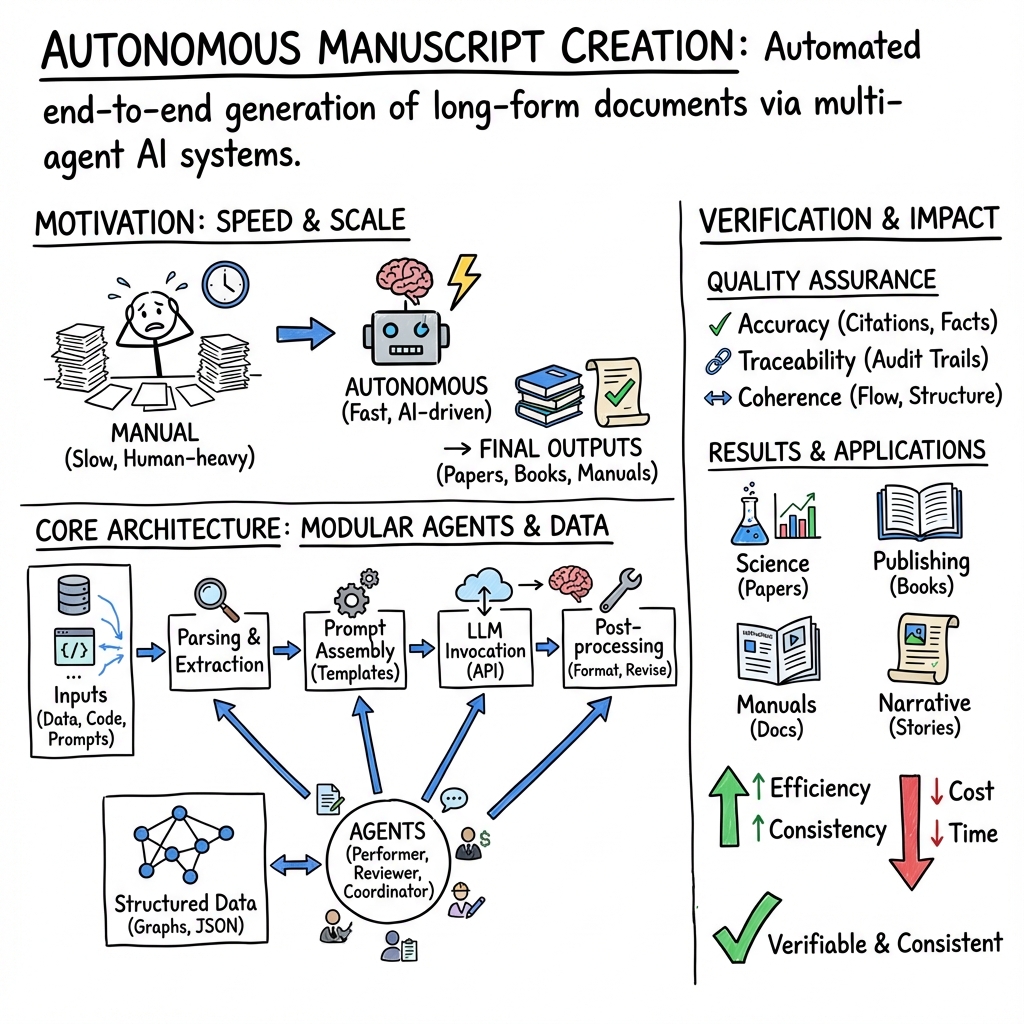
- Autonomous manuscript creation is the automated generation of long-form documents using LLMs, agent-based workflows, and structured representations to ensure semantic rigor.
- It employs modular, multi-stage pipelines combining parsing, prompt-engineering, and quality control to transform raw data into well-structured, verifiable manuscripts.
- These systems enable significant efficiency gains and broad applications, ranging from scientific publications and technical manuals to creative narratives.
Autonomous manuscript creation denotes the end-to-end automated generation of long-form, structurally coherent, and semantically rigorous documents—including academic papers, technical manuals, books, and narratives—through software systems leveraging LLMs, agent-based workflows, and structured representations. These systems minimize or eliminate direct human authorship, aiming for outputs consistent with established writing conventions and verifiable knowledge structures.
1. Fundamental Architectures and Workflows
Autonomous manuscript creation is characterized by modular, multi-stage pipelines in which specialized components or agents transform raw inputs (data, code, knowledge graphs, or prompts) into finalized documents.
In scientific publishing, pipelines typically comprise:
- Parsing modules to ingest raw materials (e.g., Python code or Jupyter notebooks), tokenize and extract semantic features.
- Data extraction subcomponents for executing analytic code, generating figures, tables, and metrics, and serializing outputs (commonly as JSON).
- Prompt-template engines governing the assembly of section-specific LLM prompts, fusing code explanations, data outputs, and citation information.
- LLM invocation modules interfacing with models via API, returning completions for each structural section (Abstract, Methods, etc.).
- Post-processing/Revision systems that standardize format, apply heuristics, and optionally trigger feedback loops (e.g., re-generation of low-confidence outputs) (Harper, 2024).
In publishing and creative domains, architectures are typically configuration-driven, supporting hierarchical overrides (publisher → imprint → title), continuous ideation modules with tournament evaluation (scoring scholarly quality and persona alignment), and multi-model AI integration frameworks operating across the drafting, verification, assembly, and distribution phases (Zimmerman, 23 Oct 2025). For creative generation, agent-based pipelines instantiate narrative structures through agentic partition (e.g., interviewer, scribe, planner, section writer, and coordinator agents for autobiographical writing (Talaei et al., 17 Jun 2025); or role, plot, recall, and writer agents for narrative fiction (Cheng et al., 30 Sep 2025)).
Formal workflow abstraction often follows a generate-and-test paradigm, with context graphs maintaining provenance (Ifargan et al., 2024). Pseudocode and pipeline block diagrams illustrate the movement from raw input through orchestrators, agent modules, and assembly into human-consumable formats.
2. Representation and Semantic Control
Central to autonomous manuscript creation is the use of structured, intermediate data representations that decouple surface realization from underlying logic or content.
In code → paper systems, source code is parsed to extract doc-strings, comments, and function signatures, and executed to produce intermediate results, which are then injected into prompt scaffolds. The narrative content is generated by LLMs, anchored tightly to inputs, ensuring semantic traceability for every result, figure, or claim (Harper, 2024).
In creative/narrative systems, text-independent representations (e.g., knowledge graphs of semantic triples specifying characters, relations, events, scenes) separate story logic from style. Agents manipulate the prototype through well-defined graph operations, and writing agents render these structures into prose while inserting advanced devices (foreshadowing, retrospection) (Cheng et al., 30 Sep 2025). Every action and event is justified within an intentional framework, supporting believability and causal coherence (Botelho, 2021).
In instruction/manual creation, rule-based systems capture environmental mechanisms, skills, and corrective processes as editable records with attributed examples, facilitating both plan synthesis and iterative refinement (Chen et al., 2024).
Auditability and verifiability are enhanced by constructing explicit trace graphs linking every manuscript element to its computational and data origins (Ifargan et al., 2024).
3. Agent-Oriented and Multi-Stage Generation
Autonomous systems frequently rely on multi-agent orchestration, where modular responsibilities—information collection, planning, content drafting, verification, and coordination—are spatially and temporally partitioned.
- Performer agents synthesize hypotheses, plan analyses, and generate code or narrative sections (Ifargan et al., 2024).
- Reviewer/critic agents validate, comment, or filter outputs, employing role-reversal prompt dynamics.
- Domain-specific agents, such as memory extraction or session coordination in autobiographical pipelines, manage streams of user interaction and structural cohesion (Talaei et al., 17 Jun 2025).
- Ideation and tournament agents implement batch proposal, pairwise evaluation, and selection, with scoring functions blending quality and alignment to higher-order themes/personas (Zimmerman, 23 Oct 2025).
The agent workflows often instantiate a layered structure:
- Initialization (extract user goals, seed representations)
- Iterative expansion (chapter-wise or section-wise growth by dedicated sub-agents)
- Quality control (coherence scoring, verification, and edit loops)
- Assembly and finalization into published formats (LaTeX, Markdown, typographic codices, PDFs).
Single-shot approaches (each section generated independently, as in (Harper, 2024)) favor modularity and debugging, while multi-agent approaches scale better to complex documents and support recursive critique/self-improvement.
4. Quality Assurance, Evaluation, and Verification
Objective, automated, and reproducible quality assessment is integral to the field:
- Text generation metrics (BLEU, ROUGE-L): While not always published in primary sources, these measure overlap in n-grams or longest common subsequence between generated and reference texts (Harper, 2024).
- Coherence and discourse metrics: Learned discourse models yield scalar coherence scores; in creative-authoring, custom composite indices (e.g., narrative quality and length—QLS) combine multiple narrative features (Cheng et al., 30 Sep 2025).
- Accuracy and validation metrics: Citation accuracy is computed as the proportion of correct citations; validation success tracks the error-free rate of pipeline runs; throughput and cost metrics track efficiency (Zimmerman, 23 Oct 2025).
- Empirical error rates: In research automation, correctness is stratified by task complexity (breadth of analytic models), with autopilot mode yielding 80–90% correctness in simple cases, but co-piloting required for complex, high-breadth tasks (Ifargan et al., 2024).
- Traceability and auditability: Hyperlinked provenance graphs trace every reported result to underlying code/data, supporting programmatic verification (Ifargan et al., 2024).
- Groundedness: In personal narrative systems, substantiate each claim with source memories, ensuring that every assertion has a documented origin (Talaei et al., 17 Jun 2025).
Verification frameworks may also integrate domain-specific checks (e.g., API-based citation scrutiny (Zimmerman, 23 Oct 2025)), logical consistency scans, and human review for flagged high-stakes content.
5. Domain Coverage and Applications
The methodologies of autonomous manuscript creation are broadly extensible:
- Scientific research: Automated drafting of verifiable research manuscripts from code and data, supporting transparency, traceability, and reproducibility.
- Technical instructive documentation: Autonomous manuals synthesized through planner/builder/formulator agent triads, with case-conditioned prompting to mitigate LLM hallucinations. These frameworks outperform human-guided baselines on standard benchmarks (Chen et al., 2024).
- Publishing: Configuration-driven pipelines for full book and imprint creation, with multi-stage ideation, drafting, verification, and typesetting. Demonstrated cost reductions (≈80%), time-to-market reductions (≈90%), and high validation/citation accuracy (99–100%) (Zimmerman, 23 Oct 2025).
- Long-form narrative generation: Multi-category creative engines using graph-based prototypes and multi-agent workflows to produce stable, coherent multi-chapter narratives at minimal cost and high structural control (Cheng et al., 30 Sep 2025).
- Autobiographical and memory-driven manuscripts: Multi-agent conversational writing systems dynamically collect, cluster, and narrativize user-provided memories, with high narrative completeness and user satisfaction (Talaei et al., 17 Jun 2025).
Adapting to new domains involves the replacement of code parsers, adjustment of language-specific prompt scaffolds, and domain-customized quality heuristics (Harper, 2024).
6. Open Challenges and Future Directions
Despite substantial progress, several challenges remain:
- Agentic autonomy: Many systems rely heavily on pre-specified user goals or criteria. Scaling to autonomously generated and adopted “main ideas” and self-designed criteria for creativity/evaluation is identified as a frontier (Botelho, 2021).
- Complex task coverage: Fully-autonomous completion succeeds for simple, hypothesis-testing tasks; human guidance remains critical for high-breadth, complex, or under-specified research projects (Ifargan et al., 2024).
- LLM compliance and scaling: Systems may depend on the capabilities of state-of-the-art LLMs; incorporating rule/concept enforcement or relaxation mechanisms, dealing with LLM limitations, and supporting domain transfer are ongoing challenges (Chen et al., 2024).
- Global document restructuring: Absence of automated, large-scale restructuring (e.g., reorganizing narratives or biographies) can cause repetition and suboptimal organization; modular pipelines facilitate future incorporation of such capabilities (Talaei et al., 17 Jun 2025).
Proposed future enhancements include the integration of engagement and restructuring classifiers, style-conditioned drafting, and open-sourcing frameworks for broader adoption and further reduction of required human oversight.
Autonomous manuscript creation thus encompasses architectural modularity, structured semantic representations, agent-centric workflows, rigorous quality assurance, extensible application frameworks, and critical challenges of autonomy, complexity, and verification. It stands as an emerging paradigm at the confluence of artificial intelligence, computational creativity, and technical communication (Harper, 2024, Ifargan et al., 2024, Zimmerman, 23 Oct 2025, Cheng et al., 30 Sep 2025, Talaei et al., 17 Jun 2025, Chen et al., 2024, Botelho, 2021).