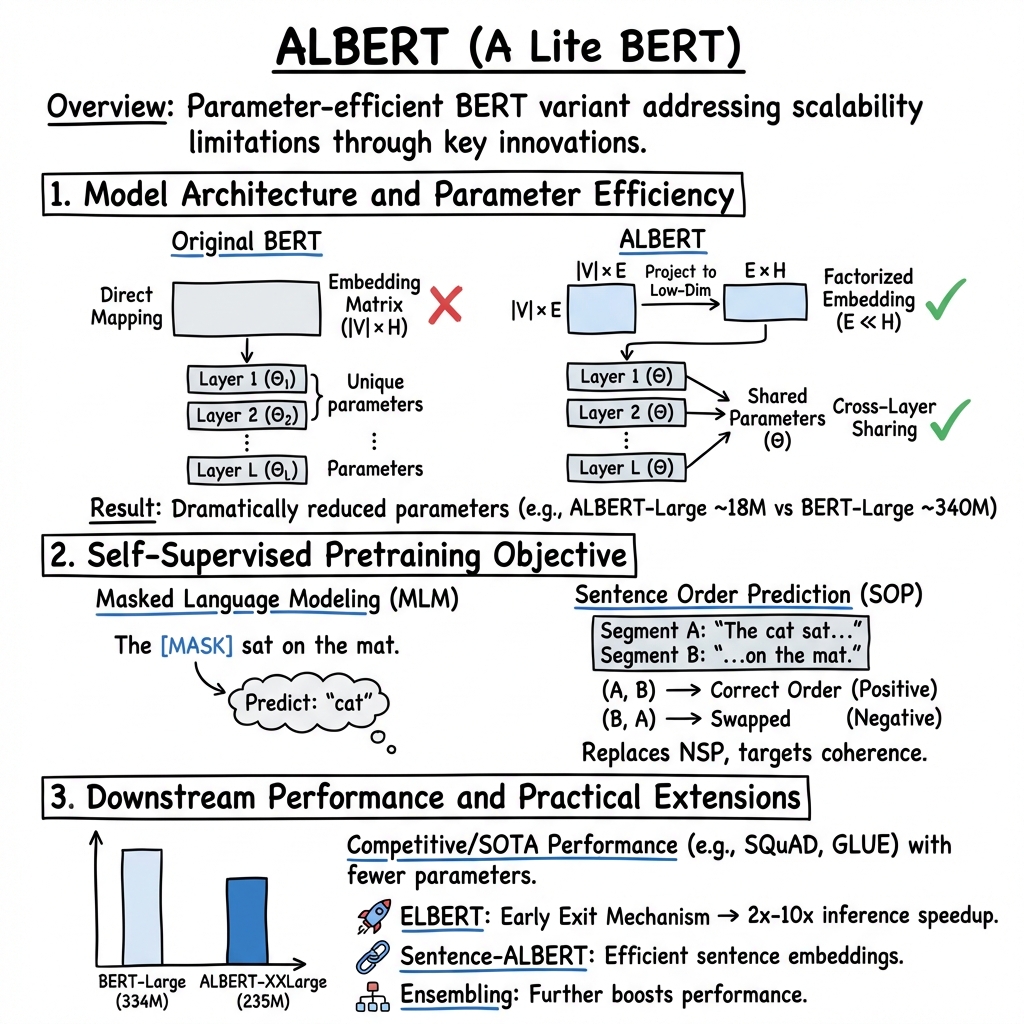
ALBERT: A Lite & Efficient BERT
- ALBERT is a lightweight variant of BERT that reduces parameters by factorizing embeddings and sharing Transformer layers across depths.
- It modifies pretraining objectives by replacing next sentence prediction with sentence order prediction to improve inter-sentence coherence.
- ALBERT achieves competitive results on tasks like SQuAD and GLUE, offering practical advantages through efficient scaling and inference acceleration.
ALBERT (A Lite BERT) is a parameter-efficient variant of the Bidirectional Encoder Representations from Transformers (BERT) architecture, designed to address the scalability limitations of large pre-trained LLMs. By introducing two key innovations—factorized embedding parameterization and cross-layer parameter sharing—ALBERT achieves substantial reductions in parameter count while maintaining or exceeding the performance of original BERT models across a range of natural language understanding benchmarks. ALBERT also replaces BERT's next sentence prediction objective with a structurally stronger sentence order prediction loss, specifically enhancing inter-sentence coherence modeling. The architecture supports efficient scaling to very large hidden sizes and deep models, serving as a foundation for further developments in model efficiency, inference acceleration, and multi-task learning (Lan et al., 2019).
1. Model Architecture and Parameter Efficiency
ALBERT implements two orthogonal parameter reduction strategies:
- Factorized Embedding Parameterization: Traditional BERT directly maps a one-hot vocabulary vector to the hidden representation with a embedding matrix (where is vocabulary size, is hidden size). ALBERT decouples this, first projecting into a lower-dimensional embedding space (), then into the hidden space , with . This reduces the embedding parameters from to . In typical configurations (), this results in an 8-fold parameter reduction in the embedding layer (Lan et al., 2019).
- Cross-Layer Parameter Sharing: Instead of unique parameters for each of the 0 Transformer layers, ALBERT shares a single set of parameters for all layers. For each layer 1:
2
This yields an almost 3-fold reduction in parameters associated with the Transformer block.
By combining these methods, ALBERT enables large and deep models operating with a substantially smaller memory and computation footprint compared to vanilla BERT variants. For example, ALBERT-Large (24 layers, hidden size 1024) has only ~18M parameters versus ~340M in BERT-Large, while ALBERT-XXLarge (12 layers, hidden size 4096) has ~235M parameters (Lan et al., 2019, Li et al., 2021).
2. Self-Supervised Pretraining Objective
ALBERT modifies BERT's self-supervised objectives in two principal ways:
- Masked Language Modeling (MLM): Retained as in the original BERT, where random n-grams (with 4) are masked and the model must reconstruct the masked tokens (Lan et al., 2019).
- Sentence Order Prediction (SOP): Replaces the Next Sentence Prediction (NSP) task. SOP presents the model with two consecutive segments 5 from the same document in either correct order (positive) or swapped (negative). The model must classify whether the order is correct. This targets discourse-level coherence rather than simply topic similarity. The SOP loss function is:
6
where 7 is the predicted probability of the correct order based on the pooled [CLS] embedding.
The combined pretraining loss is 8 (Lan et al., 2019).
3. Pretraining Dynamics and Embryology
The developmental trajectory of ALBERT during pretraining reveals phase-wise acquisition of linguistic and world knowledge (Chiang et al., 2020). Key phenomena include:
- Token Reconstruction and Mask Prediction Learning Speed: Function words (conjunctions, determiners) are learned fastest, while content words (nouns, proper nouns) are acquired over longer timescales. For example, determiners reach 50% normalized reconstruction accuracy by ~15,000 steps, while proper nouns require ~130,000 steps.
- Linguistic Knowledge Evolution: Probing reveals that syntactic and core semantic information (POS, constituency, coreference, semantic role labeling) emerges early (first 100–200k steps) and then plateaus or mildly decays as training continues. This suggests diminishing returns in downstream task capability from long pretraining beyond 200–250k steps.
- World Knowledge Non-Monotonicity: Factual recall abilities display oscillatory or non-monotonic evolution, with some relations peaking early and then being forgotten as MLM dominates training. Most downstream GLUE and SQuAD2.0 performance is already realized by 200–250k pretraining steps (Chiang et al., 2020).
4. Downstream Performance and Practical Extensions
ALBERT achieves competitive or state-of-the-art results across major benchmarks. Key findings and approaches include:
- SuperGLUE, SQuAD, and RACE: ALBERT models achieve strong absolute performance, often outperforming BERT at comparable or significantly reduced parameter count and memory cost. For example, ALBERT-XLarge (60M params) achieves SQuAD2.0 F1 of 86.1 and RACE accuracy of 74.8, while ALBERT-XXLarge (235M params) achieves SQuAD2.0 F1 of 88.1 and RACE accuracy of 82.3 (Lan et al., 2019).
- Model Scaling: Increasing hidden size and model capacity in ALBERT (e.g., ALBERT-xlarge, ALBERT-xxlarge) correlates with improved contextual modeling and downstream QA performance, as observed on SQuAD 2.0 (Li et al., 2021).
- Sentence Embedding Models: When adapted into sentence embedding architectures (e.g., as a replacement backbone for Sentence-BERT in Sentence-ALBERT), ALBERT maintains high competitiveness on semantic textual similarity and natural language inference benchmarks despite reduced parameterization (Choi et al., 2021).
- Ensembling for QA: Ensembles combining multiple ALBERT models using strategies such as weighted voting or mean logits further improve extractive QA performance, culminating in SQuAD 2.0 F1 scores exceeding 90 (Li et al., 2021).
| Model Variant | # Params | SQuAD2.0 F1/EM | GLUE Avg | RACE (%) |
|---|---|---|---|---|
| BERT-Large | 334M | 85.0 / 82.2 | 85.2 | 73.9 |
| ALBERT-Large | 18M | 82.3 / 79.4 | 82.4 | 68.5 |
| ALBERT-XLarge | 60M | 86.1 / 83.1 | 85.5 | 74.8 |
| ALBERT-XXLarge | 235M | 88.1 / 85.1 | 88.7 | 82.3 |
[All values from (Lan et al., 2019)]
5. Acceleration and Inference-Efficient Variants
Despite low parameter counts, ALBERT's inference cost (FLOPs) remains high due to full-depth Transformer evaluation. ELBERT extends ALBERT by incorporating a confidence-window based early exit mechanism without adding backbone parameters (Xie et al., 2021):
- Layerwise Classifiers: A classifier is attached at each layer, producing a softmax over target classes.
- Confidence Criterion: At each step, the model computes normalized entropy (termed "puzzlement"), and if this falls below a threshold 9, inference halts early.
- Monotonicity Criterion: If instant confidence is not achieved, a second criterion checks for non-decreasing maximum class probability over a sliding window of 0 past layers.
- Computation/Accuracy Trade-off: ELBERT achieves 2x–10x average inference speedup (as measured by reduction in FLOPs) with ≤1% absolute accuracy loss—sometimes even accuracy gains at moderate speedups. ELBERT outperforms other ALBERT-accelerated early-exit schemes (DeeBERT, FastBERT) across AG-News, IMDB, SST-2, and GLUE tasks.
6. Analysis, Regularization, and Future Directions
- Regularization Effects: Cross-layer parameter sharing is shown to induce smoother, more regular transitions between layer representations, acting as an implicit regularizer and assisting generalization (Lan et al., 2019).
- Model Interpretability: Attention visualization tools (e.g., BertViz) applied to ELBERT demonstrate that early-exit layers often align with salient decision points in the input, mitigating overthinking and wasted computation (Xie et al., 2021).
- Ablation Findings: Additional architectural modules (e.g., highway networks, character CNNs, RNNs) typically produce limited gains atop ALBERT-base, with most downstream performance improvements attributable to scaling model size and ensembling (Li et al., 2021).
- Pretraining Policy: Empirical evidence supports early stopping or dynamic snapshotting based on probing tasks during pretraining, as the majority of downstream transfer capability emerges early (Chiang et al., 2020).
- Open Directions: Proposed research includes block-sparse attention for faster wide models, more challenging inter-sentence objectives beyond SOP, and integration with efficient inference and mixture-of-experts architectures (Lan et al., 2019).
7. Summary and Impact
ALBERT advances the design of large-scale pre-trained LLMs by decoupling embedding size from hidden size and sharing Transformer parameters across layers, yielding high-accuracy models with dramatically reduced parameter counts. Its innovations in pretraining objectives and inference efficiency have solidified its role in both academic research and applied natural language processing, as evidenced by state-of-the-art results on widely adopted NLU and QA benchmarks. The phase-wise pretraining dynamics revealed by probing studies suggest new directions for efficient, targeted pretraining. The model's adaptability to acceleration strategies such as ELBERT broadens its applicability to resource-constrained and real-time NLP settings (Lan et al., 2019, Chiang et al., 2020, Xie et al., 2021, Li et al., 2021).