Affine Invariant Metrics: Theory & Practice
- Affine invariant metrics are measures that remain unchanged under affine transformations, ensuring stable and consistent analysis of geometric and statistical structures.
- They underpin closed-form computations of geodesics and distances in SPD matrices, surfaces, and image patterns, facilitating applications from shape correspondence to perceptual modeling.
- Practical implementations leverage these metrics for robust statistical estimation, kernel methods, and deep image quality assessments by addressing computational and invariance challenges.
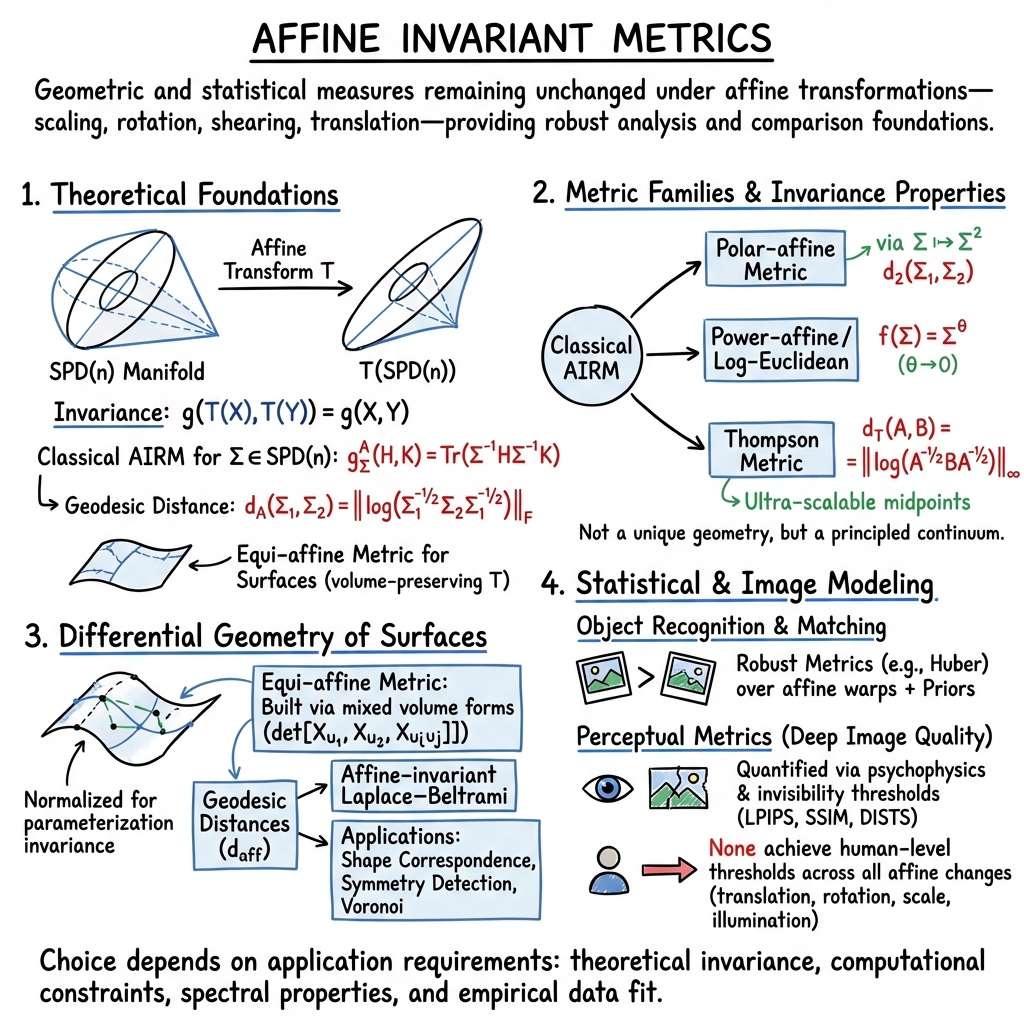
Affine invariant metrics are a class of geometric and statistical measures that remain unchanged under affine transformations—maps composed of scaling, rotation, shearing, and translation. These metrics provide the foundation for robust analysis and comparison of geometric objects, statistical structures, signals, and perceptual models, especially in contexts where invariance to coordinate transformations or local reparameterizations is critical. Affine invariance for a metric implies for all and all affine transformations . Key application domains include manifold geometry of symmetric positive-definite matrices, differential geometry of surfaces, image and pattern recognition, and perceptual modeling.
1. Theoretical Foundations of Affine Invariant Metrics
Affine invariance in metrics is framed as invariance under the general linear group action, typically , acting on objects via congruence transformations or coordinate changes. In the case of symmetric positive-definite (SPD) matrices, the classical affine-invariant Riemannian metric is given explicitly by
for tangent to (Thanwerdas et al., 2021, Thanwerdas et al., 2019). This metric is strictly invariant under congruences: , .
Geodesics, distances, and curvature in the corresponding Riemannian symmetric space 0 are available in closed form: 1 This generalized distance has a key role in fields that require the comparison of SPD objects independently of coordinate representation.
Affine invariance extends beyond SPD matrices. For two-dimensional surfaces in 2, equi-affine Riemannian metrics are constructed via mixed volume forms: 3 where 4 and 5 (Raviv et al., 2010, Raviv et al., 2010). This metric is invariant under volume-preserving affine maps.
2. Metric Families and Invariance Properties
Recent research demonstrates that "affine-invariant metric" does not specify a unique geometry but rather a principled continuum of metrics (Thanwerdas et al., 2019). Besides the classical AIRM, notable families include:
- Polar-affine Metric: Induced by pulling back affine-invariant geometry along the map 6, with geodesic distance 7.
- Power-affine and Deformed-affine Metrics: For any smooth diffeomorphism 8, 9 is defined as 0, yielding metrics invariant under 1-affine actions. The power family uses 2; the log-Euclidean metric is the limit as 3.
- Thompson Metric: For positive-definite matrices 4, 5. This metric is affine-invariant under congruence and features ultra-scalable midpoints 6 constructed from extremal eigenvalues (Mostajeran et al., 2022).
In the context of kernel-metric hierarchies, the affine-invariant metric is the instance where 7 in 8 for an eigenbasis 9 (Thanwerdas et al., 2021).
3. Affine Invariant Metrics in Differential Geometry of Surfaces
On smooth 2D surfaces, the construction of an equi-affine metric proceeds by defining an arclength invariant under volume-preserving affine maps 0. The mixed volume
1
is used to build local quadratic forms. The key normalization 2 ensures invariance to parameterizations. Positive-definiteness is enforced by spectral correction. The resulting metric 3 is foundational for defining geodesic distances (4) and for constructing affine-invariant Laplace–Beltrami operators.
Discrete implementations (mesh-based) involve local quadratic fitting and edge-length computation compatible with fast marching algorithms. Applications include Voronoi tessellation, multidimensional scaling, robust shape correspondence, and symmetry detection, with all tools exactly commuting with equi-affine deformations (Raviv et al., 2010, Raviv et al., 2010).
4. Affine Invariant Metrics in Statistical and Image Modeling
Affine invariance is central in object recognition, image matching, and quality assessment. In 2D image domains, robust (e.g., Huber-type) metrics parameterized over all affine warps—rotation, scaling, shearing, translation—are combined with suitable priors to ensure invariance and robust estimation (Zografos et al., 2010). Bayesian statistics and smooth norms provide superior resilience to outliers, scale collapse, and degenerate solutions.
For perceptual metrics in deep image quality assessment, affine invariance is quantified by determining invisibility thresholds via psychophysics. Analyzed metrics (LPIPS, SSIM, DISTS, etc.) are transformed via monotonic equalization to a common scale, with empirical thresholds determined such that deviations below the threshold are declared imperceptible and thus invariant (Alabau-Bosque et al., 2024). None of the surveyed metrics achieves human-level thresholds for translation, rotation, scale, or illumination changes across all tested transformations.
5. Affine Invariant Metrics on Correlation Matrices
The quotient-affine metric for full-rank correlation matrices is constructed by quotienting the affine-invariant metric on 5 by the diagonal scaling action 6 (7 diagonal). The corresponding metric 8 is restricted to the open elliptope 9 (matrices with unit diagonal) by explicit orthogonal projection procedures (Thanwerdas et al., 2021). Key ingredients include a closed-form exponential map, Levi–Civita connection, and curvature expressions, with dimensions reduced by 0 relative to 1.
6. Computational and Practical Considerations
Computational efficiency varies across affine-invariant metrics. The classical AIRM and its power/polar variants require matrix square roots, exponentials, and eigen-decompositions. The Thompson metric exploits extremal eigenvalue computation for rapid midpoint averaging, facilitating scalable applications in high-dimensional statistics (Mostajeran et al., 2022). Choice of metric in applications is influenced by invariance requirements, computational constraints, data variability, and stability under near-singular configurations (Thanwerdas et al., 2019).
For deep image metrics, empirical procedures involve generating grids of affine distortions, conducting forced-choice psychophysical experiments, and fitting response curves to translate metric outputs into physical thresholds of perceptual invariance (Alabau-Bosque et al., 2024).
7. Controversies, Extensions, and Guidelines
Contemporary research points out that the label "affine-invariant metric" admits a variety of formally valid constructions. The choice among classical, power, polar, Thompson, and quotient metrics must reflect specific requirements—spectral properties, log-linearity, diagonal stability, or application-driven statistical criteria (Thanwerdas et al., 2019). A plausible implication is that metric selection should be based on both theoretical invariance and empirical data fit, particularly when interpreting distances on manifolds of SPD objects or in perceptually-motivated domains.
In the geometric context, the distinction between volume-preserving (equi-affine) and general affine transformations is material, as full invariance is only assured under 2 for surface metrics (Raviv et al., 2010, Raviv et al., 2010). For perceptual and statistical metrics, invariance regions can be measured quantitatively and compared directly with human or ground-truth thresholds, providing an operational criterion for metric adequacy (Alabau-Bosque et al., 2024).