4D Gaussian Splatting in Dynamic Scene Rendering
- 4D Gaussian Splatting is a method that models dynamic scenes as a set of explicit, anisotropic 4D Gaussians capturing spatial and temporal correlations.
- It employs a compact spherindrical harmonics-based appearance model and differentiable splatting to achieve photoreal novel-view synthesis at over 100 FPS.
- The framework outperforms prior models by delivering high PSNR and low LPIPS scores while enabling applications like real-time video capture, digital twins, and interactive scene editing.
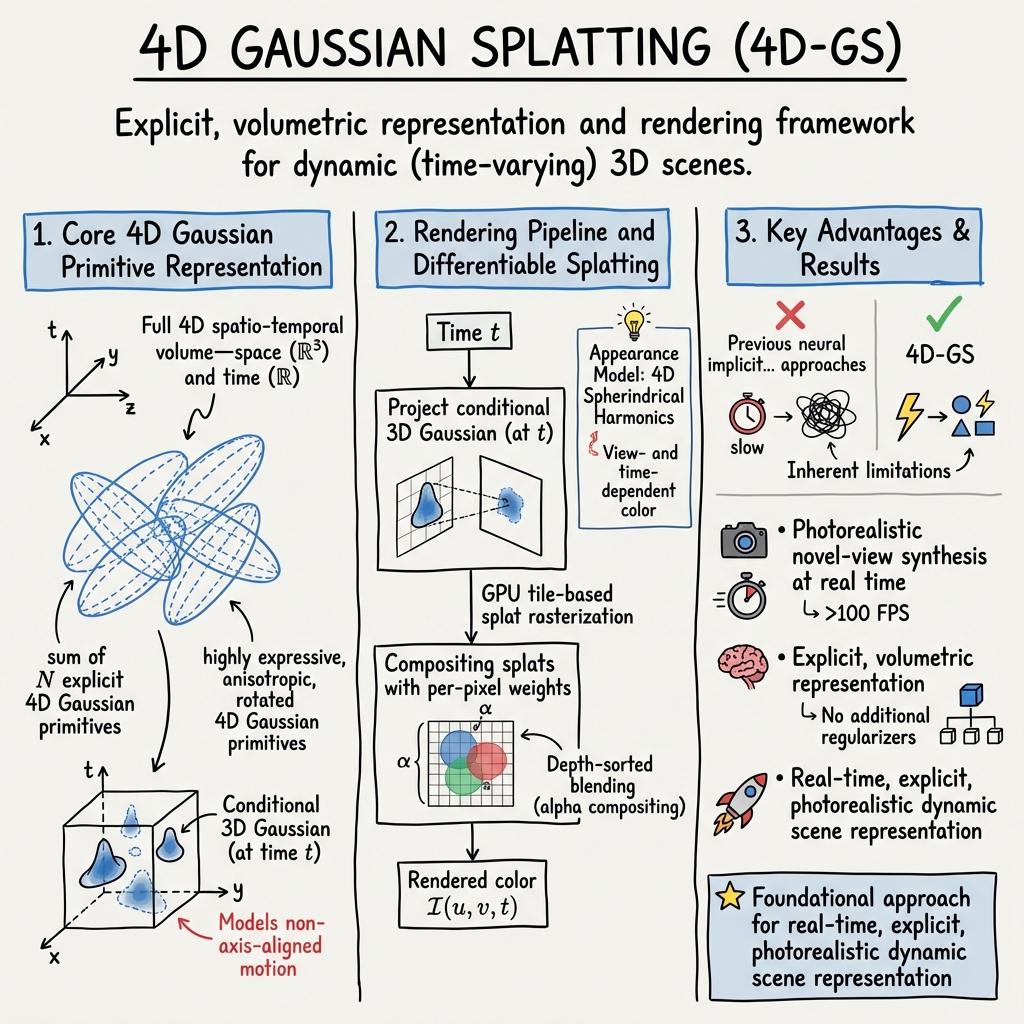
4D Gaussian Splatting (4D-GS) is an explicit, volumetric representation and rendering framework for dynamic (time-varying) 3D scenes. Introduced by Yang et al. (Yang et al., 2023), 4D-GS addresses the inherent limitations of previous neural implicit and deformable radiance field approaches by directly modeling the full 4D spatio-temporal volume—space (ℝ³) and time (ℝ)—with a set of highly expressive, anisotropic, rotated 4D Gaussian primitives. The method achieves photorealistic novel-view synthesis at real time, supporting diverse downstream applications in video-based scene capture, digital twins, interactive editing, and efficient dynamic view rendering.
1. Core 4D Gaussian Primitive Representation
A dynamic scene is encoded as a sum of explicit 4D Gaussian primitives , each parameterized by a 4D mean and a full covariance : where , .
To enable stable optimization and full 4D anisotropy (including spatio-temporal orientation), is factored as: where and 0 (a 4D rotation), parameterized using two quaternions. Each primitive thus defines an oriented, ellipsoidal support in space–time, with 1 controlling its temporal extent; 2 encodes its temporal position; and the full 3 enables modeling of non-axis-aligned motion (e.g., scene elements moving along oblique space–time paths).
Conditional and marginalization identities from multivariate Gaussians yield:
- The spatial “slice” at time 4 is a 3D Gaussian with:
5
- The temporal marginal weight:
6
2. Appearance Model: 4D Spherindrical Harmonics
View- and time-dependent color is modeled with a compact, explicit expansion: 7 where 8 are spherical camera directions and 9 is the 4D spherindrical basis: 0 for a scene duration 1, 2 being spherical harmonics.
This separable basis efficiently captures both high-frequency view-dependent reflectance and time-evolving appearance, with the learned coefficients 3 per Gaussian.
3. Rendering Pipeline and Differentiable Splatting
The rendered color 4 at pixel 5 and time 6 is computed by:
- Projecting each conditional 3D Gaussian (at 7) into image space using camera parameters, linearizing projection via the Jacobian 8.
- Computing the 2D projected Gaussian parameters:
9
- Compositing splats with per-pixel weights:
0
where 1 is a learned opacity.
GPU tile-based splat rasterization and depth-sorted blending (alpha compositing) yield efficient 2 FPS rendering at high resolutions. Gaussians with negligible 3 are pruned per frame.
4. Optimization and Training Protocol
Supervision is applied via photometric 4 loss on (pixel, time) samples: 5
Adaptive densification and pruning are performed using spatial/temporal gradient magnitudes:
- Gaussians with low spatial gradient are pruned (insufficient reconstruction).
- High-gradient Gaussians are split in full 4D space–time (to capture detail).
- The mean temporal gradient of 6 is monitored to ensure even time coverage.
Training batches rays sampled uniformly in 7, rather than sequential frames, enforcing temporal consistency and suppressing flicker.
Initialization uses colored point clouds (e.g., COLMAP) at 8, with 9 initialized randomly in 0 and temporal scale 1. End-to-end training runs for 2k iterations (batch size 4), with densification rate halved at halfway point.
5. Empirical Performance and Benchmarks
On the Plenoptic Video (multi-view, real) benchmark, 4D-GS achieves:
- PSNR = 32.01, DSSIM = 0.014, LPIPS = 0.055
- 3114 FPS on a single NVIDIA GPU
This surpasses prior neural dynamic scene models (DyNeRF, HexPlane, K-Planes, StreamRF, etc.) on both fidelity (PSNR, LPIPS) and real-time speed (often >104 faster than NeRF-based methods).
On monocular, under-constrained synthetic (D-NeRF) scenes, 4D-GS attains PSNR = 34.09 at real-time frame rates.
6. Methodological Distinctions and Theoretical Properties
- True 4D Native Representation: By representing spacetime as an explicit collection of 4D Gaussians, 4D-GS avoids overparametrizing time via separate deformation fields or per-frame duplication. All space–time correlations (motion, temporal occlusion, appearance drift) are encoded natively via the 5 and spherindrical expansion.
- Compact View-Time Appearance: Spherindrical harmonics provide a parsimonious but expressive basis for handling high-frequency view and time effects, enabling both photorealism and efficient memory use.
- Scalability and Flexibility: The rasterization and compositing algorithm is GPU-friendly and scales with the number of visible Gaussians per frame, not the number of input images or total scene length.
- Optimization Simplicity: No additional regularizers or motion priors are required. All geometry, appearance, and motion are learned end-to-end, with dynamic splitting and pruning providing automatic model adaptation.
7. Extensions and Applications
The 4DGS framework catalyzed further research exploring:
- Geometry-consistent extensions for sparse camera inputs by integrating multi-view stereo priors (Li et al., 28 Nov 2025).
- Aggressive model compression through pruning, quantization, and entropy-aware encoding to facilitate edge deployment (Wang et al., 11 Oct 2025, Zhang et al., 2024, Liu et al., 18 Mar 2025).
- Hybrid 3D–4D schemes to segregate static background (as pure 3D Gaussians) from dynamic elements (Oh et al., 19 May 2025).
- Generative content creation via diffusion-driven 4DGS pipelines (Ren et al., 2023).
- Real-time scene editing and semantic manipulation leveraging 4DGS’s explicit structure (Liu et al., 2 Oct 2025).
- Self-calibration from monocular video without external structure-from-motion (Li et al., 2024).
4D Gaussian Splatting has become a foundational approach for real-time, explicit, photorealistic dynamic scene representation, providing both practical utility and a mathematically tractable paradigm for space–time visual modeling (Yang et al., 2023, Yang et al., 2024).