AI-Guided Computational Design of a Room-Temperature, Ambient- Pressure Superconductor Candidate: Grokene
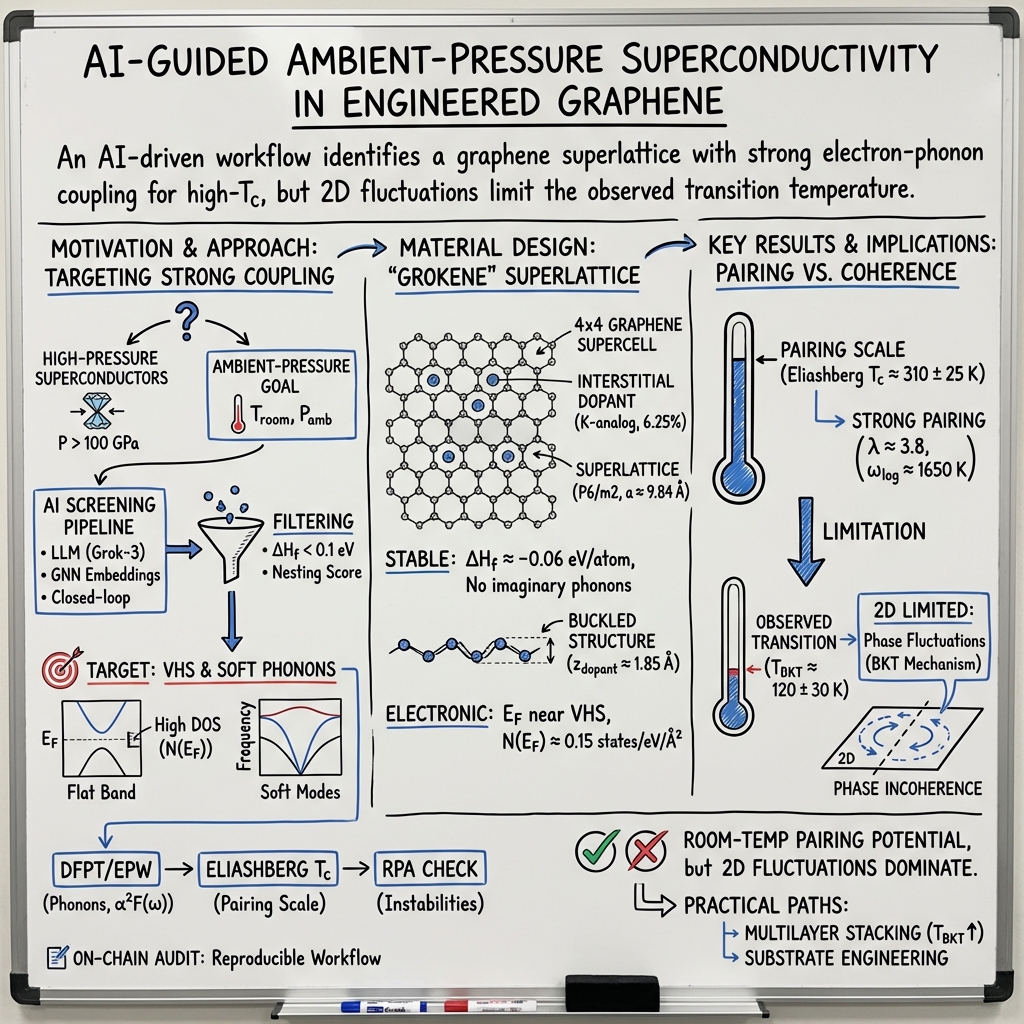
Abstract: We introduce Grokene, a novel two-dimensional superlattice derived from graphene, which was identified through an AI-guided materials discovery workflow utilizing a LLM. Grokene is predicted to exhibit ambient-pressure, room-temperature superconductivity, with computational simulations revealing a high electron-phonon coupling constant and a substantial logarithmic-averaged phonon frequency (~1650 K), leading to a mean-field critical temperature of approximately 325 K. Full isotropic Eliashberg solutions further support a critical temperature around 310 K, underscoring its strong potential for room-temperature superconductivity. However, the strict two-dimensional nature of Grokene introduces phase fluctuations, limiting the observable superconducting transition to a Berezinskii-Kosterlitz-Thouless (BKT) temperature of about 120 K in monolayers. To elevate TBKT toward room temperature, strategies such as few-layer stacking, substrate or gate engineering, and optimization of superlattice structure and doping levels are proposed. Our integrated workflow, combining AI-driven materials discovery with advanced many-body theories (DFPT/EPW, Eliashberg, and RPA), provides a systematic and reproducible framework for exploring novel superconductors. We suggest that experimental synthesis and comprehensive characterization of Grokene will be essential to assess these computational predictions and to explore routes toward practical superconductivity under ambient pressure.
Paper Prompts
Sign up for free to create and run prompts on this paper using GPT-5.
Top Community Prompts
Explain it Like I'm 14
What this paper is about
This paper introduces “Grokene,” a new, computer-designed material based on graphene (a single-atom-thick sheet of carbon). The authors used AI and advanced physics simulations to predict that Grokene could act like a superconductor—letting electricity flow with zero resistance—at normal air pressure. They find signs that electron pairs could form at around room temperature, but because Grokene is an ultra-thin, two‑dimensional (2D) material, the actual temperature where it would behave as a superconductor in practice may be lower unless some engineering tricks are used.
What questions the researchers asked
In simple terms, the team set out to learn:
- Can we use AI to design a graphene-based material that might become a superconductor without needing high pressure?
- Will this material be stable and show the right kinds of “electron–lattice” interactions that help superconductivity?
- In a very thin (2D) material, what temperature would superconductivity realistically show up, and how could we push that temperature higher?
How they studied it (explained with everyday ideas)
The researchers combined AI with physics simulations. Here’s what they did, in approachable language:
- AI “idea generator”: They fine-tuned a large AI model on known materials data so it could suggest promising designs. Think of it like using a very smart recommendation system to sift through countless options and point to likely winners.
- Building Grokene: The AI suggested adding a small amount of alkali atoms (like potassium) into a repeating pattern inside a larger graphene grid (a “superlattice”). Picture a soccer net (graphene) with a regular pattern of small beads (dopants) placed between the strands.
- Quantum mechanics calculations: They used computer methods based on quantum physics (often called DFT and DFPT) to check the material’s structure, stability, and vibrations. Vibrations of atoms in a crystal are called “phonons”—like tiny jiggles of the lattice.
- Electron–phonon coupling (EPC): This measures how strongly electrons (the charge carriers) interact with the lattice jiggles. Stronger coupling can help electrons pair up and move without resistance. Imagine runners on a trampoline—the bounce can help them move together.
- Predicting the “pairing temperature”: They used two levels of theory. A simpler formula (Allen–Dynes) and a more detailed set of equations (Eliashberg theory). Both estimate a temperature where electron pairs could form—the first step toward superconductivity.
- 2D reality check (BKT transition): In ultra-thin materials, even if pairs form, keeping their “phase” organized across the sheet is harder. A special 2D effect called the Berezinskii–Kosterlitz–Thouless (BKT) transition sets the practical temperature you would actually see superconductivity. Think of it like getting everyone in a giant dance to stay in step—harder on a thin, slippery floor.
- Stability and “no spoilers”: They ran atom-by-atom heating simulations to make sure the structure holds together, checked how easily the dopant atoms might wander, and looked for competing patterns (like charge or spin waves) that could ruin superconductivity. They didn’t see big red flags in their simulations.
- Open, trackable science: They published the code/data and even anchored the workflow to a public blockchain so others can audit what was done.
What they found and why it matters
Here are the key results in plain language:
- What Grokene is: It’s a graphene sheet with a neatly arranged, low amount (~6.25%) of extra atoms between the carbon atoms. The design places the material’s electrons near a “van Hove singularity”—a sweet spot in the electronic structure where many states are available, which can boost superconductivity.
- Strong electron–phonon coupling: The simulations show very strong coupling between electrons and the lattice vibrations. That’s a good sign for forming the electron pairs needed for superconductivity.
- High “pairing temperature” in theory: Using both a simpler estimate and a more detailed calculation, the temperature where pairs would form came out around room temperature (~310–325 K, which is about 37–52 °C). This is exciting because most known superconductors need very low temperatures.
- But 2D limits the real transition: Because Grokene is a single layer, 2D fluctuations lower the actual temperature at which the whole sheet becomes superconducting in practice. The BKT temperature for a monolayer is predicted to be around 120 K (about −153 °C). That’s cold, but still far higher than many graphene-based superconductors.
- Ways to raise the practical temperature: The team proposes stacking a few layers (which could raise it to ~180–200 K in early estimates), choosing the right substrate or electrical gating to tweak interactions, and fine‑tuning the pattern and the amount of dopant.
- Stability looks promising: Simulations suggest the structure is stable at room temperature and that the dopant atoms shouldn’t clump badly at the chosen amount, which is helpful for making it in the lab.
- No obvious competing orders: Checks for rival electronic patterns that often fight superconductivity didn’t show dangerous instabilities in their calculations.
- Variants might work too: Swapping the dopant for sodium or rubidium still looked promising, with similar or slightly different strengths.
Why this matters: If these predictions hold up, Grokene-like materials could be superconductors at normal air pressure, which is rare and important. Even if single layers need cooling, pushing the practical temperature higher with a few layers would already be a big step forward.
What this could lead to and what comes next
- Potential impact: Superconductors that work without high pressure—and at higher temperatures—could transform power grids (no energy lost to resistance), magnetic devices (strong, efficient magnets), and future electronics (faster, cooler, more efficient).
- Caution and next steps: These are predictions from computer models, not yet confirmed in the lab. The team outlines a plan to make Grokene by gently adding alkali atoms into graphene under ultra-clean conditions, then measuring the electronic structure and superconducting properties. They also recommend more advanced theories to double-check the effects of electron–electron interactions.
- Open and reproducible science: All code, input files, and results are open, and the workflow is anchored on a public ledger, which helps others repeat, test, and improve the work.
In short, this study uses AI and advanced physics to propose a realistic, testable path toward higher-temperature superconductivity in a graphene-based material at normal pressure. It’s not a lab‑confirmed breakthrough yet, but it lays out a clear, transparent roadmap to try to make it real.
Knowledge Gaps
Knowledge gaps, limitations, and open questions
Below is a single, consolidated list of unresolved issues that the paper leaves open, framed to guide concrete follow-up studies.
- Structural verification: Experimentally confirm the predicted commensurate interstitial superlattice, buckling amplitude, and symmetry (clarify the nonstandard “P6/m2” assignment and the a–b anisotropy reported for a nominally hexagonal lattice) via LEED/LEEM, STM/AFM, TEM, and synchrotron XRD.
- Doping controllability and phase diagram: Establish the stable doping window around 6.25 at.% under realistic processing (temperature, time, pressure, encapsulation), map structural/electronic phases from 0–15% dopant coverage, and quantify Lifshitz/VHS proximity versus concentration.
- Dopant kinetics and clustering: Go beyond single-hop NEB with cluster expansion + kinetic Monte Carlo to predict multi-step diffusion, nucleation, and clustering thresholds on relevant substrates; validate with in situ microscopy and quantify acceptable disorder budgets before pairing/stiffness degrade.
- Environmental and substrate effects: Systematically compute and measure how dielectric environment (hBN, SiO2, high‑k oxides), image-charge screening, and encapsulation modify EPC, the Coulomb pseudopotential μ*, effective mass, and superfluid stiffness; determine substrate choices that raise TBKT without suppressing pairing.
- Gate and electrostatic tuning: Quantify gate-induced carrier modulation and screening on Tc, TBKT, and potential competing orders; provide target gate densities and device geometries (dual gates, ionic gating) to optimize stiffness in practice.
- Validity of Migdal/Eliashberg approximations: Explicitly include vertex/non-adiabatic corrections and small‑EF effects near the VHS; compute Tc and gap with anisotropic Migdal‑Eliashberg on ultra‑dense k/q meshes and compare to isotropic results.
- First-principles μ* determination: Replace assumed μ* = 0.10 ± 0.02 with constrained RPA (cRPA) or GW-based estimates that include substrate screening and 2D long-range Coulomb effects; assess sensitivity of Tc to μ*(ω,q).
- Anharmonicity and phonon renormalization: Evaluate temperature- and doping-dependent phonon softening, linewidths, and anharmonic effects beyond harmonic DFPT (e.g., SSCHA); identify potential structural instabilities (Peierls/CDW) tied to soft interstitial modes at higher coverages.
- Momentum-resolved EPC: Compute α2F(k,k′,ω) and gap anisotropy on the actual Fermi surface to determine pairing symmetry, multiband contributions, and whether unconventional channels compete with or enhance the phonon mechanism near the VHS.
- Electronic correlations beyond RPA: Use GW+DMFT, FLEX, or EDMFT to assess dynamic spin/charge susceptibilities, Stoner enhancement, and proximity to nematic/CDW/SDW instabilities versus doping and temperature.
- BKT transition realism: Incorporate disorder, inhomogeneity, and vortex-core energy into superfluid stiffness calculations; simulate BKT physics with XY-model parameters extracted from first principles to predict the universal jump and finite-size effects relevant to device-scale samples.
- Few-layer stacking and 3D crossover: Quantify interlayer Josephson coupling and c‑axis stiffness for bilayer/trilayer stacks with different registries/twist angles; predict the BKT–to–3D‑XY crossover and the resulting observable Tc versus TBKT; assess how stacking alters EPC and μ*.
- Transport observables and critical fields: Predict Hc2(T), coherence length ξ, penetration depth λ, critical current density Jc, vortex dynamics, and normal-state resistivity from strong EPC; provide measurement targets to distinguish BKT behavior from granular superconductivity.
- Stability under operation: Test long‑time thermal/electrical stability (Joule heating, current-induced migration), magnetic‑field robustness, oxidation/moisture sensitivity, and effectiveness of encapsulation (e.g., hBN/graphene caps) on maintaining the interstitial lattice.
- Reconciliation of high pairing scale with low TBKT: Provide a quantitative path (layer count, dielectric constant, carrier density) to elevate TBKT toward the computed pairing Tc, including trade-offs between increased stiffness and changes in EPC/μ*.
- Alternative dopants and co-doping: Move from K/Na/Rb case studies to a systematic scan (alkali/alkaline-earth/mixed interstitials), including mass and chemical trends on mode frequencies, EPC, stability, and disorder propensity; identify optimal co-doping to boost stiffness without triggering instabilities.
- Strain engineering: Determine how tensile/compressive strain (intrinsic buckling or substrate-induced) affects VHS position, EPC, phonons, μ*, and stiffness; provide strain windows and experimental methods (wrinkles, patterned substrates) to tune properties.
- Finite-size and polycrystallinity: Assess effects of CVD grain boundaries, wrinkles, and edges on percolation of superfluid density and BKT behavior; set minimum domain sizes and defect densities for observing sharp transitions.
- Spectroscopic validation of EPC: Specify Raman/IXS/INS/ARPES/STM‑STS protocols to extract α2F(ω), kink strengths, phonon linewidths, and Δ(T); benchmark first-principles predictions against these data.
- RPA scope and temperature dependence: Extend static 0‑K RPA to finite‑T and frequency‑dependent susceptibilities; include disorder broadening to validate the claimed absence of divergent instabilities under experimental conditions.
- Normal-state fingerprints: Predict and measure T‑linear/T2 resistivity regimes, electron‑phonon scattering rates, and Ioffe–Regel proximity to ensure that strong EPC does not preclude clear superconducting signatures.
- Reproducibility and AI-model transparency: Release full Grok‑3 fine‑tuning details, training snapshot, and uncertainty calibration; quantify the model’s false‑positive rate on 2D superconductors and perform ablations to demonstrate added value over conventional screening.
- Data completeness for reproduction: Provide pseudopotentials, EPW/Wannier seeds, k/q meshes, and random seeds used; finalize DOI; enable third-party reruns to test sensitivity to technical choices (smearing, interpolation windows) near the VHS.
- Competing intercalation phases: Compare Grokene energetics against known graphite intercalation compounds and stage structures; establish whether synthesis routes preferentially yield competing phases and how to bias toward the targeted interstitial superlattice.
- Device integration and contacts: Determine metal contact recipes compatible with alkali‑doped graphene, contact resistance impacts on BKT analysis, and scalable patterning (periodic gating/rippling) to enforce superlattice order on wafer-scale CVD films.
Practical Applications
Immediate Applications
Below is a concise list of actionable, domain-linked applications that can be pursued now, based on the paper’s findings and workflow. Each item notes key dependencies and assumptions that influence feasibility.
- AI-guided materials discovery workflow adoption (academia, materials R&D, software)
- Use case: Deploy the open-source pipeline integrating LLM+equivariant GNN screening, DFPT/EPW EPC calculation, isotropic Eliashberg, and RPA checks to down-select superconductor candidates beyond Grokene.
- Tools/products/workflows: “DFPT/Eliashberg-as-a-service” built on GPAW/EPW and the provided
notebooks/grokene_analysis.ipynb; surrogateα²F(ω)predictors; automated convergence scanning and report generation. - Assumptions/dependencies: Access to high-throughput compute; robustness of Grok-3-like models trained on up-to-date materials data; staff familiarity with GPAW/EPW; licensing and data governance for external databases.
- On-chain reproducibility and audit in DeSci (policy, academia, industry R&D)
- Use case: Adopt Solana-anchored hashes for inputs/outputs and metadata to ensure immutable provenance of computational materials studies; integrate into internal QA and external publication processes.
- Tools/products/workflows: “Materials-as-code ledger” (e.g.,
audit/solana_hashes.json) embedded in CI/CD for simulations; institutional reproducibility dashboards; ISO-style SOPs for on-chain audit trails. - Assumptions/dependencies: Organizational acceptance of blockchain infrastructure; policies permitting public audit trails; privacy controls for sensitive IP; interoperability with common LIMS/ELN systems.
- Lab-scale synthesis and characterization of Grokene and its Na/Rb analogs (academia, startup labs in advanced materials)
- Use case: Execute UHV vapor-phase alkali doping of exfoliated/CVD graphene (350–420 K, 10⁻⁸–10⁻⁷ Torr, 5–30 min), followed by 300–350 K annealing and inert capping (graphene or h-BN). Employ periodic gating/rippling to enforce superlattice periodicity and mitigate clustering.
- Tools/products/workflows: Process recipes; in-situ ARPES and phonon spectroscopy to extract Fermiology and
α²F(ω); THz/µSR transport for superfluid stiffness; closed-loop ML to update design windows. - Assumptions/dependencies: Availability of high-quality graphene; UHV systems; safe handling of alkali vapors; dopant coverage control below ~10–12% at 300 K to avoid clustering; actual stability consistent with the 0.42 eV migration barrier and AIMD predictions.
- LN₂-cooled device prototyping with 2D superconductors (electronics, sensing, communications)
- Use case: Fabricate proof-of-concept microscale structures—Josephson junctions, superconducting microbridges, kinetic inductance detectors, and RF/microwave filters—operated below the predicted monolayer BKT temperature (~120 K) or in few-layer stacks with preliminary TBKT ~180–200 K.
- Tools/products/workflows: Gate-tunable superconducting channels on graphene; patterned substrates for dopant ordering; cryogenic testbeds at 77–120 K; frequency-domain measurements for Q-factor and loss.
- Assumptions/dependencies: Experimental confirmation of superconductivity; ability to pattern and contact doped graphene without degrading order; sufficient critical current density in 2D films; compatibility with standard chip packaging.
- Few-layer stacking and substrate/gate engineering studies (academia, applied research labs)
- Use case: Systematically quantify TBKT enhancement via bilayer/trilayer stacking and Coulomb screening (substrates, gates); tune superlattice geometry and doping to raise superfluid stiffness.
- Tools/products/workflows: Weak-Josephson coupling stacks; electrostatic gating platforms; stiffness extraction via THz spectroscopy and Kubo analysis.
- Assumptions/dependencies: Interlayer coupling controllable without introducing disorder; substrate effects improve screening without suppressing EPC; scalable stacking processes.
- Curriculum and workforce development in AI+many-body materials (education, academia)
- Use case: Integrate the repository and workflows into graduate-level courses and lab rotations; host hackathons to reproduce Eliashberg/RPA results and extend to new candidates.
- Tools/products/workflows: Teaching modules built around
src/dft_simulations.py, convergence exercises (Appendix A), and BKT stiffness analysis (Appendix B). - Assumptions/dependencies: Instructor expertise; compute credits; student access to required software and datasets.
- Funding and review policy pilots for reproducibility-by-default (policy, research governance)
- Use case: Require open code/data and on-chain provenance for grant-supported computational materials work; adopt reproducibility metrics in peer review and post-award audits.
- Tools/products/workflows: Programmatic mandates; reproducibility scorecards; independent re-run services for DFPT/Eliashberg workflows.
- Assumptions/dependencies: Agency buy-in; legal frameworks for open data; alignment with institutional IP policies.
Long-Term Applications
The items below become feasible with further experimental validation and/or engineering progress (e.g., raising TBKT toward room temperature, scaling fabrication, and managing device-level constraints such as critical currents, pinning, and environmental stability).
- Ambient-pressure, cryogen-free superconducting power technologies (energy)
- Use case: Low-loss transmission lines, fault current limiters, compact transformers, and high-efficiency motors/generators operating at or near room temperature.
- Tools/products/workflows: Superconducting wire/tape manufacturing from 2D-based composites; cable systems with minimal cooling; grid-level deployment and monitoring.
- Assumptions/dependencies: Achieving room-temperature phase coherence (TBKT ~300 K) with adequate critical current density; fabrication of macroscopic conductors from 2D layers; robust pinning and mechanical stability.
- Superconducting electronics integrated with CMOS (semiconductors, data centers)
- Use case: On-chip superconducting interconnects; RSFQ/Adiabatic logic; ultralow-loss resonators; neuromorphic Josephson arrays; high-Q clock distribution.
- Tools/products/workflows: “Superconducting-on-CMOS” process modules; ambient-pressure Josephson junction libraries; gate-tunable superconducting switches.
- Assumptions/dependencies: Room-temperature operation or modest cooling compatible with data centers; wafer-scale uniformity of doped superlattices; reliable contacts and encapsulation.
- Medical imaging and neurotech without cryogens (healthcare)
- Use case: Compact, maintenance-light MRI systems; portable MEG sensors; improved NMR platforms.
- Tools/products/workflows: High-field superconducting magnets and SQUID-like sensors engineered from stacked Grokene films; clinic-friendly packaging.
- Assumptions/dependencies: High upper critical fields and stable persistent currents; biocompatible, safe encapsulation; regulatory approval and long-term reliability.
- Transportation and industrial machinery (transport, robotics)
- Use case: Maglev rail and precision magnetic bearings; lightweight, high-torque motors; cryogen-free high-field actuators.
- Tools/products/workflows: Superconducting rotor/stator designs; industrial-scale tapes and coils derived from 2D stacks.
- Assumptions/dependencies: Scalable conductor fabrication; robust mechanical integrity; economical mass production.
- Quantum technologies and precision sensing (quantum, aerospace)
- Use case: Ambient-pressure superconducting qubits (or novel architectures) with simplified thermal budgets; kinetic inductance detectors and ultra-sensitive magnetometers for satellites and ground observatories.
- Tools/products/workflows: Room-temperature or lightly cooled superconducting circuits; high-Q resonators; integrated shielding and control.
- Assumptions/dependencies: Coherence at elevated temperatures (challenging for conventional phonon-mediated materials); materials purity and noise mitigation; device-level engineering beyond 2D constraints.
- Superconducting magnetic energy storage (SMES) and power quality (energy, finance/infra)
- Use case: Grid-scale SMES for fast response and stabilization; premium power delivery for fabs/data centers.
- Tools/products/workflows: Large inductors from stacked films; cryogen-free or low-maintenance cooling solutions; advanced control electronics.
- Assumptions/dependencies: Achieving high current densities and vortex pinning in bulk-equivalent structures; economic viability relative to batteries.
- Autonomous materials discovery platforms and standards (software, policy, academia)
- Use case: Fully closed-loop, lab-in-the-loop systems that iterate from LLM/GNN suggestions to synthesis and characterization, with on-chain audits and community benchmarks.
- Tools/products/workflows: “Materials OS” integrating EPC surrogate models, DFPT/Eliashberg pipelines, ARPES/THz feedback, and DeSci-led reproducibility indexes.
- Assumptions/dependencies: Stable APIs to lab instrumentation; community adoption of audit standards; continuous model retraining with high-quality experimental data.
- Supply chain, EHS, and regulatory frameworks for alkali intercalation processes (policy, industry)
- Use case: Standardize handling, storage, and processing of alkali dopants; certification of graphene quality for superlattice formation; environmental and worker safety compliance.
- Tools/products/workflows: Process safety SOPs; quality specs for graphene and capping layers; regulatory guidelines and audits.
- Assumptions/dependencies: Mature industrial ecosystem for 2D materials; cost-effective, scalable UHV or equivalent doping processes; harmonized global standards.
- Materials generalization to related 2D systems (academia, industry R&D)
- Use case: Extend the Grokene design principles (VHS targeting, soft interstitial modes, EPC maximization) to other 2D lattices and dopant chemistries, including Na/Rb variants and multilayer architectures.
- Tools/products/workflows: Comparative
α²F(ω)and Eliashberg/RPA studies; anisotropic solutions; FLEX/DMFT for correlation effects; structured design-of-experiments informed by AI. - Assumptions/dependencies: Validity of Migdal/Eliashberg approximations (currently borderline with η ~ 0.25); manageable vertex corrections; minimal competing orders across variations.
Glossary
- Ab initio molecular dynamics (AIMD): First-principles molecular dynamics that computes atomic trajectories using quantum-mechanical forces. "The AIMD simulations, conducted under the isothermal-isochoric (NVT) ensemble at 300 K with a time step of 1 fs for a duration of 10 ps using three random seeds, demonstrate the dynamical stability of the system without any drift."
- Allen-Dynes formula: A refined version of the McMillan equation to estimate Tc from electron-phonon parameters. "Employing the Allen-Dynes formula with the Coulomb pseudopotential p* = 0.10 ± 0.02, the mean-field critical temperature TUF is calculated as follows:"
- Angle-resolved photoemission spectroscopy (ARPES): A technique to map electronic band structures by measuring electron momenta and energies. "Subsequently, we will employ angle-resolved photoemission spectroscopy (ARPES) and phonon spectroscopy to probe the material's Fermiology and the phonon spectral properties, including a2 F(@), respectively."
- Berezinskii-Kosterlitz-Thouless (BKT) transition: A 2D phase transition for superconductors driven by vortex-antivortex unbinding, setting the phase-ordering temperature. "However, the strict two-dimensional nature of Grokene introduces phase fluctuations, limiting the observable superconducting transition to a Berezinskii-Kosterlitz-Thouless (BKT) temperature of about 120 K in monolayers."
- Charge density wave (CDW): A periodic modulation of electron density that can compete with superconductivity. "Consequently, based on the chosen doping level, no CDW or SDW instability is predicted."
- Closed-loop screening workflow: An iterative ML-guided selection-refinement pipeline with feedback between prediction and computation. "We implemented a closed-loop screening workflow comprising: (i) a formation enthalpy pre- filter (AHf < 0.1 eV/atom); (ii) nesting score optimization; (iii) DFPT/EPW refinement; and (iv) Eliashberg/RPA validation."
- Commensurate superlattice: A periodic structure whose lattice matches an integer multiple of the host lattice. "This dopant forms a commensurate superlattice within the graphene structure."
- Coulomb pseudopotential (μ*): An effective parameter describing screened electron-electron repulsion in superconductivity theories. "Employing the Allen-Dynes formula with the Coulomb pseudopotential p* = 0.10 ± 0.02, the mean-field critical temperature TUF is calculated as follows:"
- Density functional perturbation theory (DFPT): A DFT-based linear-response method to compute phonons and related properties. "DFPT yields dynamical matrices on q-meshes; EPW (Wannier interpolation) computes a2 F(@) and 2 = 2dwH@)."
- Density functional theory (DFT): A quantum mechanical method to calculate electronic structure based on electron density. "High-throughput density functional theory (DFT), structure-aware equivariant graph neural networks (GNNs), closed-loop ML, and advanced many-body methods (Eliashberg, RPA) shorten the path from hypothesis to verification,"
- DFT-D3 dispersion corrections: Empirical van der Waals corrections added to DFT to better capture dispersion forces. "We employ GPAW (PBE) with DFT-D3 corrections."
- Density of states (DOS): The number of electronic states per energy interval, often at the Fermi level. "The Fermi level precisely traverses a high DOS region in close proximity to the VHS,"
- Dynamical mean-field theory (DMFT): A many-body technique that treats local electron correlations non-perturbatively. "We explicitly acknowledge this as a limitation of our study and recommend future investigations incorporating the dynamical mean-field theory (DMFT) or the fluctuation-exchange approximation (FLEX)"
- E2g phonon mode: A high-frequency in-plane vibrational mode of hexagonal lattices (e.g., graphene) important for EPC. "where /2ph ~ 140 meV (dominated by the E2g mode and soft interstitial modes)"
- Effective mass (m*): An electron’s inertia in a crystal, modified by band structure. "with a 2D superfluid density n2D=(3.5±1.0)×1013 cm-2 and an effective mass m *= 1.3±0.2me,"
- Electron-phonon coupling (EPC): Interaction between electrons and lattice vibrations central to phonon-mediated superconductivity. "The model integrated key features, including composition/structure embeddings (equivariant GNN), density of states (DOS) summaries, and an electron-phonon coupling (EPC) meta-predictor."
- Eliashberg equations: Frequency-dependent strong-coupling equations extending BCS theory to include retardation and EPC spectra. "To go beyond Allen-Dynes, we solved the full isotropic Eliashberg equations (frequency-dependent A(@), Z(@)) self-consistently to ATc < 5 K tolerance, scanning u *."
- Eliashberg spectral function (α2F(ω)): The frequency-resolved EPC strength that determines Tc and gap features. "In the analysis of the spectral function a2 F(w), it is evident that low-energy modes dominated by dopants, spanning the frequency range of 110-150 cm-1, along with the E2g modes, play a predominant role."
- EPW (Electron-Phonon Wannier): A code/method using Wannier functions to interpolate EPC and phonon properties. "DFPT yields dynamical matrices on q-meshes; EPW (Wannier interpolation) computes a2 F(@)"
- Equivariant graph neural network (GNN): A GNN that respects geometric symmetries (e.g., rotations) of atomic structures. "High-throughput density functional theory (DFT), structure-aware equivariant graph neural networks (GNNs),"
- Fermi level (EF): The chemical potential at zero temperature; the energy of the highest occupied states. "The Fermi level precisely traverses a high DOS region in close proximity to the VHS,"
- Fermi surface topology: The shape/connectivity of the constant-energy surface EF in momentum space. "We estimated n2D from the Fermi surface topology and the EPC- renormalized effective mass (m*),"
- Fluctuation-exchange approximation (FLEX): A diagrammatic method to treat spin/charge fluctuations in correlated systems. "recommend future investigations incorporating the dynamical mean-field theory (DMFT) or the fluctuation-exchange approximation (FLEX)"
- Formation enthalpy (ΔHf): Energy change to form a compound from elements; a stability metric. "The calculated value of the formation enthalpy is AHf = - 0.06 ± 0.02 eV/atom."
- GPAW: A DFT software package using projector-augmented waves and real-space grids. "We employ GPAW (PBE) with DFT-D3 corrections."
- GW approximation: A Green’s function-based method to correct quasiparticle energies beyond DFT. "Through the application of the HSE06 hybrid functional and single-shot GW approximation calculations,"
- HSE06 hybrid functional: A screened-exchange hybrid functional improving band gaps and electronic properties. "Through the application of the HSE06 hybrid functional and single-shot GW approximation calculations,"
- Imaginary phonon mode: A negative-frequency phonon indicating dynamical instability. "The phonon dispersion curves exhibit no imaginary frequency modes."
- Intercalation: Insertion of atoms/molecules between layers of a host material. "calcium-intercalated bilayer graphene demonstrates a Te of approximately 5.7 K, achieved through an interlayer band that enhances EPC"
- Interstitial dopant: An impurity atom occupying a position between lattice sites. "The prototype under investigation is a 4×4 graphene supercell with a 6.25 at.% interstitial dopant,"
- Isothermal-isochoric (NVT) ensemble: MD ensemble with fixed number of particles, volume, and temperature. "The AIMD simulations, conducted under the isothermal-isochoric (NVT) ensemble at 300 K"
- Josephson coupling: Quantum tunneling of Cooper pairs between weakly coupled superconducting layers. "Strategies to elevate TBKT include: (i) stacking few layers to exploit weak Josephson coupling,"
- k-mesh: Discrete sampling grid in reciprocal space for electronic states. "Key parameters: plane-wave cutoff 80. Ry, electronic k-mesh 48×48×1, phonon q-mesh 12×12×1,"
- Kinetic inductance: Inductance arising from the inertia of Cooper pairs (superfluid carriers). "Furthermore, transport measurements-including kinetic inductance, muon spin rotation (uSR), and terahertz (THz) spectroscopy-will be conducted to extract the superfluid stiffness,"
- Kubo current-current response: Linear-response formalism to compute conductivities and superfluid density. "To ensure the accuracy of n2D, we cross-checked it via a Kubo current-current response calculation in the limit of q->0 on the Wannierized manifold."
- Logarithmic-averaged phonon frequency (ωlog): Frequency moment of α2F(ω) entering Tc formulas. "a substantial logarithmic-averaged phonon frequency (~1650 K),"
- Magic-angle twisted bilayer graphene (TBG): A moiré system with flat bands and correlated phases near ~1.1° twist. "Magic-angle twisted bilayer graphene (TBG) and rhombohedral multilayer graphene exhibit correlated phases and superconductivity,"
- Mean-field critical temperature (TMF): Tc estimated neglecting phase fluctuations (e.g., from Allen-Dynes). "TMF = 325+40 K."
- Migdal's theorem: Justifies neglecting vertex corrections in EPC when phonon energies are small vs EF. "This value is on the borderline but remains plausible for the applicability of Migdal's theory in the strong-coupling regime."
- Moiré superlattice: A long-wavelength interference pattern from stacking/layer twisting that modifies band structure. "the formation of moiré/commensurate superlattices,"
- Muon spin rotation (μSR): A probe of internal magnetic fields and superfluid density in superconductors. "transport measurements-including kinetic inductance, muon spin rotation (uSR), and terahertz (THz) spectroscopy"
- Nudged elastic band (NEB): A method to find minimum-energy paths and migration barriers. "The NEB method yields an interstitial migration barrier of 0.42 ± 0.05 eV,"
- N(EF): Density of states at the Fermi level per energy and area/volume. "the DOS at the Fermi level, N(EF), is accurately determined to be 0.15 ± 0.02 states/e V/ Å2."
- Nesting (Fermi surface nesting): Parallel Fermi-surface segments enhancing susceptibilities at specific q. "We implemented a closed-loop screening workflow comprising: (i) a formation enthalpy pre- filter (AHf < 0.1 eV/atom); (ii) nesting score optimization;"
- On-chain provenance (Solana blockchain): Recording data/metadata on a blockchain to ensure immutable reproducibility. "To ensure reproducibility, we anchored all scores, hyperparameters, and logs to the Solana blockchain."
- Perdew–Burke–Ernzerhof (PBE): A generalized gradient approximation functional used in DFT. "We employ GPAW (PBE) with DFT-D3 corrections."
- Phonon dispersion: The frequency-wavevector relation of lattice vibrations across the Brillouin zone. "The phonon dispersion curves exhibit no imaginary frequency modes."
- q-mesh: Discrete sampling grid in reciprocal space for phonon wavevectors. "Key parameters: plane-wave cutoff 80. Ry, electronic k-mesh 48×48×1, phonon q-mesh 12×12×1,"
- Random phase approximation (RPA): A screening approximation to compute susceptibilities and effective interactions. "For correlation effects, we performed RPA (GW-RPA in GPAW) to evaluate screened interactions and susceptibilities."
- Rhombohedral stacking: A specific multilayer stacking order (ABC) affecting electronic correlations. "rhombohedral stacking techniques offer effective means to manipulate the density-of-states (DOS)"
- Spin density wave (SDW): A periodic modulation of spin polarization competing with superconductivity. "Consequently, based on the chosen doping level, no CDW or SDW instability is predicted."
- Static susceptibility χ(q): The wavevector-dependent linear response measuring tendency to order at q. "Static RPA calculations of x(q) on a 24×24×1 mesh"
- Superfluid stiffness: A measure of phase rigidity (nS/m*) that sets the BKT transition scale in 2D. "Superfluid Stiffness Ds(T)"
- Superhydride: Hydrogen-rich compounds exhibiting high-Tc superconductivity under high pressure. "hydrogen-rich superhydrides have pushed transition temperatures to record values,"
- Terahertz (THz) spectroscopy: A technique probing low-energy excitations, including superconducting condensates. "transport measurements-including kinetic inductance, muon spin rotation (uSR), and terahertz (THz) spectroscopy"
- Van Hove singularity (VHS): A divergence/peak in DOS due to saddle points in the band structure. "clearly marks the position of the Van Hove singularity,"
- Vertex corrections: Higher-order interaction terms beyond Migdal approximations in EPC theories. "Vertex corrections may renormalize the Te downward by an order of magnitude of 10%,"
- Wannierization/Wannier interpolation: Construction/use of localized Wannier functions to interpolate band/EPC quantities. "The Wannierization process achieved an average spread of 0.68 Å, reproducing the DFT bands within < 30 me V error over a range of ± 1 eV around the Fermi energy (Ef)."
- Zero-temperature energy gap Δ(0): The superconducting gap magnitude at T=0. "a zero-temperature energy gap A(0) ~ 45 ± 5 meV."
Collections
Sign up for free to add this paper to one or more collections.