- The paper introduces a dynamical formulation linking effective graph resistance to cumulative heat dissipation in Laplacian diffusion, unifying local and global network metrics.
- The methodology employs multiscale spectral decomposition to isolate local, intermediate, and global regimes, providing clear structural insights for various network classes.
- The approach enables continuous network optimization beyond combinatorial methods, offering practical pathways for enhancing resilience in flow-critical systems.
Effective Graph Resistance as Cumulative Heat Dissipation: A Dynamical, Multiscale Framework for Network Analysis
Introduction
The concept of effective graph resistance (EGR) has become central in network science as a quantitative descriptor that extends beyond conventional metrics such as shortest-path distance or mean path length. EGR encapsulates the aggregate “distance” between node pairs, inherently accounting for all possible connecting paths and thus embedding global connectivity and robustness properties relevant for flow processes in graphs. Notably, EGR is instrumental across settings ranging from power grid resilience and transportation infrastructure to brain networks and neural architectures. Despite its utility and mathematically elegant spectral representation, the lack of a mechanistic, physically transparent view of what determines EGR and how topological changes impact it has limited its interpretability and optimization.
The paper "Effective Graph Resistance as Cumulative Heat Dissipation" (2601.00330) elucidates a new dynamical formulation of EGR based on the total heat dissipated during Laplacian-driven diffusion processes. This approach yields multi-scale insight into the Laplacian spectrum’s role, connects microscopic resistance to global structure, and underpins new, continuous topological optimization principles previously inaccessible due to the combinatorial intractability of directly manipulating EGR.
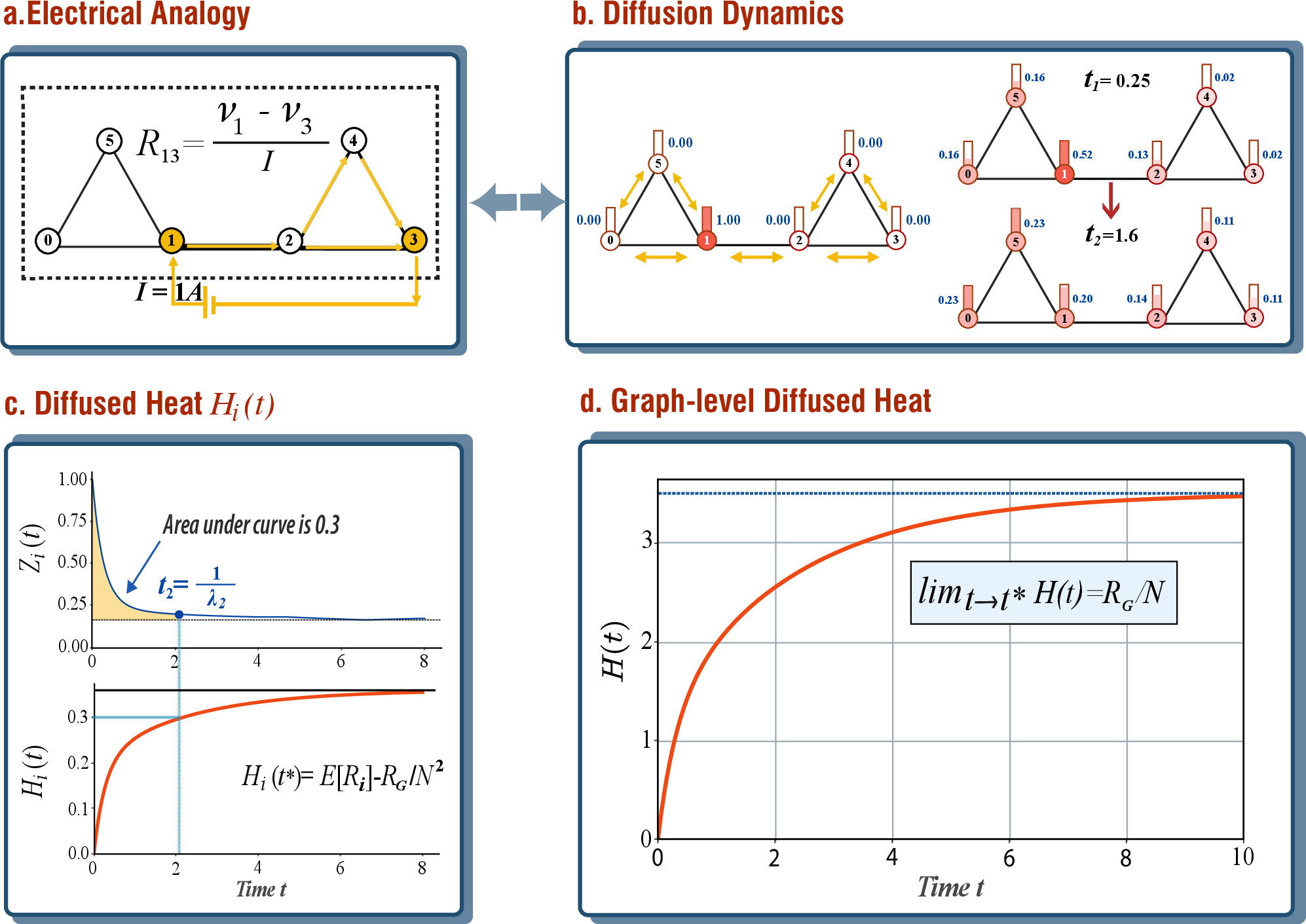
Figure 1: Effective graph resistance as the cumulative heat dissipation of diffusion dynamics.
EGR, classically defined via the Laplacian pseudo-inverse or as a sum over inverse nontrivial eigenvalues, integrates all paths connecting every node pair. While these spectral approaches compactly encode global structure, they obscure the underlying physical mechanisms by which structural attributes determine flow robustness and communicability.
This work provides a precise dynamical interpretation of EGR: for a network equipped with Laplacian diffusion, the total amount of heat dissipated by the process—i.e., the area under the off-stationary trace of the diffusion operator as the system relaxes to equilibrium—is exactly RG/N, where RG is the effective graph resistance and N the network size. Notably, the cumulative heat dissipated by an initially activated node i converges to its mean effective resistance to all other nodes, meaning that the microscopic transfer process and global resistance are directly coupled.
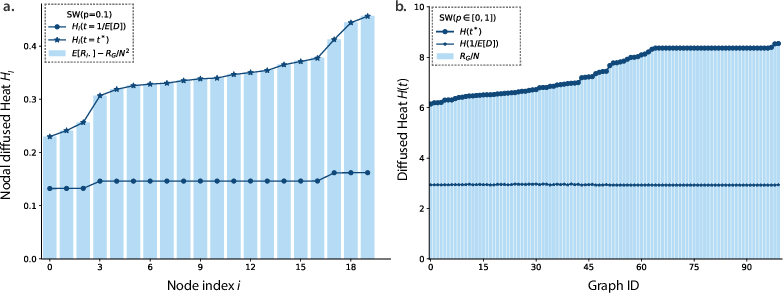
Figure 2: Cumulative heat dissipation H(t) of diffusion dynamics equals the effective graph resistance RG/N.
Empirical and theoretical verifications demonstrate that this dynamic formulation reproduces the spectral definition across diverse synthetic and empirical network classes, including small-world, random, scale-free, and community-structured graphs, as well as real-world infrastructural systems.
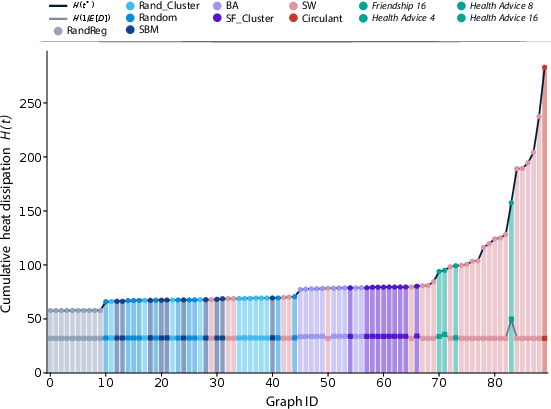
Figure 3: Cumulative heat dissipation equals the effective graph resistance RG/N across a wide range of networks.
Multiscale Spectral Decomposition
A central contribution of the paper is the explicit multi-timescale decomposition of the spectrum’s role in heat dissipation and thus EGR determination. The rate and regime of dissipation are governed as follows:
- Local regime: At short diffusion times (t→0), dissipation is dictated solely by local vertex degrees; all Laplacian eigenvalues contribute equally, and the behavior reflects only edge count and degree heterogeneity.
- Intermediate regime: As time increases (t>1/E[D]), high-frequency (large eigenvalue) contributions are exponentially suppressed, with the dynamics dominated by eigenvalues below the spectral mean. This region is sensitive to mesoscopic structural bottlenecks and community structure.
- Global regime: For late times (t≫1/λ2), the smallest nonzero (algebraic connectivity) eigenvalue, λ2, overwhelmingly dictates the decay behavior, capturing the slowest, global diffusion mode.
This multiscale framework enables the isolation of distinct structural determinants of EGR and yields interpretable routes for modifying network architecture at relevant scales.
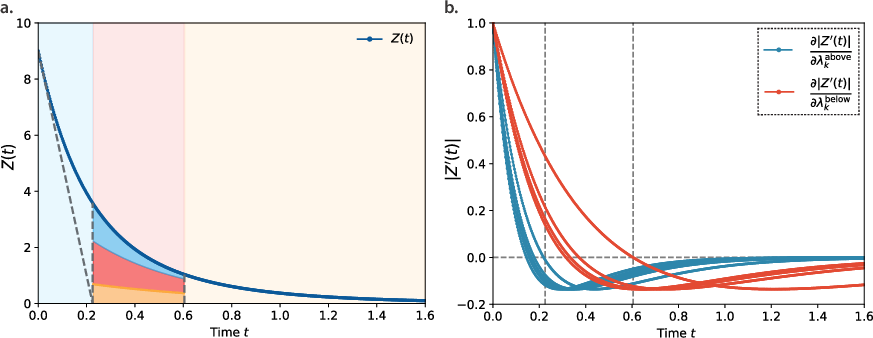
Figure 4: Multi-scale properties associated with cumulative heat dissipation H(t), highlighting transitions between local, intermediate, and global spectral regimes.
Algorithmic Optimization and Structural Guidance
Direct optimization of EGR is NP-hard under combinatorial rewiring. The continuous, spectral nature of cumulative heat dissipation provides a physically-anchored, multi-objective basis for network modification:
- In the local regime, improvements are blocked due to degree and edge-count invariance among candidate graphs.
- In the intermediate regime, EGR is minimized by compressing the low-frequency spectrum below the mean (reducing spread among small nonzero eigenvalues), eliminating Laplacian outliers, and promoting mesoscopic integrability.
- In the global regime, maximizing λ2 can further reduce EGR, but only up to a synergy threshold where joint manipulation of the entire low-frequency band is beneficial.
This enables the design of ensembles with fixed degree sequences that systematically optimize (or constrain) global resistance via spectral shaping, e.g., in stochastic block models via modulation of inter/intrablock connectivity asymmetry.
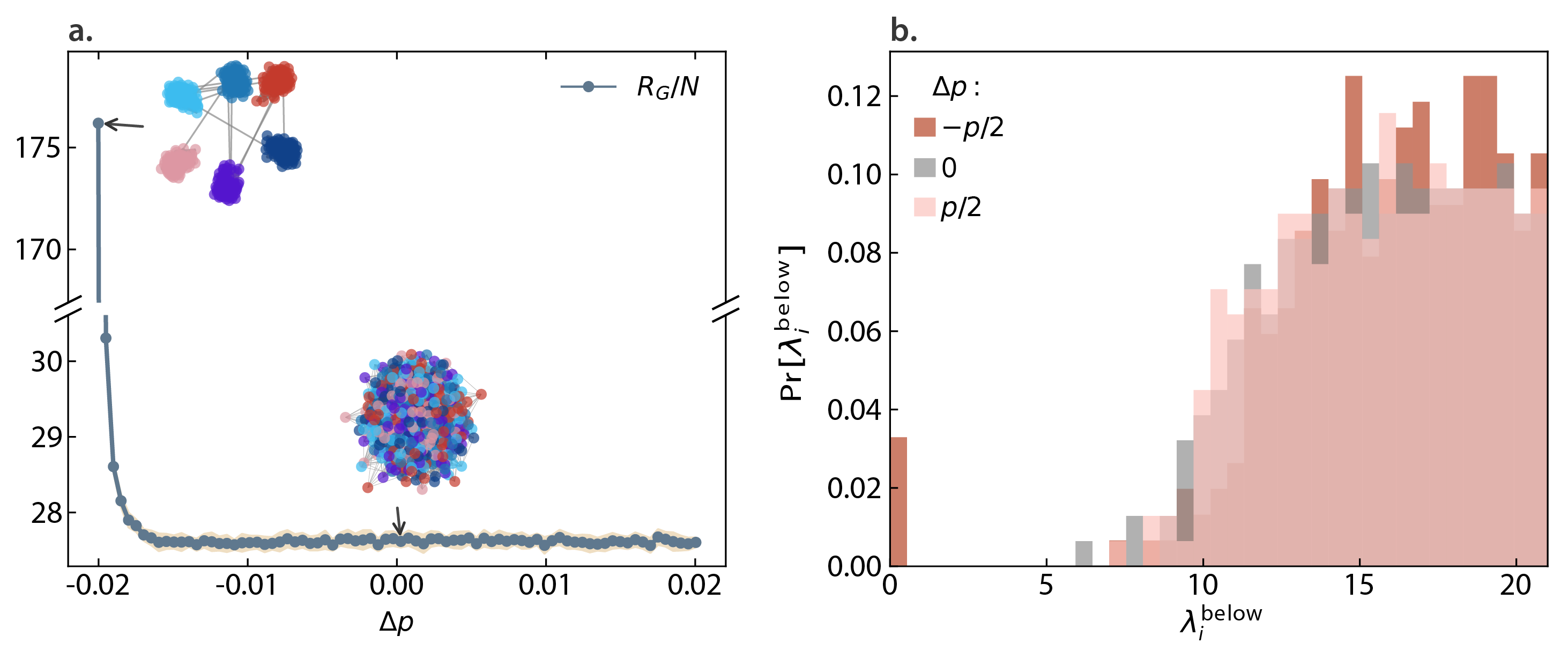
Figure 5: Cumulative-heat--based optimization by tuning intra–inter block asymmetry in stochastic block models, illustrating spectrum compaction and associated EGR reduction.
An essential outcome is that EGR, as quantified by cumulative heat dissipation, encodes structural information that is not reducible to or predictable from basic network statistics (e.g., degree, clustering, shortest-path length, spectral ratios). For fixed (N,L), networks with identical conventional descriptors can exhibit substantial variation in EGR. This property highlights the inability of single-scale, local or shortest-path-based measures to capture global flow robustness and motivates the preference for EGR-derived diagnostics in flow-critical systems.
Implications and Future Directions in Theoretical and Applied Network Science
This formulation bridges a significant conceptual gap by unifying structural and dynamical approaches to network analysis. The multiscale, dynamical metric enables novel topological optimization beyond combinatorics, provides direct physical interpretation for network robustness, and offers new routes for ensemble design tailored to specific flow or diffusion properties. In practical domains, this implies improved strategies for designing resilient power grids, efficient transportation or logistic webs, robust brain-like architectures, and scalable communication or biological networks.
Furthermore, this framework sheds light on how specific spectral signatures correlate with epidemic spreading, synchrony fragility, or diffusion inefficiency, highlighting vulnerabilities that are invisible to more conventional metrics. The approach also lends itself to integration with higher-order network formalisms and multi-layer structures.
Conclusion
By establishing the equivalence between effective graph resistance and cumulative heat dissipation under Laplacian diffusion, the paper grounds a fundamental network property in an operational dynamical process. The resulting multiscale, spectral framework enhances interpretability and enables algorithmic advances in network optimization and analysis. The implications span from refined theoretical understanding to directly implementable strategies for designing, diagnosing, and controlling complex systems where robust, distributed flows are essential (2601.00330).