CropNeRF: A Neural Radiance Field-Based Framework for Crop Counting
Abstract: Rigorous crop counting is crucial for effective agricultural management and informed intervention strategies. However, in outdoor field environments, partial occlusions combined with inherent ambiguity in distinguishing clustered crops from individual viewpoints poses an immense challenge for image-based segmentation methods. To address these problems, we introduce a novel crop counting framework designed for exact enumeration via 3D instance segmentation. Our approach utilizes 2D images captured from multiple viewpoints and associates independent instance masks for neural radiance field (NeRF) view synthesis. We introduce crop visibility and mask consistency scores, which are incorporated alongside 3D information from a NeRF model. This results in an effective segmentation of crop instances in 3D and highly-accurate crop counts. Furthermore, our method eliminates the dependence on crop-specific parameter tuning. We validate our framework on three agricultural datasets consisting of cotton bolls, apples, and pears, and demonstrate consistent counting performance despite major variations in crop color, shape, and size. A comparative analysis against the state of the art highlights superior performance on crop counting tasks. Lastly, we contribute a cotton plant dataset to advance further research on this topic.
Paper Prompts
Sign up for free to create and run prompts on this paper using GPT-5.
Top Community Prompts
Explain it Like I'm 14
Explaining “CropNeRF: A Neural Radiance Field-Based Framework for Crop Counting”
What is this paper about?
This paper is about a new way to count crops (like cotton bolls, apples, and pears) growing on plants and trees by using many photos to build a 3D model. The method, called CropNeRF, is designed to handle tricky situations in real fields—like leaves blocking the view or fruits clumping together—so farmers can get accurate counts without lots of hand-tuning or special settings for each crop.
What questions are the researchers asking?
The researchers wanted to find out:
- How can we count individual fruits accurately when they are hidden behind leaves or clustered together?
- Can we use a 3D model built from regular photos to tell where one fruit ends and another begins?
- Can one method work well for different kinds of crops (different shapes, sizes, and colors) without changing a lot of settings?
How does their method work?
First, here’s a quick idea of the tools they use:
- “2D instance masks” are like colored outlines drawn around each fruit in a photo.
- A “NeRF” (Neural Radiance Field) is a smart 3D model built from many photos taken from different angles. Think of it like stitching all the pictures together so you can “look around” the plant in 3D.
- A “point cloud” is a 3D set of dots that shows where things are in space—like a dot-based sculpture of the plant and fruits.
Below is a simple step-by-step view of the approach:
- Take many photos from different angles
- You walk around the plant/tree and snap lots of pictures.
- Reconstruct the plant in 3D (NeRF)
- The computer learns how the scene looks from any direction, producing a realistic 3D view.
- It also learns which parts are fruits vs. not-fruits (this is called a “semantic field”).
- Make two point clouds
- One for the whole scene (plant, leaves, branches, fruit).
- One just for the fruit.
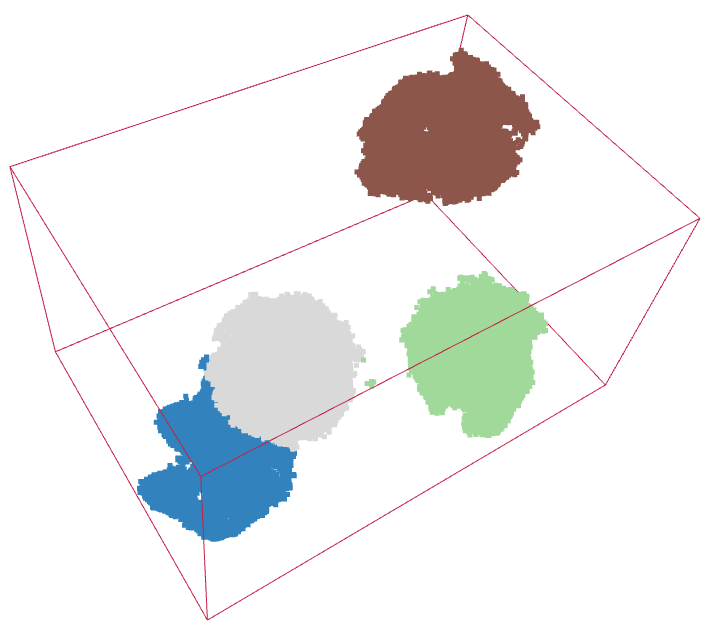
- Split the fruit point cloud into small groups
- First, it splits the fruit points into big chunks that are far apart (so separate clusters don’t get mixed).
- Then, each big chunk is split into several smaller “subclusters.”
- Think of breaking a bunch of grapes into little groups of nearby dots so no piece is too large. This makes it easier to tell individual fruits apart later.
- Score how much of each subcluster is actually visible in each photo (visibility)
- If leaves or branches are blocking part of a subcluster from a camera view, its “visibility score” goes down for that view.
- This helps avoid trusting views where the camera can’t really see the fruit.
- Check how well the subcluster lines up with the picture’s fruit outline (mask consistency)
- The method compares the visible part of a subcluster with the drawn fruit outlines in the photo.
- If there’s a good match, it gets a higher “consistency score.”
- Combine those into a “reliability score”
- Reliability = Visibility × Consistency.
- High reliability means “this view likely shows this fruit clearly and correctly.”
- Merge subclusters into individual fruits
- The method looks across all photos and uses the reliability scores to decide which subclusters belong together.
- It builds a kind of “friendship graph” where subclusters that repeatedly match the same fruit in different photos form a group.
- Each group becomes one counted fruit.
What did they find?
- It works across different crops: cotton bolls (irregular shape and size), apples, and pears.
- It is more accurate than other 3D methods they compared against (including a prior system called FruitNeRF), especially on harder cases like cotton where fruits vary a lot in size and cluster tightly.
- It doesn’t require careful, crop-specific tuning. The same settings worked across cotton, apples, and pears.
- It handles messy labels from 2D segmentations (for example, when two fruits are mistakenly outlined as one, or when a fruit is missed). The visibility and consistency ideas downweight bad or confusing views, making the final count still correct.
- You don’t need masks for every single photo. In tests, using about 15–30 masked images (out of ~150) was often enough for accurate counting.
- The choice of how many subclusters to create is not very sensitive. After a small number, the final counts stayed stable.
Why is this important?
- Better planning for farming: Accurate counts help estimate yield, schedule harvests, and plan storage and shipping.
- Less manual labor: Instead of people walking around counting fruits by hand (which is slow and error-prone), the system automates it using photos.
- Works in real fields: It is robust to leaves blocking the view, different lighting, and different fruit shapes and sizes—common challenges outdoors.
- Future-ready: The authors suggest adding other sensors (like thermal or plant-health cameras) and exploring faster 3D methods to make it even more practical.
Final takeaway
CropNeRF turns multiple photos into a smart 3D understanding of plants and uses careful scoring to decide what’s visible and what’s consistent across views. This lets it count individual fruits accurately, even when they are partially hidden or clustered together, and it does so reliably across very different crops without lots of fiddly settings.
Knowledge Gaps
Knowledge gaps, limitations, and open questions
Below is a single, consolidated list of the key issues the paper leaves unresolved—each item is phrased to be concrete and actionable for follow-up research.
- Dependence on 2D instance masks: quantify how counting accuracy degrades with mask quality, missing instances, and label noise; evaluate fully automated mask generation (e.g., zero-shot SAM, crop-specific segmenters) and reduce manual bounding-box prompting via active learning or semi-supervised methods.
- Minimal annotation requirement: determine the true minimum number and distribution of masks needed per scene (beyond the empirical 15–30) and develop an adaptive stopping criterion that uses reliability scores to decide when sufficient masks have been collected.
- Viewpoint planning: design and evaluate strategies (e.g., next-best-view, active data collection) that choose camera poses to maximize subcluster visibility and mask reliability under occlusions and canopy density.
- Robustness to camera pose errors: systematically perturb extrinsics/intrinsics and quantify sensitivity of reconstruction, visibility estimation, and final counts; explore joint pose refinement within NeRF or pose uncertainty modeling.
- Scalability and deployment: assess end-to-end runtime, memory, and energy on edge/on-robot platforms; benchmark on larger orchards (multi-row, multi-tree) and propose incremental or streaming reconstructions suitable for continuous field operation.
- Dynamic scenes: evaluate performance under wind-induced motion and temporal changes; study dynamic-NeRF variants or motion compensation to maintain reliable visibility and occlusion modeling.
- Occlusion modeling fidelity: analyze the accuracy of z-buffer–based occlusion when the environment point cloud is sparsely sampled; compare against ray marching/volumetric occlusion and quantify how projection resolution and sampling density affect visibility and reliability scores.
- Degenerate projections: define and validate handling for cases where the occlusion-free projection area of a subcluster is near-zero (e.g., extreme grazing angles); add regularization or minimum-area thresholds to stabilize reliability estimates.
- Semantic field supervision: investigate training with partial, noisy, or sparse semantic labels (semi/weakly supervised NeRF semantics) and whether instance-aware semantic fields can reduce reliance on external 2D instance masks.
- Clustering parameters: provide automatic, scale-aware selection of DBSCAN eps/min_points and k-means K per supercluster; quantify sensitivity across crops, plant sizes, and camera scales, and propose data-driven heuristics or Bayesian model selection.
- Subcluster granularity guarantees: ensure very small crops or thin structures are covered by at least one subcluster; develop adaptive subcluster sizing or multi-resolution partitioning and test failure cases where instances fragment across too many/few subclusters.
- Graph merging algorithm: clarify how negative affinities are handled in label propagation (which commonly assumes non-negative weights); compare with alternative community detection (e.g., spectral clustering, Louvain, correlation clustering) and provide theoretical/empirical guarantees for correct instance partitioning.
- Affinity formulation: explore alternative affinity functions beyond r_ij r_i'j with a sign flip (e.g., probabilistic models, margin-based losses, calibrated reliability); quantify improvements and failure modes for tightly clustered or highly occluded instances.
- Generalization breadth: extend evaluation to denser, more irregular cluster crops (e.g., grapes, tomatoes, berries) and to additional growth stages and canopy structures; identify crop-specific failure modes and necessary adaptations.
- Fair comparisons with 3DGS: run controlled, same-environment comparisons between NeRF-based and 3D Gaussian Splatting pipelines (including outdoor, occlusion-heavy cotton) to isolate modeling trade-offs in reconstruction fidelity, speed, and counting accuracy.
- Multimodal sensing integration: design and validate architectures that fuse RGB with NIR/NDVI, thermal, or depth to improve visibility estimation and semantics under dense canopy; address calibration, alignment, and training strategies for multi-sensor NeRFs.
- Scale normalization: document and standardize coordinate scaling (e.g., metric recovery from Spectacular AI or COLMAP) and analyze how scale errors propagate to DBSCAN eps, k-means K, and visibility area computations.
- Reliability score calibration: study the statistical properties of the reliability score (bias, variance) across views and occlusion conditions; propose confidence measures or Bayesian uncertainty estimates to accompany counts.
- Quantitative occlusion benchmarks: create synthetic and real datasets with controlled occlusion levels and ground-truth 3D instance labels to rigorously evaluate visibility modeling and segmentation under varying canopy densities.
- Dataset size and diversity: expand beyond 8 cotton plants and 3 apple trees (and synthetic pears) to larger, geographically diverse field sites with varied lighting, weather, and camera setups; include public ground-truth 3D instance annotations and standardized train/val/test splits.
- Reproducibility details: provide full implementation specifics (sampling densities, projection resolutions, seeds, hyperparameters), release code and trained models, and report variability (e.g., confidence intervals, error bars) across repeated runs.
- Error analysis granularity: go beyond global MAPE/RMSE to report per-cluster/per-occlusion errors, false merges/splits, and error sources (mask miss, pose error, occlusion) to target algorithmic improvements.
- Robust handling of missed detections: investigate recovery mechanisms when masks miss instances (e.g., leveraging 3D shape priors, semantic field cues), and quantify the relationship between 2D detection recall and final counting accuracy.
- End-to-end pipeline variants: explore training a single model that jointly optimizes semantics, instance grouping, and visibility (e.g., differentiable clustering/graph partitioning within NeRF) to reduce reliance on heuristic post-processing.
Practical Applications
Practical Applications of CropNeRF
Below is a structured synthesis of actionable, real-world applications that follow from the paper’s findings, methods, and innovations. Each item includes sector(s), possible tools/products/workflows, and key assumptions/dependencies that may affect feasibility.
Immediate Applications
These applications can be deployed now with currently available tools (e.g., smartphones/drones for data capture, SAM for instance masks, pose estimation via Spectacular AI/COLMAP, and GPU/cloud resources for NeRF training).
- Precision yield estimation and harvest planning
- Sector: Agriculture (orchards, row crops); Supply chain
- Tool/product/workflow:
- Mobile capture of multi-view RGB images per plant/tree (smartphone or handheld camera)
- Pose estimation via Spectacular AI or COLMAP
- Instance masks via SAM (prompted by bounding boxes)
- CropNeRF pipeline produces per-instance counts and 3D cluster maps
- Integrate outputs into orchard management software to forecast yields and plan harvest windows
- Assumptions/dependencies:
- Sufficient multi-view coverage; typically 15–30 usable masks per plant/tree suffice
- Reliable pose estimation in outdoor conditions
- Cloud/edge GPU access (≈12 minutes per cotton plant on A100; apples/pears may take longer)
- RGB-only limitations under dense canopy
- Labor and equipment scheduling
- Sector: Agriculture (operations); Logistics
- Tool/product/workflow:
- Use per-tree/plant counts to assign pick crews, schedule equipment, and sequence field operations
- Generate block-level summaries from plant-level outputs
- Assumptions/dependencies:
- Stable counts across plants
- Integration with existing scheduling tools (ERP/field ops software)
- Targeted thinning, pruning, and precision input application
- Sector: Agriculture (crop management)
- Tool/product/workflow:
- 3D instance segmentation maps highlight dense clusters for thinning
- Use occlusion-aware projections to plan pruning cuts and reduce double-counting
- Overlay outputs onto GIS or farm management maps
- Assumptions/dependencies:
- Accurate 3D reconstructions in foliage-heavy scenes
- Field crews trained to interpret/act on 3D maps
- Academic field phenotyping and agronomic trials
- Sector: Academia (plant sciences, computer vision); Breeding
- Tool/product/workflow:
- Use CropNeRF for per-plant fruit/boll counts across genotypes/treatments
- Standardize phenotyping pipelines with open-source code and the cotton dataset
- Minimal parameter tuning across species (apples, pears, cotton)
- Assumptions/dependencies:
- Access to capture devices, SAM prompts, and GPUs
- Consistent protocols for multi-view capture
- Offline planning for robotic harvesting and manipulation
- Sector: Robotics (agricultural automation)
- Tool/product/workflow:
- Generate occlusion-aware 3D instance maps to select picking targets and approach angles
- Export coordinates and visibility scores to robot planners for pick-order optimization
- Assumptions/dependencies:
- Reliable handoff from reconstruction to robot coordinate frames
- Offline (non-real-time) planning acceptable
- Insurance and audit verification (pre/post-event)
- Sector: Insurance; Agriculture (risk management)
- Tool/product/workflow:
- Perform pre- and post-storm frost/hail assessments using multi-view captures; compute counts to estimate loss
- Store outputs for claims and audit trails
- Assumptions/dependencies:
- Standardized capture protocols
- Legal acceptance of photogrammetry/NeRF-based evidence
- Education and training
- Sector: Academia; Extension services
- Tool/product/workflow:
- Course modules on NeRF-based agricultural computer vision using the released cotton dataset and CropNeRF code
- Hands-on labs on multi-view capture, pose estimation, SAM prompting, and 3D instance segmentation
- Assumptions/dependencies:
- Availability of teaching GPUs/cloud credits
- Institutional adoption
- API/SDK integration for farm management platforms
- Sector: Software; Agriculture (AgTech)
- Tool/product/workflow:
- Provide an API that ingests images + poses + masks and returns per-plant counts and 3D cluster segmentations
- Plugins for popular orchard/field management suites
- Assumptions/dependencies:
- Secure data pipelines and privacy controls
- Interoperable formats (point clouds, georeferenced outputs)
Long-Term Applications
These ideas are feasible with further research, scaling, or development (e.g., faster reconstruction, automation of mask generation, multimodal sensing, or large-scale deployments).
- On-device real-time instance segmentation for autonomous harvesters
- Sector: Robotics; Embedded AI
- Tool/product/workflow:
- Replace/augment NeRF with faster 3DGS/NeRF variants or hybrid methods for on-board inference
- Use reliability scores (visibility × consistency) to drive real-time target selection and motion planning
- Assumptions/dependencies:
- Hardware acceleration (edge GPUs, ASICs)
- Efficient online pose estimation and robust segmentation without human prompts
- Drone-based whole-orchard scanning and automated counting
- Sector: Agriculture; Remote sensing
- Tool/product/workflow:
- Autonomous drone flight paths to acquire multi-view sequences per row/canopy
- Batch processing pipeline for block-level and orchard-level counts
- Assumptions/dependencies:
- Stable pose estimation at canopy scale, wind tolerance
- Flight permissions and safety compliance
- Scalable GPU/cloud infrastructure for large datasets
- Multimodal sensing integration (multispectral, NDVI, thermal)
- Sector: Agriculture; Sensing/IoT
- Tool/product/workflow:
- Fuse RGB with NDVI/thermal to detect occluded or color-similar fruits/bolls
- Improve mask consistency and visibility under dense canopy
- Assumptions/dependencies:
- Sensor availability and calibration
- Multimodal NeRF/3DGS architectures and training pipelines
- End-to-end automated mask generation (minimal human prompts)
- Sector: Computer vision; Software
- Tool/product/workflow:
- Train detectors/segmenters with weak/self-supervision and active learning to replace manual SAM prompts
- Quality metrics built on mask consistency and visibility to auto-curate labels
- Assumptions/dependencies:
- Robust generalization across crops and growth stages
- Data collection for model training and continuous improvement
- Generalization to high-density clustering crops (grapes, blueberries, tomatoes)
- Sector: Agriculture
- Tool/product/workflow:
- Adapt partitioning steps (DBSCAN + k-means) and merging strategies to very dense clusters and small objects
- Integrate shape/size priors where necessary without brittle template tuning
- Assumptions/dependencies:
- Sufficient resolution and close-range coverage for small fruits
- Handling motion (wind) and complex occlusions
- Morphology-aware digital twins and growth modeling
- Sector: Breeding; Agronomy; Simulation
- Tool/product/workflow:
- Extend CropNeRF outputs with size/volume and morphological traits
- Track per-plant growth dynamics across timepoints; link to physiological/growth models
- Assumptions/dependencies:
- Longitudinal data capture and registration
- Accurate per-instance geometry estimation and temporal consistency
- Supply chain forecasting and market analytics
- Sector: Agriculture; Finance/ERP
- Tool/product/workflow:
- Integrate plant-level counts into block-level yield models; propagate to contracts, logistics, and hedging strategies
- Dashboards for buyers/processors linking counts to delivery timelines
- Assumptions/dependencies:
- Reliable upscaling from plant to orchard
- Data sharing agreements and privacy considerations
- Water-use optimization and climate resilience planning
- Sector: Agriculture; Policy
- Tool/product/workflow:
- Use counts and growth-stage information to adapt irrigation schedules and resource allocation
- Inform extension services and farm policy recommendations for climate adaptation
- Assumptions/dependencies:
- Integration with weather/soil moisture data
- Validation linking counts to water-use efficiency outcomes
- Tractor-mounted edge devices for routine pass-by scanning
- Sector: Agriculture; Edge computing
- Tool/product/workflow:
- Cameras + compute modules mounted on tractors to capture multi-view imagery during regular field operations
- Periodic counts without dedicated capture sessions
- Assumptions/dependencies:
- Vibration and motion robustness; pose estimation on the move
- Power and ruggedization
- Crowd-sourced regional yield mapping and extension dashboards
- Sector: Agriculture; Public/Extension services
- Tool/product/workflow:
- Aggregated counts from growers (smartphone-based) to build regional yield maps
- Dashboards for extension agents to monitor risk and advise practices
- Assumptions/dependencies:
- Participation incentives
- Data harmonization and quality control
Notes on Key Assumptions and Dependencies
- Multi-view coverage: Accurate counts require enough diverse viewpoints; the paper shows 15–30 masks often suffice per plant, but larger canopies may need more.
- Pose estimation: Robust camera pose recovery via Spectacular AI/COLMAP is critical; moving foliage and uniform textures can reduce accuracy.
- Instance masks: SAM with bounding box prompts works today; end-to-end automation is a longer-term goal. Mask consistency and visibility scoring mitigate errors but cannot fully correct bad inputs.
- Compute resources: NeRF training is the main cost; cloud GPUs can enable practical runtimes, but orchard-scale deployments require batching and scheduling.
- Lighting and occlusions: RGB-only sensing has spectral limitations in dense foliage; adding multispectral/thermal will improve reliability.
- Parameter robustness: CropNeRF reduces crop-specific tuning (e.g., template sizes) and shows stability with K≥ expected instances per cluster, but extreme clustering (e.g., grapes) may still need method adaptations.
Glossary
- 3D Gaussian splatting (3DGS): A rendering/reconstruction technique that represents scenes with 3D Gaussian primitives for fast high-fidelity view synthesis. "3D Gaussian splatting (3DGS) has emerged as alternative to NeRFs."
- 3D instance segmentation: Assigning distinct labels to individual object instances directly in 3D space. "accurately enumerates individual crop instances via 3D instance segmentation."
- COLMAP: A popular structure-from-motion and multi-view stereo pipeline for reconstructing camera poses and sparse/dense 3D. "COLMAP \cite{schonberger2016structure} was used to estimate the camera poses."
- DBSCAN: A density-based clustering algorithm that discovers clusters of arbitrary shape while handling noise. "We employ DBSCAN \cite{ester1996density} to identify the superclusters based on point density without requiring prior assumptions about the number or size of the clusters."
- Disjoint set union: A mathematical operation denoting the union of disjoint subsets. "where denotes the disjoint set union"
- Intersection over union: An overlap metric for comparing predicted and ground-truth regions (IoU = intersection area divided by union area). "quantified using the intersection over union and filtered by empirical thresholds."
- K-means clustering: A partitioning algorithm that divides data into K clusters by minimizing within-cluster variance. "This is done using the k-means clustering algorithm, depicted in Fig.~\ref{fig:multiple_subclusters}"
- Label propagation algorithm: A graph-based community detection method that assigns labels by iteratively propagating them across edges. "Finally, we apply a label propagation algorithm \cite{raghavan2007near} on the graph to partition it into subgraphs that represent the individual crop instances."
- Mask consistency score: A measure of how consistently a 2D instance mask agrees with the projected 3D subcluster across views. "By integrating visibility and instance mask consistency scores"
- Mask reliability score: A confidence measure combining visibility and consistency of a subcluster’s mask in a given view. "A visual representation of computing the mask reliability score."
- Mean absolute percentage error (MAPE): An error metric expressing the average absolute error as a percentage of ground truth. "M signifies mean absolute percentage error."
- Multilayer perceptron (MLP): A feedforward neural network used to map 3D positions and viewing directions to radiance and density. "The model encodes the scene within a multilayer perceptron via mapping a position and a viewing direction to a volume density and RGB radiance ."
- Nerfacto: A NeRF variant/implementation from Nerfstudio that serves as the base renderer in this work. "Specifically, CropNeRF is based on Nerfacto \cite{tancik2023nerfstudio}, augmented with a semantic field"
- Neural Radiance Field (NeRF): A neural scene representation that models color and density as functions of 3D location and viewing direction for novel view synthesis. "NeRFs \cite{mildenhall2021nerf} are a popular methodology for 3D reconstruction."
- Normalized difference vegetation index (NDVI): A spectral vegetation index derived from near-infrared and red bands to assess plant health. "such as normalized difference vegetation index and thermal imaging"
- Occlusion-aware projection: A projection that accounts for scene depth and occluders when mapping 3D points to the image plane. "The occlusion-aware projection function is represented by and accounts for environmental elements such as the stems, foliage, and crops"
- Precision agriculture: Data-driven farm management that optimizes inputs and operations to improve efficiency and yield. "precision agriculture is a practical and effective response to these complications."
- RGBD: Color plus depth sensing, typically from sensors or camera systems providing aligned RGB and depth images. "counted sweet peppers in RGBD videos by applying Mask R-CNN"
- Root mean squared error (RMSE): A standard error metric measuring the square root of the mean of squared differences. "R stands for root mean squared error"
- Semantic field: A learned field that predicts semantic logits over 3D space to encode class-specific occupancy. "through a semantic field that predicts the spatial logits."
- Semantic NeRF: A NeRF augmented with a semantic field to jointly model geometry/appearance and semantics. "used to train a semantic NeRF model during the 3D reconstruction stage."
- Semantic segmentation: Pixel-level classification assigning a semantic label to each pixel in an image. "Semantic segmentation masks are then generated from the instance masks."
- Structure-from-Motion (SfM): A photogrammetric technique that recovers 3D structure and camera motion from multiple 2D images. "Structure-from-motion (SfM) has been employed to generate 3D point cloud reconstructions of orchards for precise crop localization."
- Subcluster affinity score: A pairwise measure indicating the likelihood that two 3D subclusters belong to the same object instance. "The affinity among subclusters is calculated based on subcluster visibility and mask consistency scores."
- Tracking-by-detection paradigm: A multi-object tracking approach that links per-frame detector outputs across time. "multi-frame techniques based on a tracking-by-detection paradigm."
- Visibility score: A measure of how much of a 3D subcluster is visible from a given camera view, accounting for occlusions. "To quantify their visibility, we assign a score to each subcluster as viewed from camera ."
- Volumetric representations: 3D scene models that encode density and color throughout a continuous volume rather than only at surfaces. "They offer high-fidelity volumetric representations without the need for extensive camera calibration."
- Weighted complete graph: A graph where every pair of nodes is connected with an edge carrying a weight, used here to encode subcluster affinities. "for each pair of subclusters in a supercluster we compute the affinity score and build a weighted complete graph."
- Wheel odometry: Estimating a vehicle’s motion by integrating wheel encoder measurements over time. "wheel odometry and depth information to enhance tracking accuracy."
- Z-buffering: A rasterization technique that uses a depth buffer to resolve visibility and handle occlusions during projection. "we employed a z-buffering technique, which is commonly used in computer graphics."
Collections
Sign up for free to add this paper to one or more collections.

