Quantum Oppenheimer-Snyder black hole evaporation and its fate
Published 30 Dec 2025 in gr-qc | (2512.24213v1)
Abstract: In this paper, we investigate the evaporation of the quantum Oppenheimer-Snyder black hole. Within a semiclassical framework, we compute the energy emission of Hawking radiation by introducing a massless scalar field as a test field, considering both minimally and non-minimally coupled cases. For the minimally coupled case, we find that loop quantum gravity effects become crucial at the late stage of the evaporation process, causing the emission rate to slow down and eventually terminate, leading to the formation of a black hole remnant. A quasi-normal mode analysis indicates the stability of this remnant. For the non-minimally coupled case, we show that the fate of the black hole strongly depends on the value of the coupling constant $ξ$. Focusing on the cases $ξ=\pm1$, we find that for $ξ=1$, the energy emission rate accelerates at late times and no remnant is formed, whereas for $ξ=-1$, the emission rate slows down and eventually terminates, resulting in a stable black hole remnant, as supported by the corresponding quasi-normal mode analysis.
The paper demonstrates that LQG corrections to the Oppenheimer-Snyder collapse halt Hawking evaporation, resulting in a stable remnant.
It employs semiclassical analysis with minimally and non-minimally coupled scalar fields and quasi-normal mode diagnostics to quantify energy emission rates.
Results indicate that remnant formation and stability depend sensitively on scalar coupling, offering insights into resolving the black hole information paradox.
Quantum Oppenheimer-Snyder Black Hole Evaporation in Loop Quantum Gravity
Introduction and Framework
This paper investigates the evaporation dynamics and final state of the quantum Oppenheimer-Snyder (q-OS) black hole, an LQG-motivated generalization of the classical Oppenheimer-Snyder gravitational collapse model. The q-OS black hole metric introduces a quantum correction proportional to αM2/r4, modifying the Schwarzschild exterior and linking the collapse dynamics to LQG-corrected Friedmann equations for the interior. This model thus captures semiclassical gravitational collapse with non-perturbative quantum gravitational effects, allowing detailed study of Hawking radiation and black hole evaporation endpoints in LQG.
A semiclassical analysis is performed for Hawking evaporation, considering emission of a massless scalar field both with minimal and non-minimal curvature coupling. The late-stage evaporation, the possibility and stability of remnants, and the role of the coupling constant ξ in non-minimal scenarios are examined using both analytic expansions and quasi-normal mode (QNM) diagnostics.
Hawking Radiation and Evaporation: Minimally Coupled Scalar Field
Black hole evaporation is initially analyzed by introducing a test, massless, minimally-coupled scalar field. The effective potential for mode propagation is extracted, and the energy emission rate via Hawking radiation is computed including the LQG-induced quantum correction parameter α. In the regime M2≫α, quantum corrections are subleading and the emission rate matches that of a classical Schwarzschild black hole. However, as the black hole mass approaches the Planck scale (M2∼α), the quantum correction term becomes dominant.
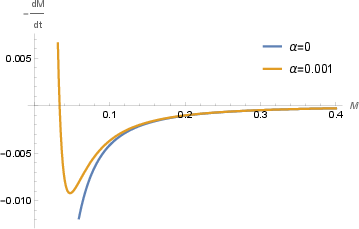
A strong numerical result of the analysis is that due to the positive correction ∝α/M4, the energy emission rate slows down at Mr=23α, eventually terminating at a nonzero final remnant mass Mfinal=223α; in stark contrast, the Schwarzschild case exhibits unbounded acceleration of evaporation and no remnant formation. This behavior is visually evident in the comparison plotted below.
Figure 1: Comparison of the Hawking radiation emission rate between the classical Schwarzschild black hole and the q-OS black hole with a minimally coupled scalar field.
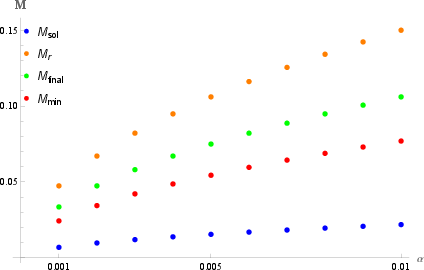
The quantum remnant forms before the black hole radius drops below the minimal semicalssical threshold, as demonstrated by a comparison of the critical masses (Mfinal, Mmin, Msol, Mr) as a function of α, confirming the robustness of remnant formation.
Figure 2: α∈[0.001,0.01]. The blue dots represent Msol.
Remnant Stability: Quasi-Normal Mode Analysis
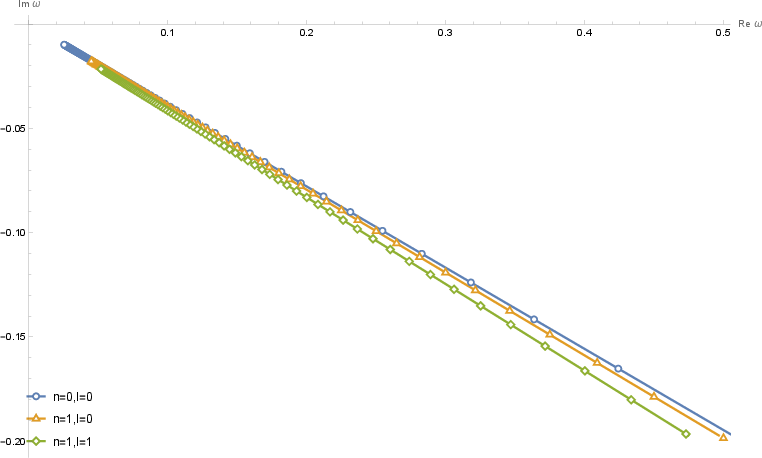
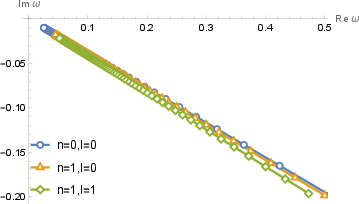
The stability of the resulting quantum black hole remnants is addressed using higher-order WKB analysis of the QNM spectrum. The imaginary part of the fundamental modes remains negative throughout the relevant regime, demonstrating dynamical stability for remnants at the quantum-corrected endpoint of evaporation.
Figure 3: The QNMs for the q-OS BH with a minimally coupled scalar field. α=0.001, M∈[0.1,10.0].
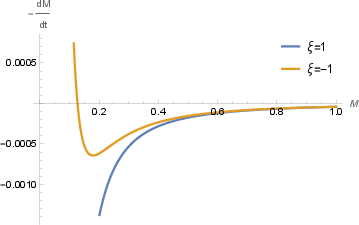
The analysis is extended by considering a massless scalar with a generic non-minimal curvature coupling parameter ξ. The late-stage evaporation is shown to be highly sensitive to the choice of ξ. The emission rate acquires an additional term ∝ξα/M4, and for ξ=1 the quantum gravity effects do not suppress evaporation; the energy emission rate continues to increase toward zero mass as in the classical Schwarzschild case, precluding remnant formation. Conversely, for ξ=−1, the quantum correction further slows evaporation, terminating at a higher remnant mass than for the minimal coupling case.
Figure 4: The energy emission rate of the q-OS BH with non-minimally coupled scalar field. The parameter α=0.001.
QNM computation for the ξ=−1 scenario again shows all relevant modes in the remnant regime are stable (Imω<0), corroborating the persistence of a stable remnant.
Figure 5: The QNMs of the q-OS BH with non-minimal scalar with the case of ξ=−1. α=0.001, M∈[0.1,10.0].
The analysis also identifies the existence of a critical coupling value ξc≈0.075: for ξ≳ξc, evaporation proceeds to zero mass, while ξ≲ξc admits remnant formation; however, at couplings near this critical value, the semi-classical approximation is expected to break down due to large quantum fluctuations, and a full quantum gravity analysis becomes necessary.
Implications and Theoretical Consequences
The main implication is that LQG-motivated quantum corrections generically halt black hole evaporation at a finite mass, yielding a stable black hole remnant over a broad range of scalar field couplings. This remnant scenario provides a concrete mechanism for information retention at the endpoint of evaporation, offering a potential (albeit speculative) resolution to the information paradox, in line with other LQG-based models [belfaqih2025hawking]. The formation and stability of quantum remnants, together with the role of matter coupling, offer a controlled setting to investigate fundamental aspects of black hole unitarity and late-stage quantum gravitational dynamics.
Additionally, the paper highlights that if the scalar field matter content is dominantly non-minimal with ξ>0.075, the standard picture of complete evaporation resuming at late times may be recovered. Thus, the specific fate of evaporating quantum black holes may depend on the detailed microphysics of matter-gravity coupling.
Practical consequences include the possibility that black hole remnants, if sufficiently long-lived or stable, could constitute a dark matter component or provide observable astrophysical signatures. However, these implications depend on the detailed cosmological scenario and the interplay with other quantum gravity effects.
Future research directions should rigorously address the full quantum gravity regime near and below the Planck mass, develop better models for quantum corrections to Hawking temperature in fully quantum backgrounds, and clarify the unitary evolution of matter fields in evaporating backgrounds beyond the semi-classical approximation.
Conclusion
This work provides a comprehensive semiclassical analysis of evaporation of quantum Oppenheimer-Snyder black holes within an LQG framework, emphasizing the fate and stability of black hole remnants. The analysis demonstrates that, for minimally or non-minimally coupled scalar fields (with ξ≤0.075), LQG effects dynamically enforce a halt to Hawking evaporation, yielding a stable and quantifiable remnant. The scenario presents strong implications for the black hole information paradox and reinforces the importance of matter coupling for the ultimate fate of quantum gravitationally evaporating systems. Rigorous quantum gravity studies of late-stage evaporation are necessary to address unresolved issues regarding unitarity and the detailed theoretical status of remnants.