Small quantum Tanner codes from left--right Cayley complexes
Published 23 Dec 2025 in quant-ph | (2512.20532v1)
Abstract: Quantum Tanner codes are a class of quantum low-density parity-check codes that provably display a linear minimum distance and a constant encoding rate in the asymptotic limit. When built from left--right Cayley complexes, they can be described through a lifting procedure and a base code, which we characterize. We also compute the dimension of quantum Tanner codes when the right degree of the complex is 2. Finally, we perform an extensive search over small groups and identify instances of quantum Tanner codes with parameters $[[144,12,11]]$, $[[432,20,\leq 22]]$ and $[[576,28,\leq 24]]$ for generators of weight 9.
The paper presents a novel construction method for quantum Tanner codes using left–right Cayley complexes, yielding CSS codes with moderate lengths.
It combines algebraic lifting and numerical searches to produce codes with high rates, low generator weights, and distances scaling with the group size.
Results indicate these codes outperform toric benchmarks at small sizes and offer promising pathways for practical quantum error correction.
Small Quantum Tanner Codes from Left–Right Cayley Complexes
Introduction and Motivation
This paper presents a comprehensive study of quantum Tanner codes constructed via left–right Cayley complexes, focusing on their explicit instantiations for moderate code lengths. Quantum LDPC codes, and specifically quantum Tanner codes, are central candidates for achieving scalable quantum error correction with high rates and large minimum distances. The motivation stems from the need to surpass standard models such as the rotated toric code and approach the performance of bivariate bicycle (BB) and lifted product codes at code lengths relevant for near-term quantum hardware (hundreds of qubits).
Construction of Quantum Tanner Codes from Cayley Complexes
The authors adopt the left–right Cayley complex framework, leading to a family of CSS codes where qubits are associated with squares of a square-complex. Generator supports are codewords from local product codes, and the overall construction is parameterized by two ordered multisets A, B of a finite group G. The local codes are chosen over F2nA and F2nB with explicit generator and parity-check matrices, yielding a base code on nAnB qubits. The central novelty is the lifting procedure, which replaces each base qubit with ∣G∣ physical qubits indexed by G, utilizing left and right regular actions to orchestrate the global stabilizer structure.
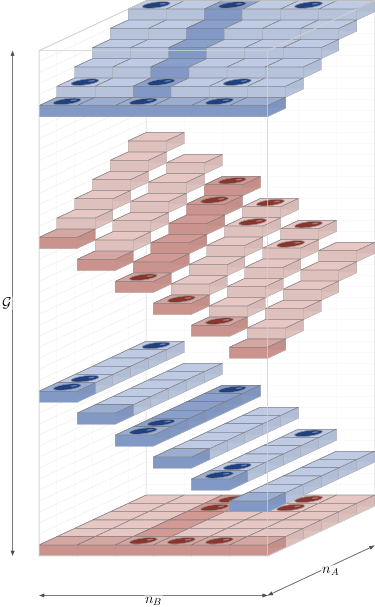
Figure 1: Three-dimensional representation of the quantum Tanner codes, with G=C46, nA=nB=6, showing how A, B, and group elements index qubits and generator supports within slices.
This algebraic description highlights how the code space and stabilizer structure are direct lifts of “local” CSS codes; however, the presence of nontrivial group symmetries complicates direct parameter analysis. The commutation among X and Z generators is guaranteed by orthogonality of the underlying local codewords.
Analytical Results: Dimension and Distance Computation
For certain parameter regimes (∣B∣=2 with repetition code locality), the authors provide a rigorous formula for the dimension of the lifted quantum Tanner code, matching that of the base code under transitivity assumptions on right multiplication in G. This tractable case highlights settings where code dimension remains robust under lifting. Generally, however, lifting can induce or eliminate logical operators, and the distance becomes difficult to analyze: while the minimum distance inherited from the base code guarantees a lower bound, the code distance can scale up to ∣G∣ times larger.
The relationship between code locality, generator weight, and potential minimum distance is also made explicit. Low-weight generators (w=6,8,9) are realized by strategic combinations of repetition and Hamming codes as the local codes, offering potentially favorable hardware implementation profiles.
Numerical Search and Explicit Code Parameters
Recognizing the infeasibility of purely analytic parameter characterization outside special cases, the authors perform an extensive computational search targeting small groups G and permutations of local codes. Gaussian elimination yields code dimensions, while the QDistRnd GAP package is used for probabilistic distance estimation.
Strong numerical results include the discovery of parameter sets such as [[144,12,11]], [[432,20,≤22]], and [[576,28,≤24]] with generator weights as low as w=9. These codes display k>n while directly matching or exceeding the distance scaling of the toric code at similar block lengths. For generator weights w=6 and w=8, the codes achieve high d2/n, indicating excellent relative performance on distances at fixed code sizes, especially for smaller n (n≤256).
The search process also establishes that targeting local codes with strong classical Tanner code distance properties is a useful, but not complete, heuristic—the quantum code structure introduces additional subtleties, especially in logical operator support and commutation relations.
Implications, Theoretical Significance, and Future Directions
This work demonstrates that quantum Tanner codes from left–right Cayley complexes, previously known for asymptotic optimality, can compete with BB and two-block group algebra codes at moderate sizes. It thereby provides explicit quasi-optimal constructions with practical generator weights for near-term quantum hardware. The results also establish the practical feasibility of generating and analyzing moderate-length quantum LDPC codes by lifting local code templates, yielding high-rate, high-distance codes.
Nontrivial theoretical challenges remain. The analysis of logical operator structure reveals that, except in limited cases, one cannot always find a basis of logicals localized to vertical slices—the code’s global symmetry and the interplay between the lifts and local code structure give rise to more delocalized logicals. Furthermore, the distance estimation for n>500 remains a computational bottleneck, and the decoding problem for these finite-sized codes is unresolved, as existing asymptotic decoders rely on robustness criteria not met for small n.
Future research directions include:
Optimizing search heuristics: Developing more effective classical Tanner code filters that better predict final quantum parameters.
Refining distance and logical operator analysis: Deeper combinatorial or algebraic methods could improve our understanding of logical support and code distance in the lifted regime.
Short code decoding algorithms: Constructing decoders suited for finite-size quantum Tanner codes by leveraging the specific algebraic and geometric code structure.
Conclusion
The paper systematically advances the explicit construction and analysis of small-to-moderate quantum Tanner codes obtained from left–right Cayley complexes. By combining an analytical study of specialized cases and a comprehensive numerical search, the authors identify instances with superior parameters compared to benchmark quantum codes at relevant block lengths. The work clarifies both the strengths and current limitations of such codes; notably, the existence of high-rate, high-distance LDPC codes with modest-weight generators, and the challenges of decoder design and analytic parameter estimation for general lifts. The approach outlined here provides a rigorous methodology to construct and evaluate quantum error-correcting codes tailored to the next generation of quantum hardware.