- The paper introduces a novel atom-clad waveguide design that integrates a laser-activated Rb pill into silicon nitride PICs for controlled vapor density.
- It establishes a low-power, pulsed activation protocol combined with optical desorption to effectively suppress rubidium-induced optical losses.
- Experimental results reveal tunable, non-equilibrium Rb spectra enabling high-sensitivity waveguide-based spectroscopy for quantum photonic applications.
Enabling Atom-Clad Waveguide Operation in Microfabricated Alkali Vapor-Photonic Integrated Circuits
Introduction
Recent developments in quantum photonic integration leverage the unique advantages of alkali atomic vapors, which facilitate strong atom-photon interactions in deployable, compact, and scalable quantum technologies. Silicon nitride-based photonic integrated circuits (PICs) integrated with alkali vapors such as rubidium (Rb) offer high optical field control, enhanced light-matter coupling, and compatibility with commercial photonic nanofabrication techniques. However, conventional methods for alkali integration—utilizing glass-blown cells, distilled alkali metals, and epoxy seals—are incompatible with modern wafer-scale photonic flows and present reproducibility and stability challenges. Critically, as device footprints shrink and Rb sources are brought into close proximity with guided photonic structures, Rb-induced degradation of optical transmission becomes a limiting factor for practical system integration.
Device Architecture and Fabrication Approach
The work establishes a 3D-integrated, compact vapor-PIC device combining silicon nitride PICs, a micro-machined borosilicate glass chamber, and a pill-based Rb source, hermetically encapsulated by anodic bonding.
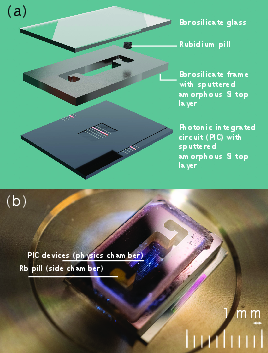
Figure 1: Schematic and photograph of the hybrid device integrating an anodically bonded borosilicate vapor cell, Rb pill, and photonic integrated circuit.
The system’s core consists of a silicon nitride PIC serving as the base layer, an etched glass frame forming the vapor chamber, and a glass lid. A Rb "pill" dispenser is placed in a side chamber connected via a channel. The compact geometry (12 × 16 × 3.5 mm) and the use of a pill source—a Rb molybdate mixture that is laser-activated—circumvents atmosphere sensitivity and complex filling protocols, providing a scalable pathway toward hybrid quantum PICs.
Experimental Setup for Controlled Rb Activation
The device operation exploits meticulous activation of the Rb source using a focused 980 nm heating laser while simultaneously monitoring Rb density and photonic transmission with free-space and waveguide-based absorption spectroscopy.
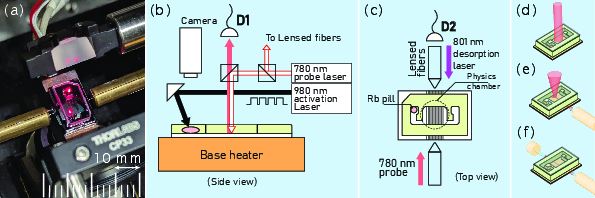
Figure 2: Experimental configuration featuring laser-based Rb pill activation, dual-mode Rb density assessment (free-space and PIC coupled), and in-situ waveguide absorption monitoring.
The setup enables real-time control and measurement of Rb atom density within the cell and at the waveguide surface, facilitating protocol optimizations to mitigate adverse Rb-PIC interactions.
Loss Mechanisms under Conventional Rb Activation
Application of standard high-power (∼1 W, multi-second) activation—typical for MEMS-based frequency standards—releases large quantities of Rb vapor that rapidly polymerize on the waveguide surface, causing irreversible insertion losses exceeding 1750 dB/cm for air-clad PIC waveguides. The resultant catastrophic increase in optical loss renders long-interaction waveguides (>100 μm) inoperative.
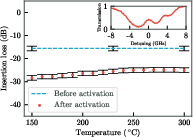
Figure 3: Temperature dependence of insertion loss in a 60 μm air-clad waveguide following standard Rb pill activation; the inset shows the spectroscopic D2 absorption at elevated temperatures.
This outcome demonstrates that standard pill activation strategies are fundamentally incompatible with delicate, surface-exposed photonic structures due to high localized Rb flux and insufficient desorption rates.
Protocol for Low-Power, Pulsed Rb Release and Density Control
To mitigate PIC degradation, a low-power, pulsed activation regime was established, using milliwatt-scale 980 nm laser pulses of adjustable duration and duty cycle.
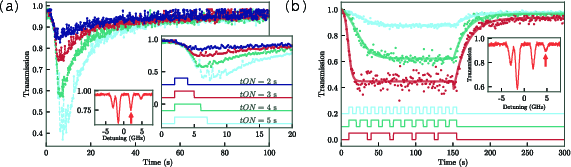
Figure 4: (a) Transient Rb density measured via transmission after single low-power activation pulse of varied duration. (b) Stable quasi-steady Rb vapor density maintained via repetitive pulsed activation.
This approach decouples the chemical equilibrium between Rb solid/vapor and cell temperature, allowing for fine-tunable, transient Rb densities orders of magnitude below classical Clausius-Clapeyron equilibrium. The resulting vapor phase is governed by both activation parameters and thermal kinetics at the glass/vapor interface.
Cell temperature modulates the chemical decomposition rate and wall desorption/adsorption dynamics, enabling additional handles for tuning transient and quasi-steady-state Rb densities. The temperature-dependent modulation of loading and recovery rates was quantitatively characterized.
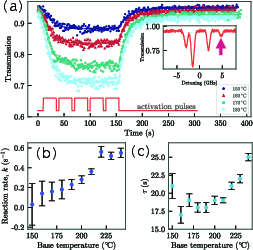
Figure 5: Temperature-dependent Rb loading and unloading dynamics with pulsed low-power activation; logistic and exponential fits extract activation and decay rate constants.
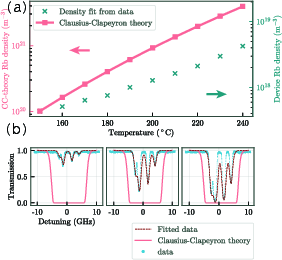
Figure 6: Comparison of experimental Rb vapor densities with predictions from the Clausius-Clapeyron equilibrium model, highlighting strong deviations at low activation powers.
Active Mitigation of Rb-Induced Waveguide Degradation
Even with optimized, low-density Rb release, atoms may adsorb on photonic surfaces. To circumvent photonic degradation, an in-situ, counter-propagating 801 nm desorption laser is coupled into the PIC waveguide. The desorption beam suppresses Rb attachment via light-induced atomic desorption and/or localized heating effects, effectively eliminating the Rb-induced loss within experimental uncertainty.
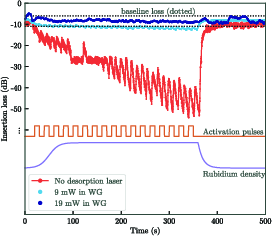
Figure 7: Insertion loss of a 3-mm PIC waveguide under varying desorption laser powers during low-power Rb pulsing, demonstrating full suppression of Rb-induced loss at 19 mW desorption power.
Waveguide-Resolved Rb Spectroscopy
With photonic integrity preserved, robust waveguide-based Rb spectroscopy is feasible in 3-mm-long air-clad waveguides. Activation pulse parameters directly control the atomic vapor density, and therefore, the observed spectral contrast within the waveguide evanescent field. The observed absorption features exhibit marked Doppler and transit-time broadening compared to reference cells, indicative of non-equilibrium, non-Maxwellian atomic velocities shaped by the pulsed release.
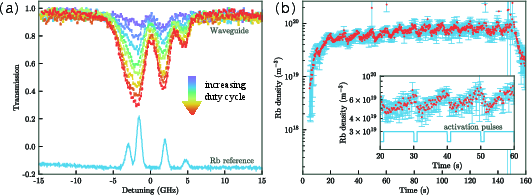
Figure 8: Rb D2 absorption spectra in a 3 mm PIC waveguide under incrementally higher Rb densities realized via activation duty cycle adjustment (a) and corresponding temporal evolution of extracted densities (b).
Spectra are analyzed using a fitting protocol based on line-strength ratios, generating temperature and density estimates aligned to a modified Clausius-Clapeyron model.
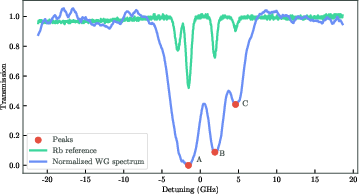
Figure 9: Normalized Rb transmission spectra through the waveguide, marking key hyperfine absorption dips used for density determination.
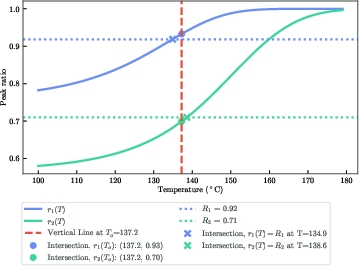
Figure 10: Ratio-metric fitting to Clausius-Clapeyron curves for deriving Rb vapor density from spectral features.
Implications and Future Directions
This study resolves longstanding trade-offs between manufacturability, controllability, and photonic stability in vapor-PIC hybrid devices. The work delivers a practical process by which chip-scale, wafer-integrated photonic devices can robustly employ alkali vapors via in-situ, transiently tuned atomic densities. The active desorption protocol, coupled with pill-based low power dosing, allows repeatable atomic spectroscopy and quantum optical measurements in extended photonic circuits—capabilities essential for quantum nonlinear optics, on-chip atomic sensing, cavity QED, and single-atom/single-photon interactions.
However, the transient nature of the vapor phase, while advantageous for contamination control and device reset, may be limiting for applications demanding stable, continuous vapor environments (e.g., long-term frequency referencing). The paper suggests that atomic layer deposition of glass surfaces could further increase device lifetimes and Rb retention, enabling even broader use cases.
Conclusion
A manufacturable, low-footprint hybrid alkali vapor-PIC platform is presented that overcomes the challenge of Rb-induced photonic loss through pulsed dispenser activation and active optical desorption. This enables sustained, high-sensitivity waveguide-based Rb spectroscopy and precise atomic density control over micro- to millimeter-scales. The approach establishes a foundation for scalable hybrid quantum photonics and chip-integrated atomic devices. Future work will likely refine surface treatment strategies and expand to resonant nonlinear and cavity-enhanced architectures, advancing the practical scope of quantum photonic integrated technologies.