- The paper reveals that birefringence-driven transverse walk-off couples sum and difference coordinates in SPDC biphoton wavefunctions.
- Key numerical simulations and experiments using a type-I BBO crystal show the emergence of wedge-shaped, asymmetric broadening in photon pair correlations.
- The findings have immediate implications for quantum imaging and high-dimensional entanglement protocols by challenging separable state assumptions.
Imaging Walk-Off Driven Distortions in EPR Photon Pair Correlations
Overview
This work presents a comprehensive theoretical, numerical, and experimental investigation of birefringence-induced transverse walk-off effects in spontaneous parametric down-conversion (SPDC) and their impact on the propagation and imaging of Einstein–Podolsky–Rosen (EPR) photon-pair spatial correlations. The analysis reveals intrinsic coupling between sum and difference coordinates in the biphoton wavefunction, persisting even in the thin-crystal regime when free-space propagation is included. These effects manifest as asymmetric, propagation-dependent broadening and tapering of spatial correlations—a regime not captured by standard separable models. The experimental results, grounded in measurements from a type-I BBO SPDC source, corroborate the theoretical predictions and simulation outcomes. The findings codify new constraints on spatial entanglement quantification and quantum imaging, with immediate implications for high-dimensional quantum information protocols.
Theoretical Framework
The standard thin-crystal approximation in SPDC assumes that the biphoton amplitude factorizes into independent functions of the sum and difference of transverse coordinates, a simplification valid in the negligible-walk-off regime. This yields analytic tractability for spatial entanglement estimation and underpins various quantum imaging techniques. However, explicit derivation within a uniaxial crystal with extraordinary-polarized pumping demonstrates that birefringence induces a transverse walk-off, leading to lateral centroid drift of the pump and consequently non-separable position-momentum coupling in the phase-matching kernel.
Crucially, the work shows that even for $1$ mm thickness—well within the conventional “thin” boundary—propagation of the joint two-photon state exposes this phase-matching-induced coupling, particularly evident near the crystal image plane. The anti-correlation width Δx− develops a linear dependence on the sum coordinate x+ and the propagation distance z, departing from the Gaussian broadening familiar in idealized treatments.
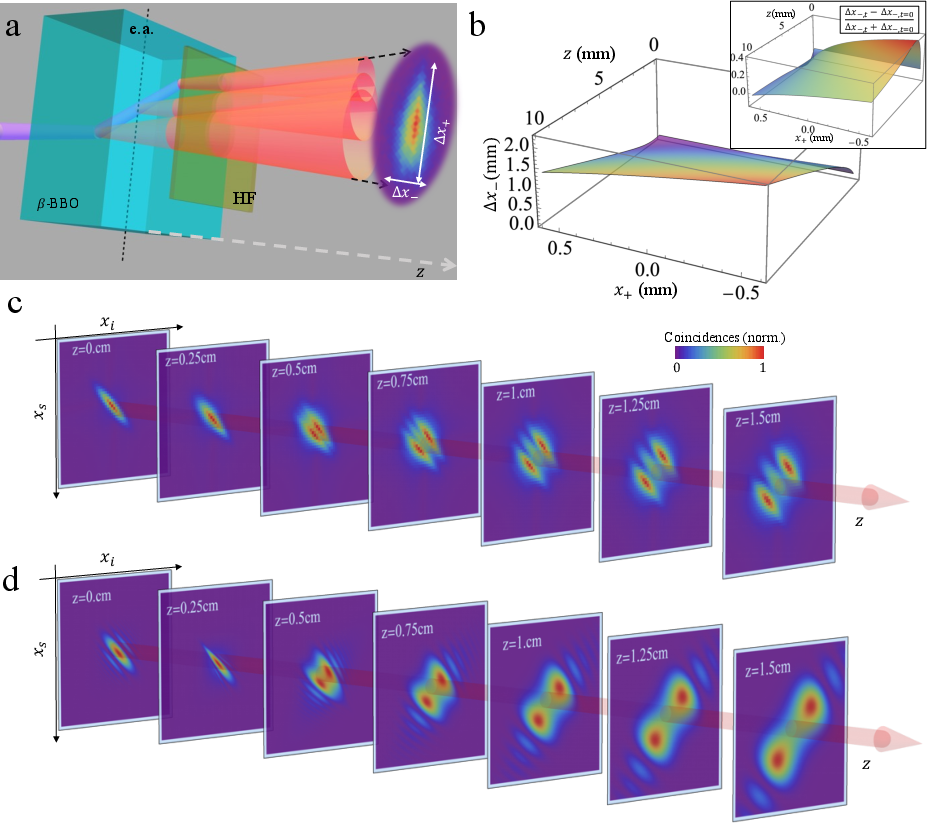
Figure 1: (a) Schematic of birefringence-induced walk-off; (b) x+-dependent anti-correlation width; (c)-(d) Numerical simulations of the propagation reveal formation of wedge-shaped correlations and sum–difference coupling.
Propagation of the biphoton Wigner function substantiates these conclusions, showing the evolution from tightly correlated photons (at crystal output) to a distinctly wedge-shaped coincidence distribution. Analytical approximations and ansatz-based wavefunction modifications, including phase curvature terms, capture the non-separability and asymmetric correlation patterns. Simulations neglecting coupling to the orthogonal (y) direction reproduce the essential physics but do not account for all quantitative experimental features.
Experimental Realization and Results
The experimental apparatus employs a pulsed $405$ nm laser to pump a $1$-mm-thick type-I BBO crystal, with correlated photons detected using a Tpx3Cam event-based camera. An imaging system records spatial correlations at various free-space propagation distances referenced from the crystal image plane. The measured joint spatial intensity distributions exhibit strong agreement with the numerical modeling, featuring clear wedge-like structures and asymmetric broadening.
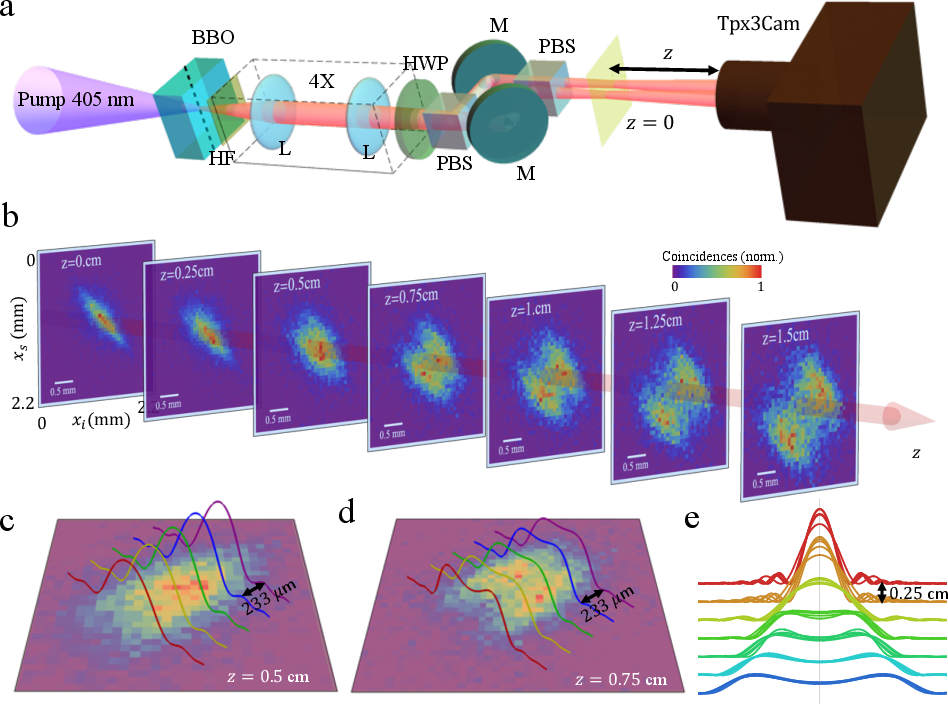
Figure 2: (a) Experimental setup; (b) measured x-axis correlations showing propagation-induced asymmetry; (c) simulation match; (d-f) one-dimensional cuts and post-selected propagation profiles mapping out phase-matching evolution.
Fitting one-dimensional slices with phenomenological models (e.g., sinc2-based functions) reveals systematic dependence of spatial correlation width on post-selected sum coordinates. With increasing propagation distance, double-lobed structures and pronounced asymmetries emerge—a direct signature of transverse walk-off. These effects are further amplified when the pump carries structured spatial modes, such as orbital angular momentum (OAM), where asymmetries in the reconstructed coincidence images invalidate naive separability-based interpretation.
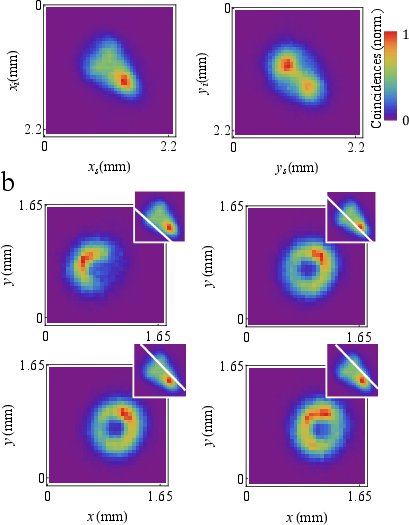
Figure 3: OAM-pumped correlations and post-selection along xi=xs+c reveal walk-off-induced pump–phase-matching convolution, with pump profile reconstruction becoming c-dependent.
Numerical Analysis
Numerical simulations leverage grid-based propagation of the biphoton Wigner function. The domain is discretized to resolve high spatial-frequency features, and passive transformations implement free-space propagation. For zero walk-off, only the diagonal structure (correlated photons) is evident and symmetric broadening ensues with propagation. In the presence of walk-off, off-diagonal lobes develop, and the marginal probability distribution acquires a wedge geometry, in full accord with experiment.
Further fitting analysis illustrates the detailed evolution of measured correlation patterns across propagation planes and summed coordinate sections, highlighting the inability of standard thin-crystal theory to capture these features.
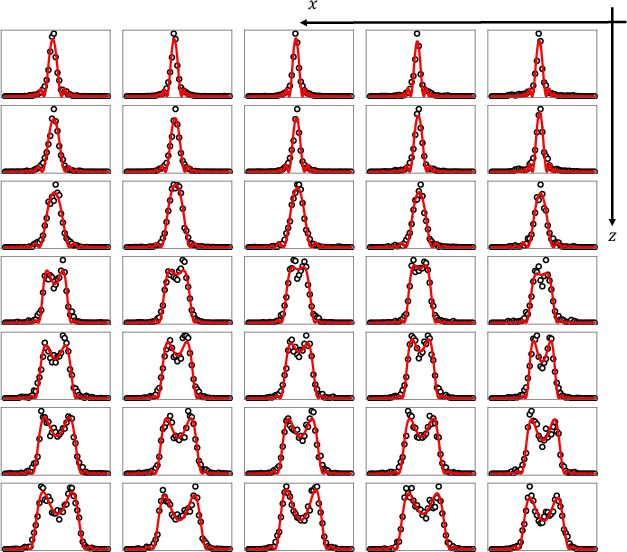
Figure 4: Comparative fits of experimental data and best theoretical models across propagation distances and summed coordinate sections.
Implications
The results directly impact quantum imaging, high-dimensional entanglement characterization, and spatial-mode quantum information processing. The emergence of sum–difference coupling due to birefringent walk-off imposes new constraints on the invertibility of pump and phase-matching characterization schemes based on coincidence imaging and post-selection. As such, protocols predicated on separable biphoton states require reevaluation in experimentally realistic scenarios involving finite walk-off, especially in tightly focused, structured-light, or thick-crystal regimes.
Practically, careful analysis of walk-off effects facilitates accurate reconstruction of underlying optical states and preserves access to the phase and intensity profiles of complex pump modes. Theoretically, the work motivates adoption of full-propagation modeling and non-separable state descriptions in SPDC-based quantum technologies.
Speculation on Future Directions
Exploration of the high-gain regime (beyond spontaneous SPDC) stands to reveal whether multimode dynamics further enhance walk-off-driven coupling and spatial distortions, possibly opening novel avenues for controlled high-dimensional entanglement engineering. Extension of the framework to dispersive, scattering, or turbulent media, as well as beyond-paraxial or tightly focused regimes, may yield generalized control and exploitation schemes for non-separable quantum correlations. A robust understanding of these phenomena will be indispensable for next-generation quantum information science and technology leveraging EPR photon states.
Conclusion
This work rigorously demonstrates that transverse walk-off intrinsically couples the pump and phase-matching contributions in SPDC, generating pronounced, propagation-dependent asymmetries within the joint spatial correlations of EPR photon pairs. Both analytic and numerical frameworks reveal that these distortions are observable under experimental conditions previously thought to be immune. The implications for quantum imaging, entanglement quantification, and information retrieval are immediate and broad-ranging, necessitating new modeling and analysis approaches for high-precision and high-dimensional photonic quantum technologies.