- The paper introduces an information-theoretic framework showing that criticality-based baskets robustly capture central nodes in citation networks.
- It compares SPC, SPE, and longest unit paths, demonstrating minimal yet statistically significant differences in path metrics across models.
- The study reveals that basket-based methods offer a computationally efficient and stable alternative to traditional path-centric approaches.
Main Path Analysis: Critical Appraisal and Theoretical Foundations
Background and Motivation
Main Path Analysis (MPA) has been used extensively in scientometrics and innovation studies to trace influential trajectories within citation networks. Historically, its justification has been rooted in expert intuition and empirical validation, rather than rigorous theoretical principles. The methodology essentially identifies citation sequences that maximize a traversal count, the number of source-to-sink paths utilizing a given edge. Despite wide adoption, foundational questions about the optimality, uniqueness, stability, and true informativeness of paths selected by MPA methods remain open.
Theoretical Developments and Methodological Comparison
This work provides a systematic dissection of main path methodology through the formalism of directed acyclic graphs (DAGs), including both synthetic (hypercubic lattice, random geometric) models with known embedding structure and over twenty real data networks. The key innovations are: (1) recasting existing variants of main path analysis, particularly the Search Path Count (SPC) and Search Path Entropy (SPE) methods, within an information-theoretic and geometric framework; (2) benchmarking their performance against simple and alternative path-finding schemes (e.g., longest unit path, greedy local algorithms, random walks); and (3) introducing basket-based approaches leveraging generalised criticality.
The authors formalize DAGs D=(V,E), defining paths, interval subgraphs, and multiple edge-weighted length schemes. For the SPC strategy, the edge weight is the total count of s→t paths traversing each edge; for SPE, it is the entropy (logarithm of the SPC count)—a direct link to microstate counting in statistical mechanics. The maximally-weighted path, under each scheme, is termed the SPC or SPE main path. The connection to classical geodesics is explicit: on regular geometries, maximizing entropy-based weights coincides with the geometric diagonal or "core" of the citation flow.
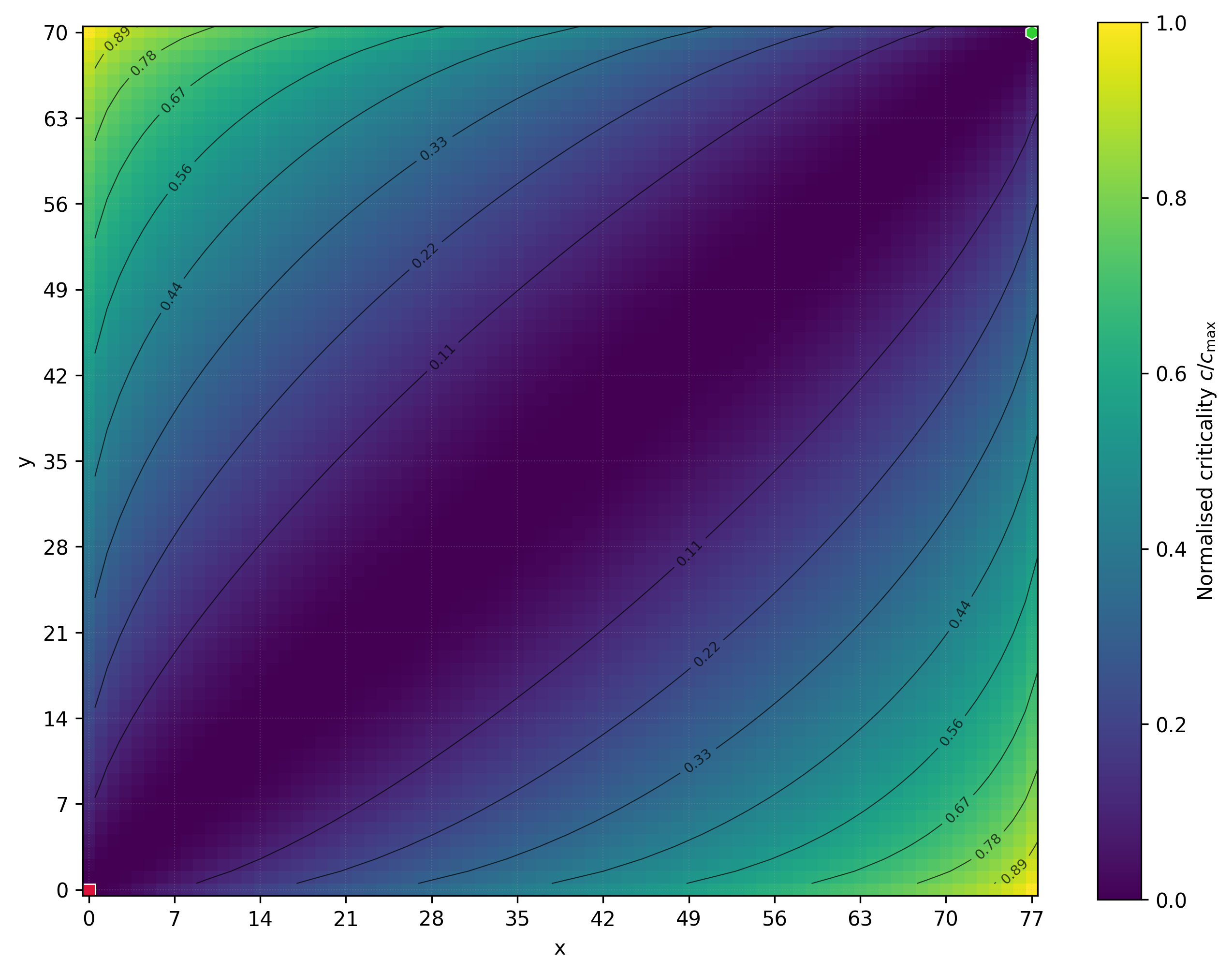
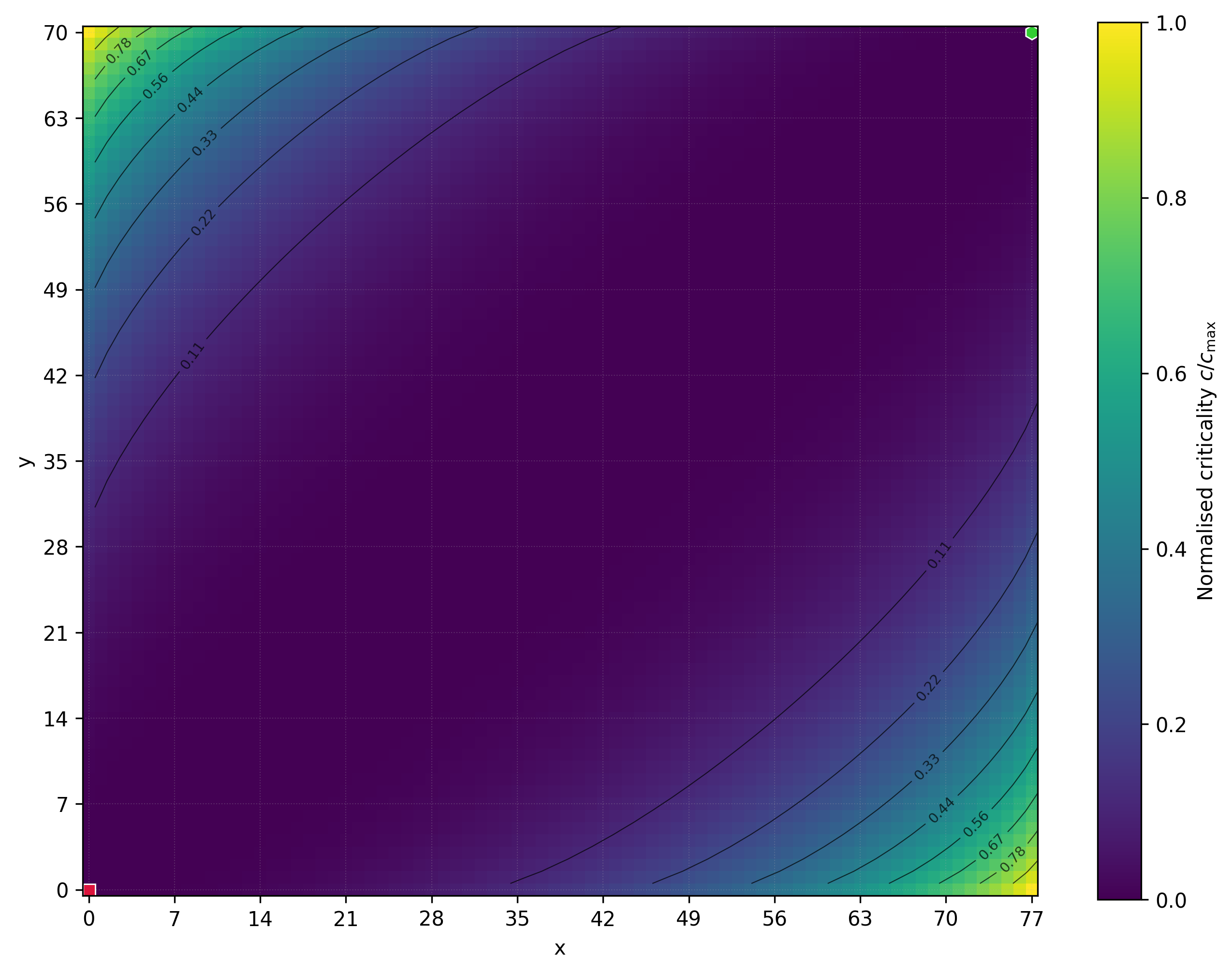
Figure 1: The relative criticality /cmax of nodes in a large hypercubic lattice section, visualizing concentration of low-criticality nodes near the geodesic.
More broadly, the study explores path degeneracy, variance and the efficacy of alternatives—such as simply taking the longest path by unit edge count (unweighted), or greedily following highest-degree successors. The analysis encompasses not just single paths but ensembles of "near-optimal" routes.
Empirical Results: Models and Real Networks
Numerical experiments, particularly on random geometric DAGs and hypercubic lattices, reveal strong structural similarities among the SPC, SPE, and longest unit paths; when a reference geodesic exists, all three align closely with it. However, the superiority or uniqueness of any single method is not substantiated. Metrics such as path weights, perpendicular deviation from the diagonal, and node degree profiles show minimal but statistically significant differences (often on the scale of a few percentage points for degree, or a single edge in path length). Crucially, the basket of zero criticality nodes—those lying on any maximally-weighted path—robustly covers the union of main paths and their near-optimal variants.
These findings are reflected quantitatively in real-world citation networks (from technological, scientific, legal, and software domains), as well as in vaccine innovation DAGs. The basket approach, focusing on the set of nodes with lowest generalised criticality, consistently achieves comprehensive coverage of all main path nodes, and in nearly all empirical cases, the critical node set for the unweighted scheme also includes those for SPC and SPE. This coverage property extends to baskets containing the lowest (say, 1–5%) criticality nodes, which further improve coverage for networks with more complex, hierarchical or modular topology.
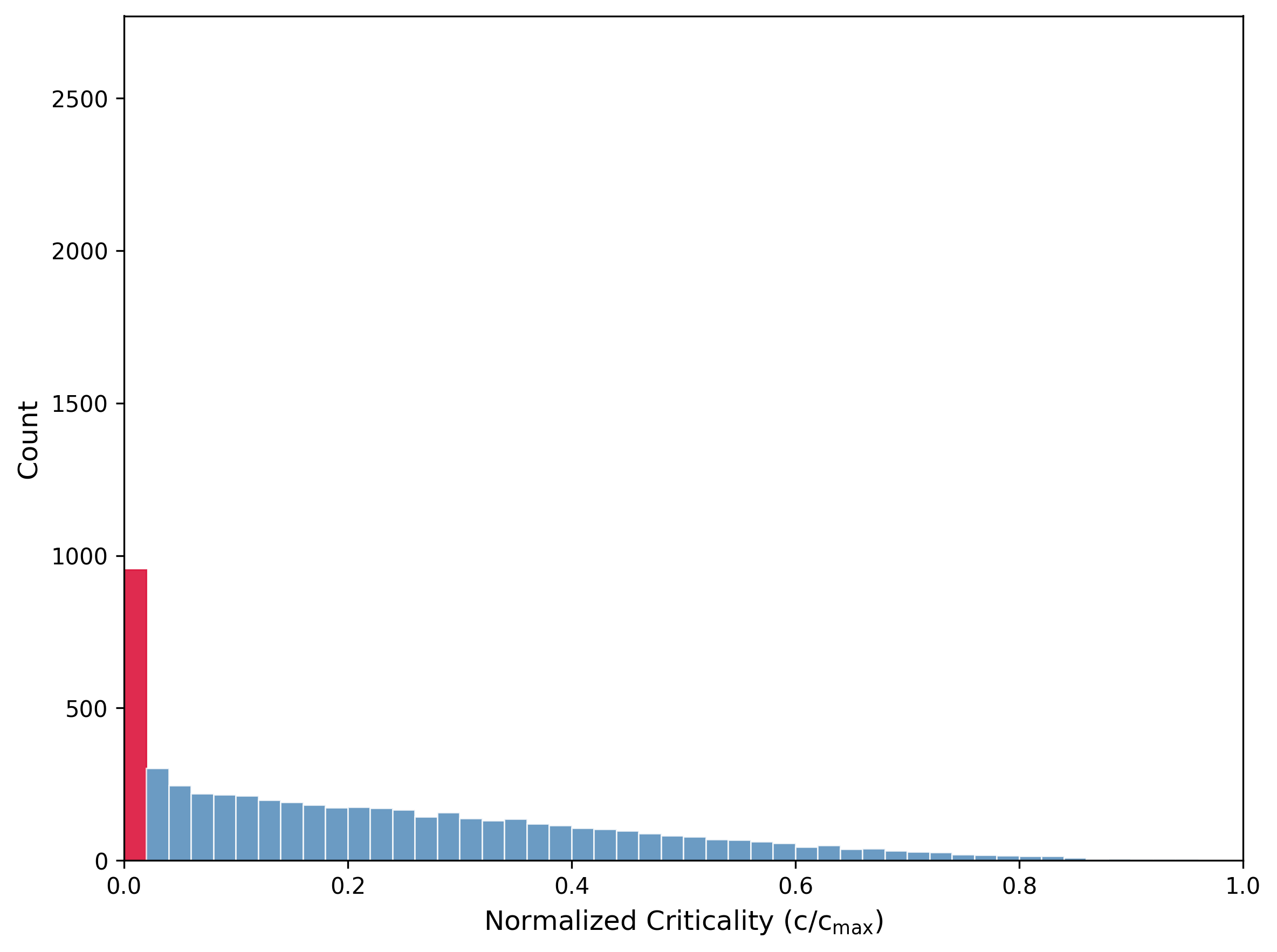
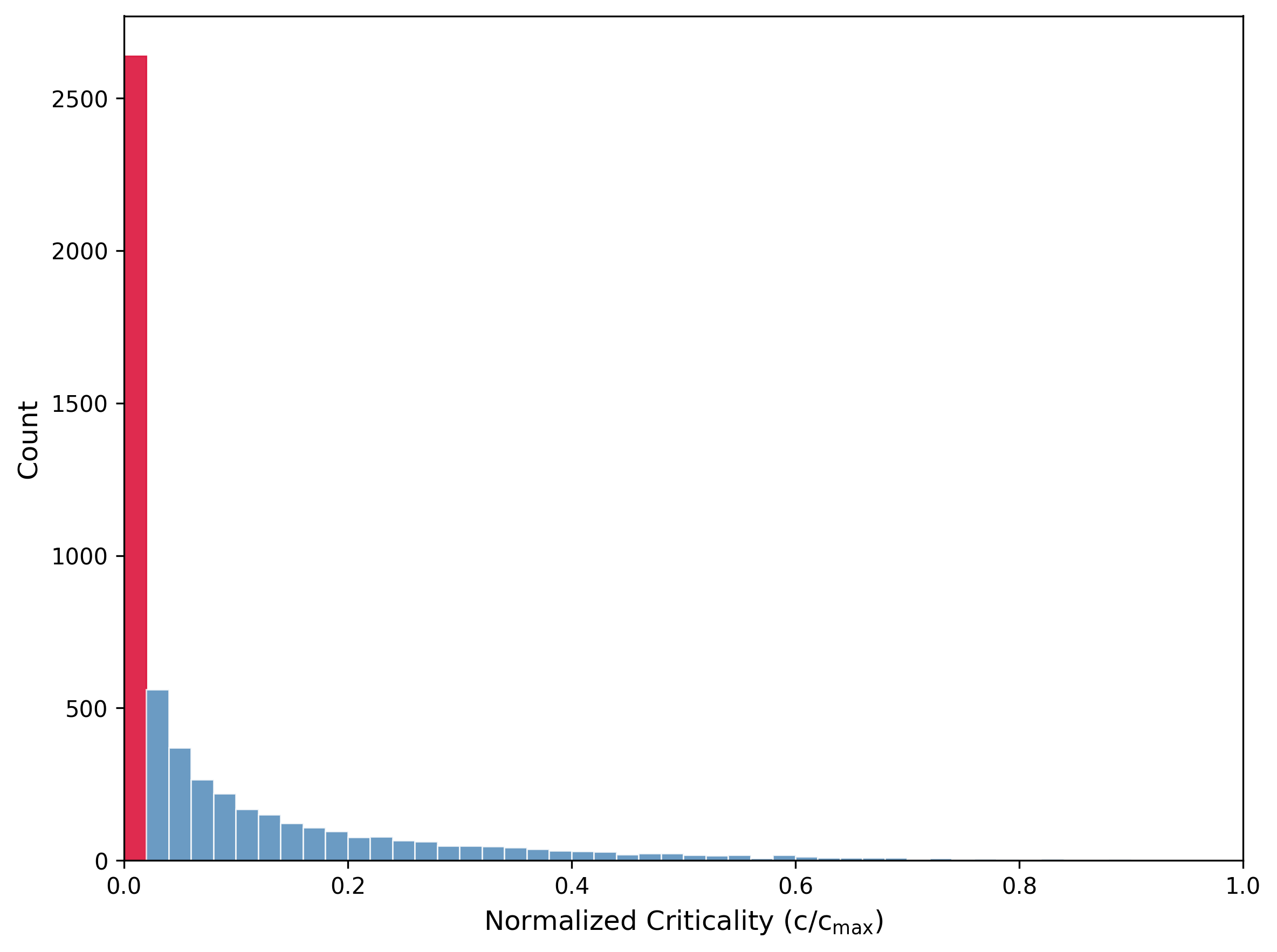
Figure 2: Histograms of criticality for a large lattice: SPC criticality is sharply concentrated; SPE criticality is broader—substantial fraction lies near (but not at) zero.
Furthermore, the authors show that main path analysis via SPC is computationally and numerically demanding: factorial growth in path counts leads to enormous numbers—commonly hundreds of digits—requiring arbitrary-precision arithmetic for even modestly large networks. In contrast, the longest unit paths are simple and efficient to compute, and their basket-based extensions are more robust to network symmetries, near-degeneracies, or numerical instability.
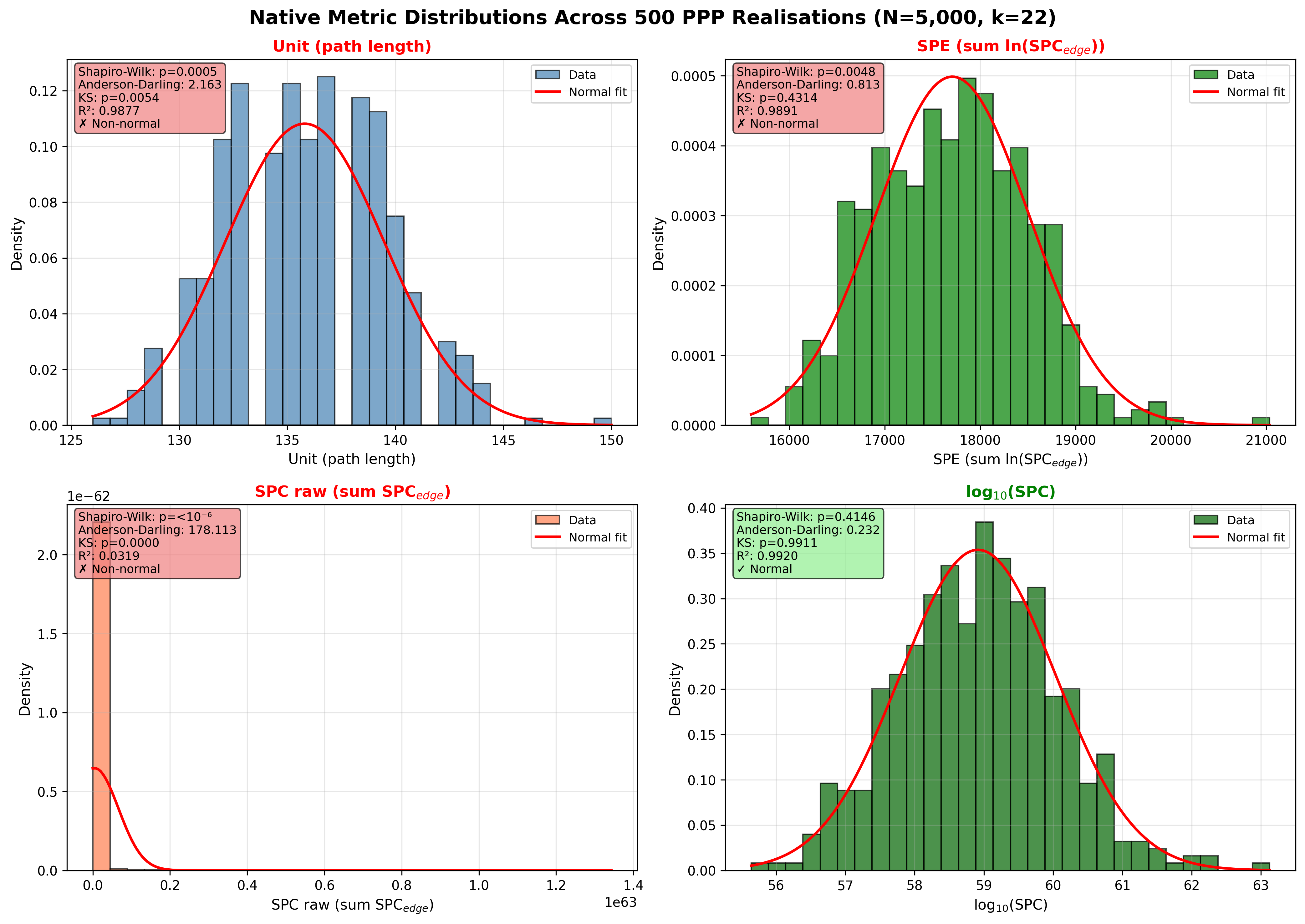
Figure 3: Distributions (empirical and quantile/normality plots) of optimized path weights across 500 random DAG instances: while unit and SPE path length distributions are near-Gaussian, SPC weights are highly skewed/non-normal.
Interpretive Implications and Best Practice
The empirical and theoretical evidence in the paper converges on several strong (if not overtly contradictory) claims:
- Main path selection is both unstable and arbitrary in the presence of path degeneracy or near-ties.
- Criticality-based baskets provide robust, comprehensive coverage and avoid overfitting to single narratives.
- There is no intrinsic advantage—either theoretically or practically—in employing SPC or SPE main path methods over the much simpler longest unit path and associated criticality baskets.
- The focus on a single path is an artefact of historical computational limitations and not justified by the structural or informational properties of citation DAGs.
For practical network analysis, these results strongly support basket-based criticality methods as preferable to main path tracing, especially in large, high-dimensional, or noisy networks.
Future Directions
The geometric and entropy foundations uncovered here are significant for both methodological refinement and theoretical exploration. By showing that SPE variants optimize a geometric (entropy-based) distance, the work opens a path to generalizing main path ideas to other forms of knowledge networks, or to contexts where intrinsic geometry (including latent semantic or topic space) is important. The basket framework could also be integrated with semantic or topical coherence measures, or with key-node path search techniques, further enhancing interpretability.
Furthermore, the observed numerical instability of SPC, even in simple models, highlights the importance of robust numerical methods and motivates the systematic use of arbitrary-precision or log-domain computations when exact SPC weights are of theoretical interest.
Conclusion
This study establishes a rigorous, information-theoretic foundation for main path analysis in directed acyclic graphs, elucidates the limitations and practical issues inherent in existing variants, and demonstrates, through extensive numerical and empirical evidence, that the basket of zero-criticality nodes—particularly from the unit length perspective—provides a computationally efficient, stable, and empirically robust means of identifying structurally central nodes in citation and innovation networks. This perspective transcends the path-centric tradition and reorients main path analysis toward multi-route, uncertainty-aware, and interpretable backbone identification.

