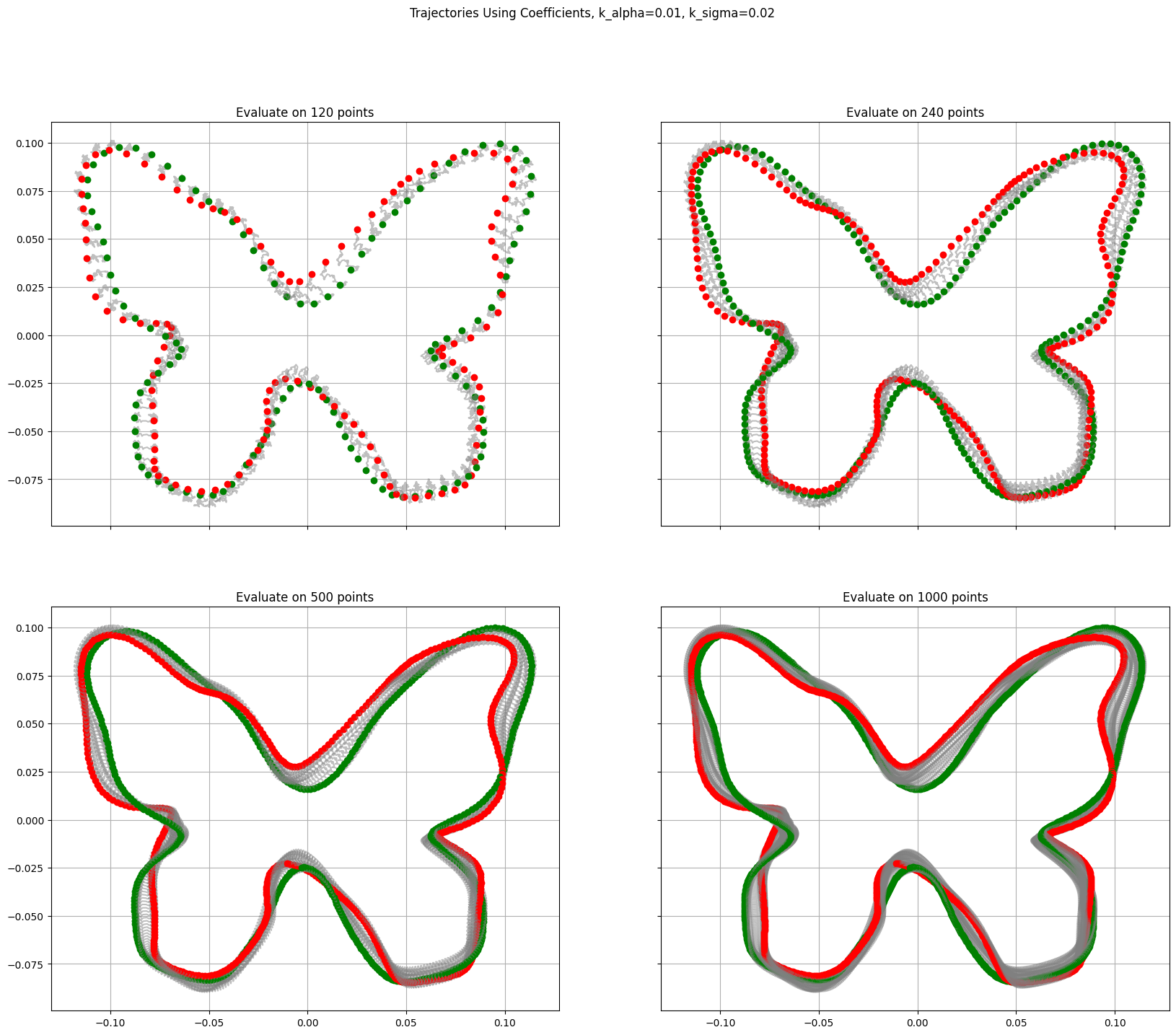
- The paper introduces an axiomatic framework for stochastic shape processes that ensures representation independence and shape structure preservation.
- It formulates Kunita flows as stochastic diffeomorphism processes using spatially correlated kernels, enabling efficient numerical implementation and robust parameter inference via bridge sampling.
- A comprehensive comparison with alternative models highlights the advantages of employing Kunita flows for advanced morphometric and phylogenetic shape analysis.
Stochastics of Shapes and Kunita Flows: Axiomatic Foundations and Practical Applications
Introduction
The paper "Stochastics of shapes and Kunita flows" (2512.11676) presents a formal framework for modeling stochastic processes on shape spaces, motivated by needs in fields such as evolutionary biology where morphometrics evolve stochastically over time. Unlike classical shape analysis that operates primarily in finite-dimensional or linear regimes, this work confronts the challenges posed by the non-linear and often infinite-dimensional nature of shape spaces. Central to the approach is the axiomatic characterization of desirable properties for stochastic shape processes and the demonstration that Kunita flows—stochastic flows of diffeomorphisms—naturally satisfy these properties. The framework is supported by an extensive survey of alternative shape stochastic processes, and practical parameter inference using modern bridge sampling techniques is provided.
Foundations of Shape Spaces
Shape spaces, being intrinsically non-linear, resist simple vector space operations and demand careful mathematical treatment. Two principal modeling paradigms are outlined:
- Outer Shape Models: These models consider shapes as subsets of an ambient space, typically Rd, and leverage groups of diffeomorphisms to act upon the entire space. Landmark-based configurations, functional representations, and image-based models are unified by the orbit structure induced via group actions. Riemannian metrics can be defined via right-invariant quadratic forms on the corresponding Lie algebra of vector fields, facilitating geodesic computations characterized by systems of Hamiltonian equations.
- Inner Shape Models: Alternatively, inner models define spaces of parametrized or embedded shapes directly, such as immersions or embeddings of manifolds into Rd. Sobolev and elastic metrics are commonly imposed, and quotienting by reparameterizations yields shape spaces independent of parameterizations.
The geometric and topological framework set here is a prerequisite for the subsequent stochastic constructions.
Axiomatic Approach to Shape Stochastics
The authors define four key axiomatic properties for stochastic shape processes:
- Representation Independence: Processes must be defined independently of the choice of representation or discretization (e.g., landmark number).
- Shape Structure Preservation: Trajectories initiated from valid shapes must remain within the shape space for all finite times.
- Equivariance: Dynamics are required to be equivariant under rigid transformations and reparameterizations, so that stochastic evolution commutes with symmetries of the shape space.
- Recovery from Discretizations: The underlying process should be theoretically recoverable in the limit from any sequence of increasingly refined discretized representations.
This set of properties distinguishes stochastic shape modeling from naively defined stochastic processes (such as independently evolving landmarks), ensuring conceptual and practical coherence across representations.
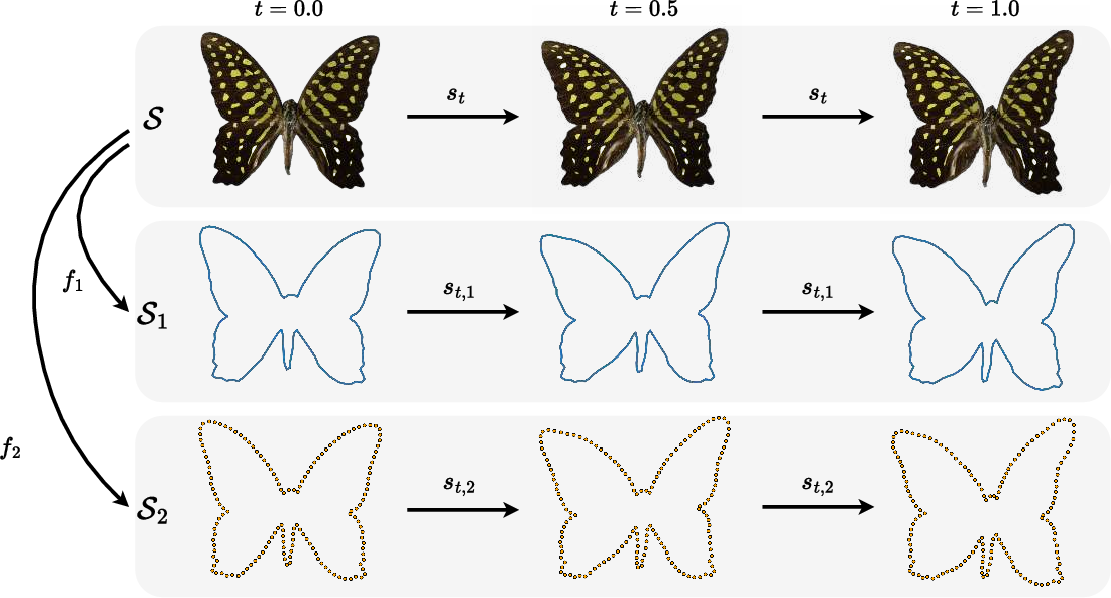
Figure 1: Schematic illustration of the compatibility between continuous stochastic shape evolution, curve-based representations, and discrete landmark approximations, highlighting representation independence and structure preservation.
Kunita Flows: Construction and Properties
Kunita flows consist of stochastic processes of diffeomorphisms $\phi_t \in \Diff(\mathbb{R}^d)$ which act naturally on shape spaces. Defined via stochastic differential equations (SDEs) in functional Hilbert spaces, these flows have spatially correlated increments and locally continuous drift, critical for preserving shape continuity and structure.
Statistical Properties and Inference
A key advantage of the Kunita framework is the clear definition of variance for shape processes, independent of the discretization. The trace of the covariance operator, normalized by spatial volume, provides a robust measure of shape variance.
Parameter inference is realized via bridge sampling and guided proposal schemes. These techniques allow conditioning the stochastic process on observed shape data (e.g., at the leaves of a phylogenetic tree) and estimating process parameters such as kernel amplitudes and correlation lengths via Markov chain Monte Carlo (MCMC).
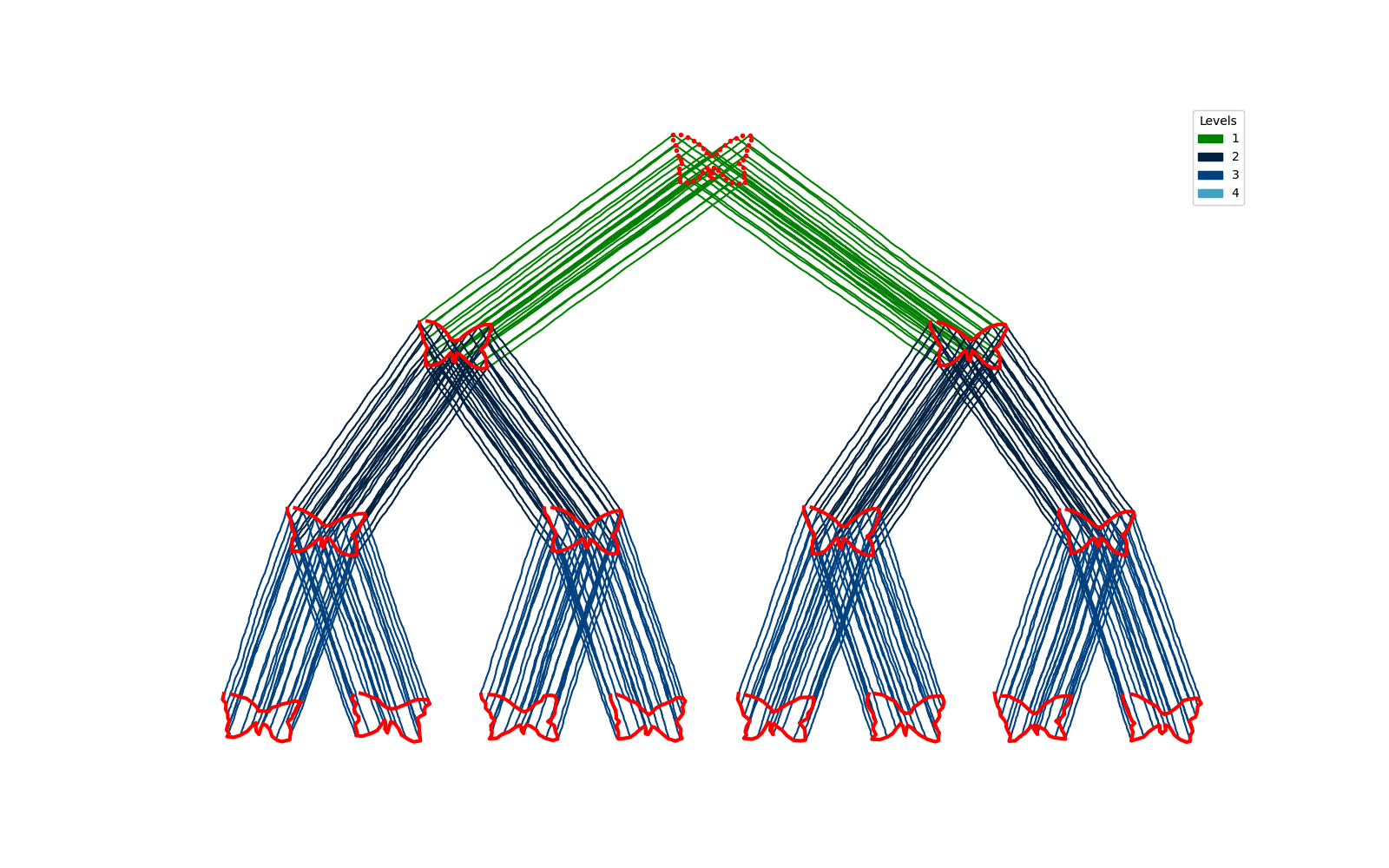
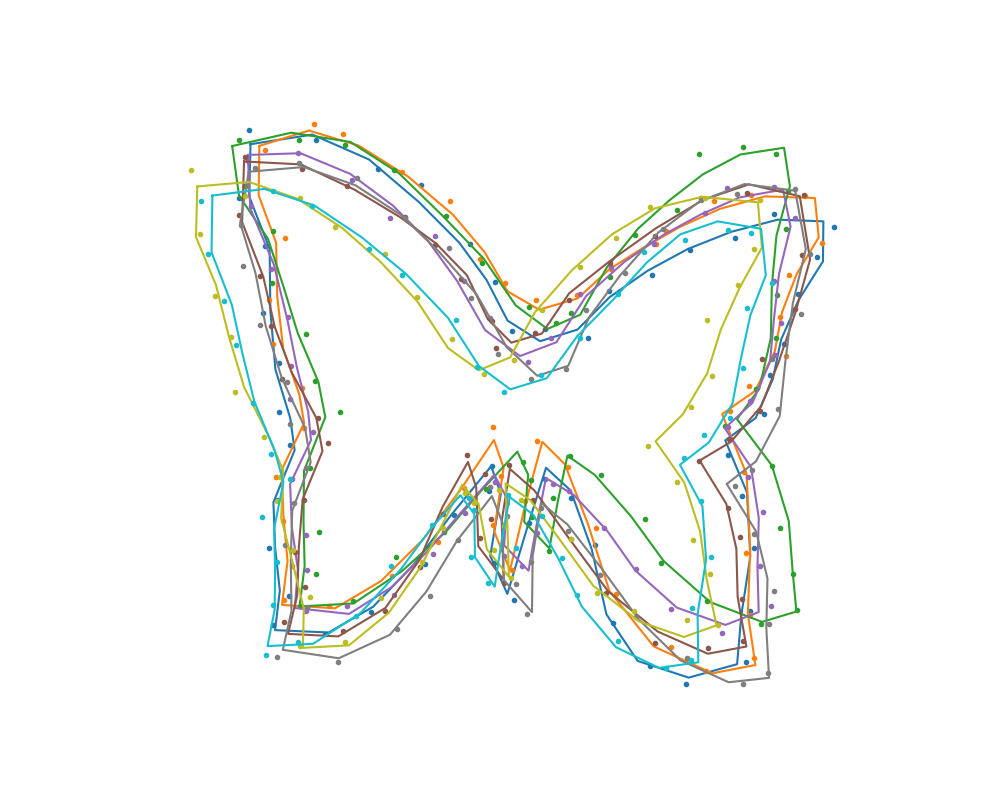
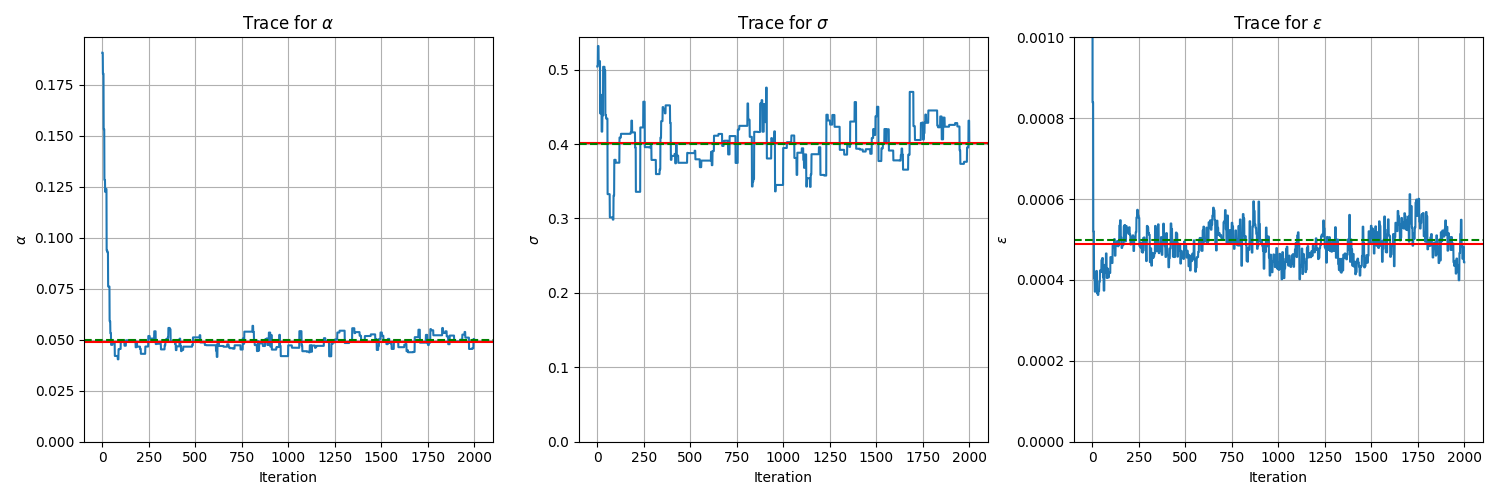
Figure 3: (Left) Example phylogenetic tree with butterfly wing shapes at the leaves, used for parameter estimation. (Center) Observed leaf shapes with observation noise on landmarks. (Right) MCMC trace plots showing convergence of estimated kernel parameters to true values.
Survey of Alternative Stochastic Shape Processes
The paper thoroughly contrasts Kunita flows with alternative models including:
- Riemannian Brownian Motion: While fundamental on finite-dimensional manifolds, these processes are representation-dependent and may fail to preserve shape structure as the number of landmarks increases.
- Stochastic EPDiff: Stochastic generalizations arising from fluid dynamics yield diffeomorphic flows acting on shapes but with complex momentum coupling.
- Langevin and Stochastic Hamiltonian Dynamics: Pose alternatives using momentum-based perturbations, both in finite and infinite dimensions, but may lack certain structural guarantees.
- Autoregressive and FDA Models: Discrete-time and functional data analysis approaches provide flexible statistical models but sacrifice mechanistic interpretability.
Conditioning and Bridge Sampling in Shape Spaces
The conditioning of stochastic shape processes on observed data—a practical necessity for statistical inference—is addressed using score-based SDE modifications. Guided proposal methods and Doob’s h-transform are extended to infinite-dimensional Hilbert spaces, facilitating not only shape interpolation but also rigorous parameter estimation within phylogenetic and morphometric applications.
Implications and Future Directions
The axiomatic treatment and explicit linkage to Kunita flows afford clarity and robustness in stochastic shape analysis, supporting representation-independent geometric and statistical conclusions. Practical parameter inference in morphometric contexts is enabled, with demonstrated applicability to phylogenetic modeling. The theory’s flexibility in accommodating arbitrary discretizations and its capacity for conditioning on real observations make it broadly suitable for next-generation biological and medical shape analysis systems.
Potential future developments include:
- Enhanced numerical schemes leveraging fast basis expansions.
- Extension of Hilbert-space bridge sampling techniques to more complex observation models (e.g., noisy or partial data).
- Exploration of further kernel families for structured shape dynamics.
- Investigation of pathwise regularity and ergodic properties in high-dimensional morphometric applications.
Conclusion
The formalization and adoption of Kunita flows as canonical stochastic processes on shape spaces fulfill stringent axiomatic criteria, resolving major theoretical and practical challenges in stochastic shape analysis. The framework harmonizes geometric representation, statistical inference, and numerical implementation, and supports robust modeling in evolutionary biology, medical imaging, and related fields. The comprehensive survey and comparative analyses provided in the paper further benchmark the approach against existing alternatives, underlining its suitability for advanced morphometric and shape evolution studies.