- The paper establishes network-irreducible multiparty entanglement (GNME) as a robust measure of genuinely collective quantum correlations beyond short-range, area-law confined contributions.
- It introduces convex optimization with the Gilbert algorithm and network inflation hierarchies via semidefinite programming to certify entanglement, yielding precise noise thresholds for canonical states.
- Results in one- and two-dimensional systems show that GNME sharply peaks near quantum criticality and is highly sensitive to thermal fluctuations, impacting quantum simulation and error correction.
Network-Irreducible Multiparty Entanglement in Quantum Matter
Introduction and Motivation
The paper "Network-Irreducible Multiparty Entanglement in Quantum Matter" (2512.11118) identifies a critical limitation of standard measures of genuine multiparty entanglement (GME) in complex quantum systems. Conventional GME, while widely used as a signature of collective entanglement, is shown to be dominated by bipartite contributions that satisfy an area law in ground and thermal states of local Hamiltonians. This implies that much of the detected GME is essentially short-range and localized to interfaces between subsystems, potentially misrepresenting the presence of truly collective multipartite correlations.
To overcome this fundamental limitation, the authors adopt the framework of Genuine Network Multiparty Entanglement (GNME), inspired by quantum network scenarios. GNME distinguishes multiparty entanglement that cannot be simulated using (k−1)-partite resources and local operations, thus capturing only the irreducible portion of GME that is intrinsic to the multipartite structure of a state.
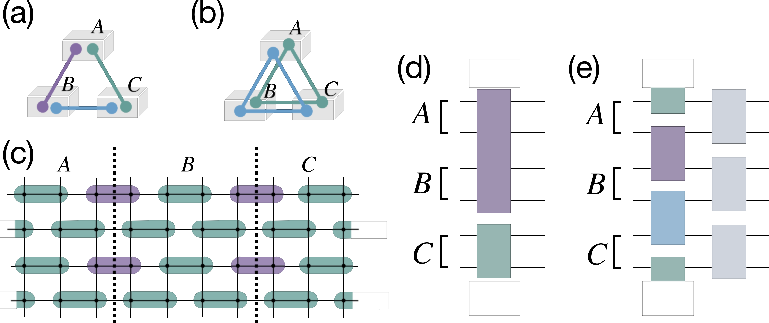
Figure 1: (a) Triangle network state constructed from three Bell pairs; (b) two copies of the three-qubit GHZ state, demonstrating network-irreducible entanglement; (c) a valence bond solid state; (d) depth-1 (biseparable) and (e) depth-2 (triangle-network) circuit constructions.
Area Law Versus Network-Irreducible Entanglement
The standard approach to multiparty entanglement quantification utilizes measures such as the Genuine Multiparty Negativity (GMN), which is defined via the minimal bipartite negativity across all possible bipartitions, extended through the convex roof. The authors show analytically that any such measure, if constructed from an area-law bipartite monotone (e.g., logarithmic negativity), will inherit this area law. For finite-temperature (Gibbs) states, the coefficient is temperature-dependent but still strictly tied to interface area. Thus, typical GME is largely determined by short-range correlations, especially in ground states and thermal states of local Hamiltonians.
In contrast, GNME is defined via network-reducibility: a k-party state possesses non-zero GNME only if it cannot be expressed as the output of a quantum network using (k−1)-partite entanglement resources and Local Operations and Shared Randomness (LOSR). This sets the operational bar much higher than conventional GME, as it excludes all area-law-dominated, bipartite-like contributions. Network-irreducible entanglement thereby provides a systematic tool to resolve genuinely collective quantum correlations.
Quantification and Certification: Geometric and Network Methods
The quantification of GNME is technically demanding due to the intricate convex structure of the set of network-reducible states. The paper leverages two complementary approaches: convex optimization over geometric distance and network inflation hierarchies.
- Geometric Approach: The distance between a target state and the convex set of network states (or a tractable inner-approximation, the Unitary Quantum Network, UQN) is minimized using the Gilbert algorithm. While this upper bounds the network distance, it can provide constructive certificates, especially when combined with Gilbert criterion-based robustness thresholds.
- Inflation Techniques: The inflation method recursively constructs symmetrized extensions of the network and imposes consistency, permutation, and independence constraints. Certification is achieved via semidefinite programs (SDP) by searching for infeasibility in embedding the target state into appropriate inflations. This framework yields increasingly tighter lower bounds on GNME as the inflation order increases.
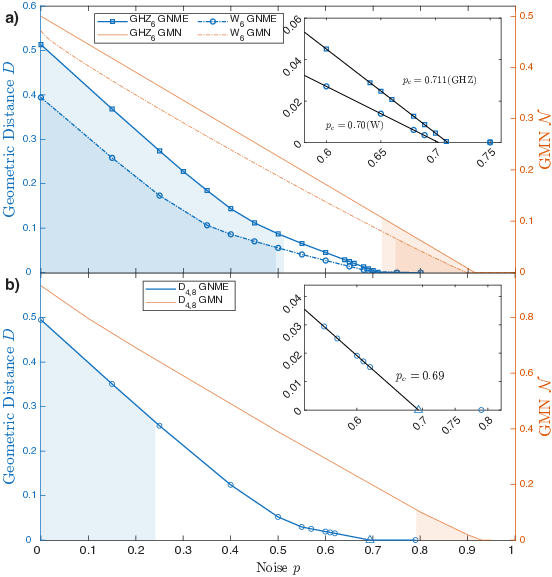
Figure 2: GNME and GME versus white noise fraction p for canonical GHZ, W, and Dicke states; geometric distance (left, blue), GMN (right, red). The regions illustrate GNME robustness and intervals where GME persists without GNME.
Results: Benchmarks in Canonical States
Applying the above methods to canonical multipartite entangled states, the authors produce robust estimates and certifications for the white-noise tolerance of GNME. Key findings include rigorous bounds for the GHZ, W, and Dicke states, as well as strong numerical evidence that the window of GME without GNME can be substantial, especially as system size increases.
Notably, the ∣W3⟩ state mixed with p=0.5 white noise provides an explicit example of a state exhibiting finite GME but no GNME. The critical noise thresholds for GNME certification are consistently below those for GME, revealing the discriminating power of the network-based definition.
GNME in Quantum Many-Body Systems
Focusing on the physically relevant 1D quantum Ising model, the paper uncovers that the GNME—measured via geometric distance and corroborated by inflation—displays a sharply peaked profile centered at the quantum critical point (hc=1). Away from criticality, GNME is rapidly suppressed, much more so than GME, which remains finite in extensive off-critical ranges due to residual short-range entanglement:
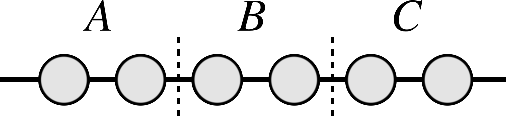

Figure 3: GNME (geometric distance to UQN) and GMN for adjacent spins in the 1D quantum Ising model. Blue regions denote GNME-certified intervals; GNME is highly localized near the critical point.
Additionally, at finite temperature, GNME dies out at a lower threshold than GME, reinforcing the notion of network-irreducible entanglement as being critically sensitive to both quantum criticality and thermal fluctuations.
Figure 4: Rapid thermal suppression of GNME versus GME in the quantum Ising chain; blue region marks temperatures with certified GNME, while GME persists to significantly higher temperatures.
The 2D analysis includes the study of quantum spin liquids (Kitaev honeycomb, Kagome lattice chiral spin liquid, and the RVB state), where, in some instances, microscopic subregions show strong conventional GME but vanishing GNME within numerical precision. This provides compelling evidence for the strictly short-range nature of truly collective entanglement in these phases, and that large GME does not imply nontrivial GNME in quantum matter.
Implications and Future Directions
The findings have direct implications for both quantum information theory and many-body physics. Practically, multipartite entanglement measures used in quantum simulation, error correction, and metrological applications must be carefully interpreted with respect to their sensitivity to network reducibility, lest they overestimate the nonlocal quantum resources available. From a theoretical perspective, the sub-area-law scaling and critical localization of GNME reshape our understanding of entanglement structures, especially in critical and topologically ordered systems.
The robustness of the inflation and geometric distance approaches, when applied to realistic reduced density matrices from many-body models, opens a pathway for future investigations in higher dimensions, out-of-equilibrium scenarios (quantum quenches, dynamical critical points), and more complex topological phases. Extending the scalability of these certification techniques to larger subsystems remains an open technical challenge with significant importance for the quantum characterization of matter.
Conclusion
This work establishes that network-irreducible multiparty entanglement (GNME) defines a stringent and physically meaningful notion of collective quantum correlation in complex matter, effectively filtering out area-law-dominated, bipartite-induced contributions that dominate standard GME. Through rigorous analytic arguments, advanced convex optimization, and network inflation hierarchies, the authors demonstrate that only in highly collective or critical regimes does GNME attain nontrivial values, motivating its adoption as a tool for probing genuinely collective entanglement in quantum systems. The proposed framework sets the stage for future progress in the quantification and operational utilization of multiparty entanglement in quantum science.

