- The paper introduces a dual-mode clipping strategy—complete and relaxed—that integrates with branch-and-bound to tighten intermediate-layer bounds at low computational cost.
- It demonstrates a 50–96% reduction in subproblem counts and up to three orders of magnitude speedup over LP solvers across standard verification benchmarks.
- The framework efficiently prunes infeasible regions and scales to deep, high-dimensional models, enabling robust verification in safety-critical neural network applications.
Clip-and-Verify: Linear Constraint-Driven Domain Clipping for Accelerating Neural Network Verification
Introduction
Neural network (NN) verification is a pivotal challenge for certified deployment in safety-critical and mission-critical applications, particularly due to the combinatorially hard nature of verifying input-dependent properties in deep, high-dimensional architectures. Existing state-of-the-art verifiers achieve scalability by combining branch-and-bound (BaB) search with efficient linear bound-propagation relaxations. However, there remains a fundamental bottleneck: the inability to efficiently and scalably refine intermediate-layer bounds during BaB—especially for large models and deep branching. "Clip-and-Verify: Linear Constraint-Driven Domain Clipping for Accelerating Neural Network Verification" (2512.11087) introduces a general, highly efficient framework for exploiting linear constraints throughout BaB to significantly tighten neural network relaxations, aggressively prune infeasible subspaces, and decisively reduce the verification search space and cost.
Linear Constraint-Driven Domain Clipping: Framework and Algorithms
The core insight of Clip-and-Verify is recognizing that every BaB split—whether on input or activation space—implies new linear constraints on the input, either from activation stability decisions or output property hyperplanes. These constraints can, in principle, tightly contract the feasible region and thus improve intermediate-layer bounds if integrated efficiently into the verification pipeline.
Clip-and-Verify formalizes a dual-mode framework:
- Complete Clipping: Directly optimizes intermediate neuron bounds under active linear constraints, using a specialized dual coordinate ascent with sorted breakpoints, achieving near-LP-tightening at a cost orders of magnitude lower than standard LP solvers.
- Relaxed Clipping: Efficiently shrinks the axis-aligned box input domain by analytically projecting each constraint onto the box, yielding closed-form updates and enabling mass parallelization across model and property instances.
This framework decouples expensive per-neuron optimization (necessary for full tightness) from efficient box-relaxation updates, dramatically lowering the complexity of propagating constraint-driven refinements through every BaB node.
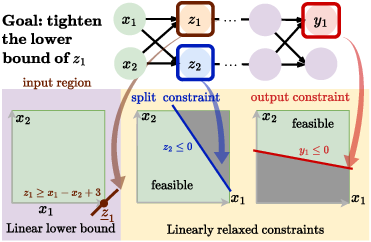
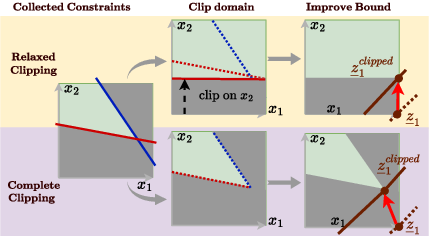
Figure 1: Linear bound propagation creates input-aligned linear constraints exploited by Clip-and-Verify for tight domain restriction and refinement of intermediate-layer bounds.
The geometric effect is that for each BaB subproblem, infeasible or already-verified regions are clipped away, and intermediate-layer relaxation error is reduced due to the smaller, more structured feasible set.
Integration into Branch-and-Bound Verification
The design of Clip-and-Verify ensures seamless integration with both input and activation split BaB verification:
- Input BaB: After each box split, the output property hyperplane from prior bound propagation is converted into a linear constraint and used to shrink (clip) the box domain. This can directly eliminate verified or infeasible portions, drastically reducing the proliferation of subsequent subdomains.
- Activation BaB: Activation splits (e.g., ReLU assignments) translate into linear constraints on the input via bound propagation. These constraints further contract the input feasibility set, and can be recursively applied to intermediate layers via the clipping algorithms.
- Critical Neuron Selection: Complete clipping is applied to a small, dynamically selected subset of neurons per subproblem (by, e.g., BaBSR intercept score), whereas relaxed clipping is used globally for the input domain. This hybrid scheduling maintains verification tractability even in extremely deep or wide models.
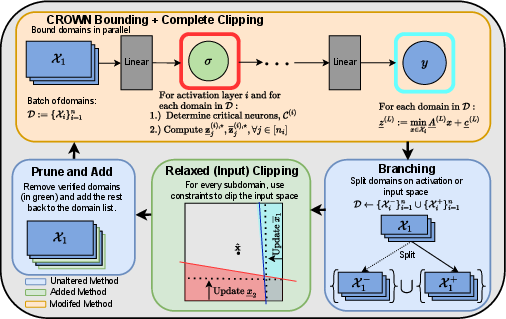
Figure 2: The full Clip-and-Verify pipeline, demonstrating how clipping modules are interleaved with branching and bounding steps in BaB for both input and activation splits.
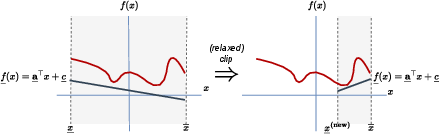
Figure 3: Visualization of how relaxed clipping contracts the input interval, enabling tighter bound propagation upon further refinement.
Empirical Results and Strong Claims
The empirical evaluation of Clip-and-Verify demonstrates substantial reductions in BaB subproblem counts (often by 50–96%), accelerating verification time and improving verified coverage on standard and hard VNN-COMP, robust vision, and neural control system benchmarks. Notable results include:
- Up to 96% reduction in BaB subproblems on LSNC (input BaB) and ~80% reduction on ACAS-XU and high-dimensional control systems.
- State-of-the-art verified accuracy on industry-standard benchmarks, including deep ResNets, CIFAR-100, TinyImageNet, and vision transformers, approaching theoretical property verification upper bounds.
- Competitive or lower verification time relative to prior state-of-the-art verifiers (including BICCOS and α,β-CROWN), even on the most difficult properties and largest models (see Figure 4).
- Highly efficient GPU-based implementations, achieving two to three orders of magnitude speedup over LP solvers (e.g., 0.0028s per clip operation vs. ~2s for 10-iteration Gurobi LP solves in batch settings).
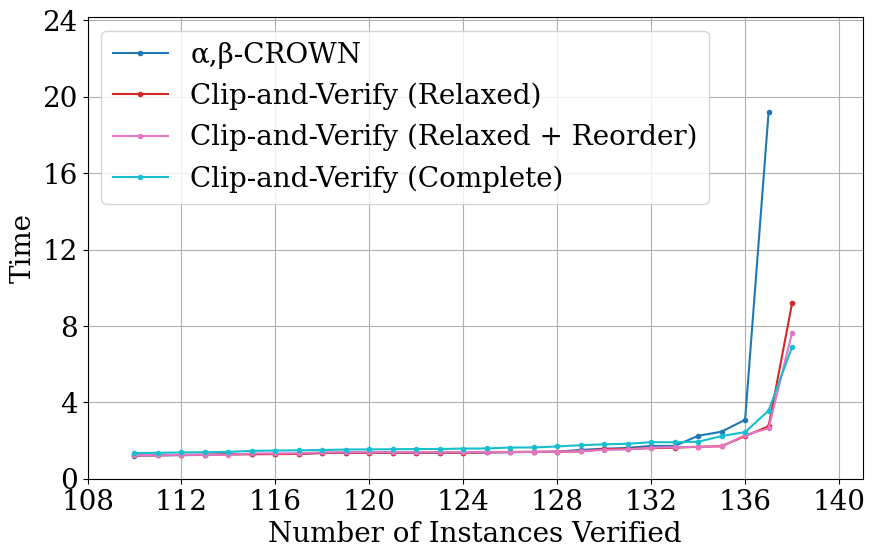
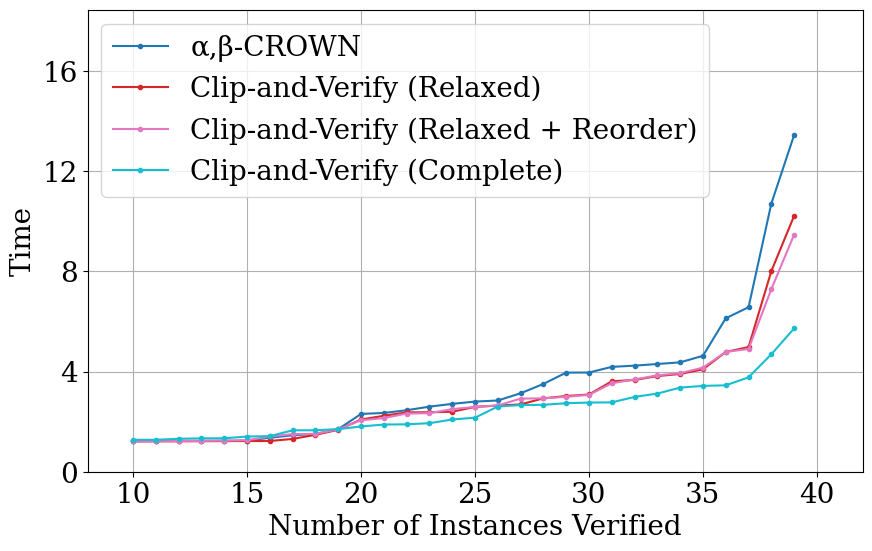
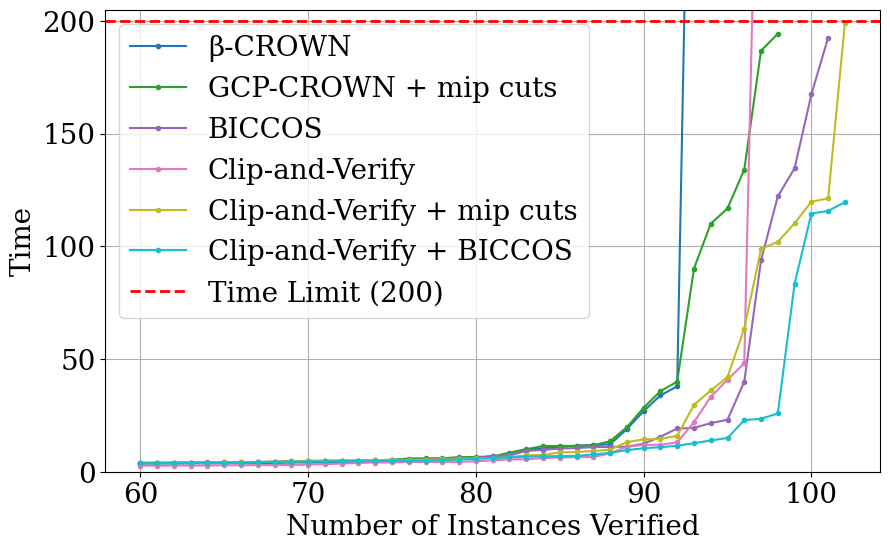
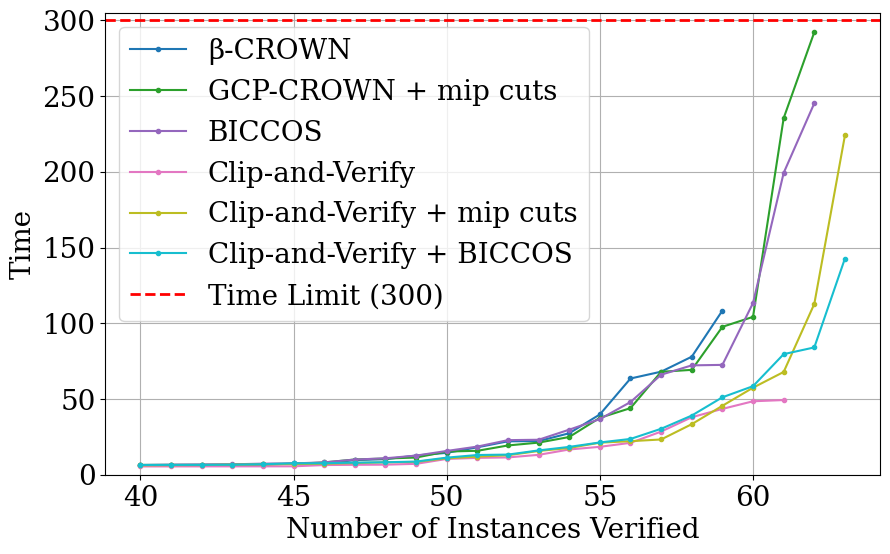
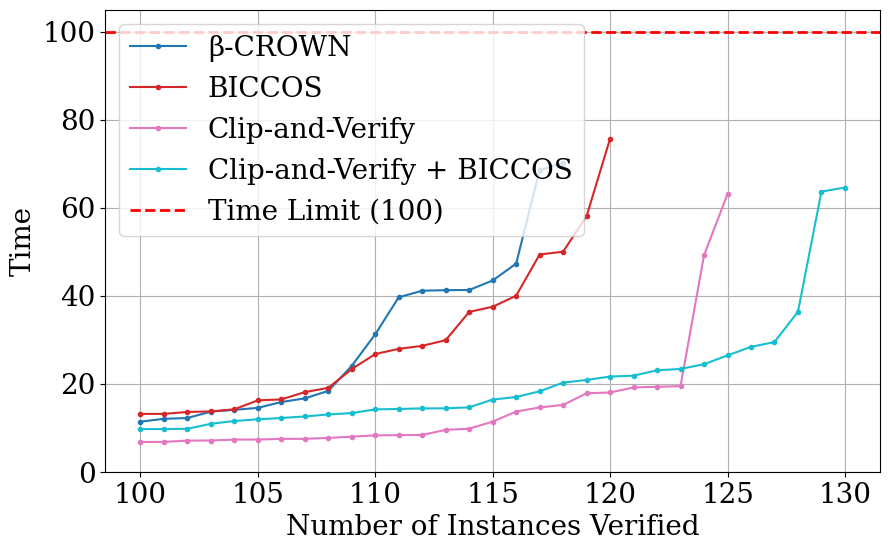
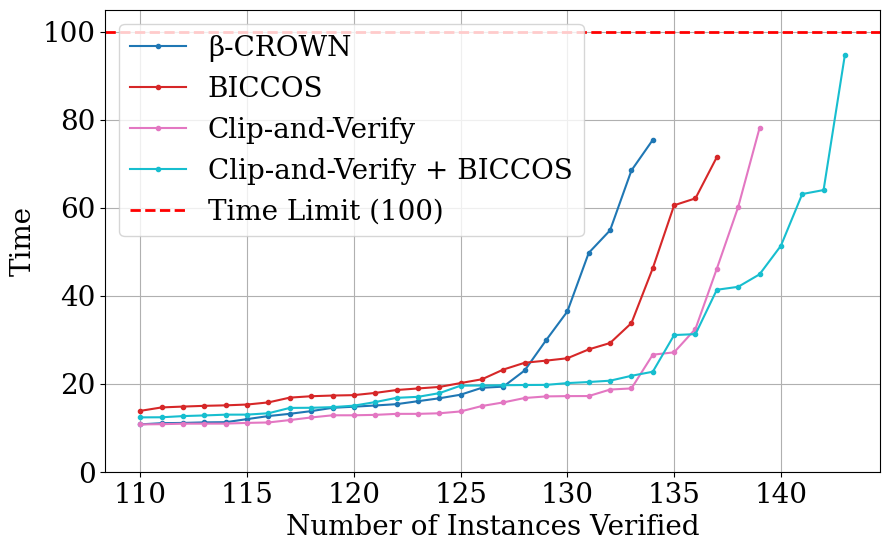
Figure 4: Clip-and-Verify achieves strong performance across both input and activation BaB on benchmarks of widely differing scales and complexity—including large modern ReLU networks and transformer models.
A critical and nontrivial claim is that complete clipping, despite being based on dual coordinate ascent, achieves LP-equivalent bound tightening in O(n log n) time (for single-constraint subproblems), with direct equivalence to the continuous knapsack solution process. Empirically, LP and commercial simplex solvers were shown to be 740–880x slower than the specialized GPU implementation at near-identical bound tightness.
Furthermore, the approach is agnostic to the source of constraints, supporting integration of property, activation, and even external semantic constraints, provided they are linear—a property directly beneficial for verifying general nonlinearities and advanced activation architectures (e.g., vision transformers).
Theoretical and Practical Implications
The practical impact is immediately clear: by enforcing aggressive constraint-driven pruning and bound refinement at every BaB node, the effective search tree is contracted by orders of magnitude. This directly improves tractability, enabling complete neural network verification at scales previously intractable for LP/MIP/symbolic-semantics solvers.
Theoretically, the work demonstrates that for any family of linear constraints that can be efficiently collected (e.g., from previous bounding rounds or domain splitting history), the verification complexity can be exponentially reduced (in terms of unstable neurons and subproblem tree depth), as the intermediate bounds become increasingly tight—a key known bottleneck in all BaB-based NN verification frameworks.
Practically, this method is readily applicable to any state-of-the-art bound propagation BaB verifier. The public integration into α,β-CROWN and winning of VNN-COMP 2025 underscores robustness and scalability on hardware commensurate with modern deployment (multi-core CPU + GPU).
Clip-and-Verify generalizes and unifies prior advances in bound propagation tightening (e.g., CROWN, DeepPoly, cutting planes, PRIMA, BICCOS) by shifting focus from fixed initial relaxations to adaptive, constraint-driven tightness throughout the BaB search. Notably, for robust neural network control verification (Lyapunov ROA, region-of-attraction), only the clipped approach achieved any verification within time constraints, establishing its criticality for dynamical system safety.
Limitations and Potential for Future Work
Although the presented framework achieves new benchmarks in both tractability and coverage, the effectiveness is partially bounded by the tightness and representativeness of the collected linear constraints. For some multi-neuron or strongly non-linear dependencies (beyond the reach of linear propagation), further advances will require integrating polyhedral (PRIMA/k-ReLU) or semidefinite relaxations with efficient clipping operators. There is also scope in optimizing constraint selection and order, which can influence efficacy in high-constraint regimes, as well as exploring alternatives to box proxy domains for input clipping.
The extension of domain clipping to more general convex sets, as well as integration with contraction-based or value-function constraints in neural ODE/control applications, offers rich avenues for future investigation.
Conclusion
Clip-and-Verify represents a substantive advancement in the scalability and precision of complete neural network verification. By leveraging efficiently extractable linear constraints at every BaB node, and combining direct per-neuron bound tightening with lightweight global input box refinement, it accelerates verification—both in subdomain count and wall-clock time—while simultaneously expanding the set of properties that can be formally certified. The methodology is broadly extensible, mathematically principled, and practically validated on large-scale vision and control verification tasks (2512.11087).

