Information-Theoretic and Operational Measures of Quantum Contextuality
Published 11 Dec 2025 in quant-ph | (2512.11049v2)
Abstract: We propose an information -- theoretic framework for quantifying Kochen-Specker contextuality. Two complementary measures are introduced: the mutual information energy, a state-independent quantity inspired by Onicescu's information energy that captures the geometric overlap between joint eigenspaces within a context; and an operational measure based on commutator expectation values that reflects contextual behavior at the level of measurement outcomes. We establish a hierarchy of bounds connecting these measures to the Robertson uncertainty relation, including spectral, purity-corrected, and operator norm estimates. The framework is applied to the Klyachko-Can-Binicioğlu-Shumovsky (KCBS) scenario for spin-1 systems, where all quantities admit closed-form expressions. The Majorana-stellar representation furnishes a common geometric platform on which both the operational measure and the uncertainty products can be analyzed. For spin-1, this representation yields a three-dimensional Euclidean-like visualization of the Hilbert space in which, states lying on a plane exhibit maximum uncertainty for the observable along the perpendicular direction; simultaneous optimization across all KCBS contexts singles out a unique state on the symmetry axis. Notably, states achieving the optimal sum of uncertainty products exhibit vanishing operational contextuality, while states with substantial operational contextuality satisfy a nontrivial Robertson bound -- the two extremes are achieved by distinct quantum states.
The paper introduces a novel information-theoretic framework that quantifies quantum contextuality using mutual information energy and commutator-based measures.
It establishes sharp bounds linking geometric overlaps, state purity, and uncertainty relations to operational contextuality, validated in the KCBS scenario.
The work reveals that optimal uncertainty does not imply maximal contextuality, highlighting essential trade-offs for quantum advantage.
Information-Theoretic and Operational Quantification of Quantum Contextuality
Introduction: Contextuality and Measurement Structure
Quantum contextuality, formalized by the Kochen–Specker (KS) theorem, captures the state-dependent non-classicality of quantum measurements: measurement outcomes depend nontrivially on the chosen compatible observables within a given context. Classical (“non-contextual”) value assignment becomes untenable in Hilbert spaces of dimension d≥3, so the quantification of contextuality is central for operational and foundational quantum theory. Numerous numerical and information-based approaches toward contextuality measures have been proposed, often tailored to specific architectural or operational frameworks and frequently motivated by the needs of quantum information processing.
This work introduces an information-theoretic formalism that unifies geometric and operational aspects of contextuality. The construction is based on two measures: the state- and basis-independent mutual information energy (MIE), and a complementary operational contextuality measure based on commutator expectation values. The interplay between these measures, the structure of joint eigenspaces, and uncertainty relations is systematically elucidated.
Mutual Information Energy: Geometric Quantification
The MIE is defined as a basis- and state-independent scalar that quantifies the geometric overlap between projector subspaces belonging to two joint measurements that share a single observable. For observables A, B, C with Hilbert space dimension d≥3 and [A,B]=0=[B,C], MIE is
E(B;A,C)=d1i,j∑Tr[(PiA,BPjC,B)2],
where PiA,B and PjC,B project onto common eigenspaces of (A,B) and (C,B). E(B;A,C)=1 indicates noncontextual joint measurability, while E(B;A,C)=1/d (the minimal value assuming mutually unbiased bases) signals maximal contextuality.
The deviation $1-E(B;A,C)$ gives a direct operational meaning: it equals (up to scaling) the net Hilbert–Schmidt norm of the commutator between all joint projectors. This quantifies the intrinsic, structure-induced contextuality for the given context, independently of system state. This projection-based formalism is robust with respect to spectral degeneracies and avoids ambiguities arising from basis or representation choices.
In realistic experimental scenarios, one cares about the degree to which contextuality can manifest for a given quantum state. To this end, the operational measure is introduced:
D(G,ρ)=α∑Tr([Aα,Cα]ρ),
where each context Gα is a commuting triple with [Aα,Bα]=0=[Bα,Cα], and ρ is the system’s density matrix. This measure vanishes for noncontextual configurations and provides a signal accessible to experiment: if D(G,ρ)=0, the system can “witness” contextuality for the given state and observable structure.
The paper establishes a sharp hierarchy of upper bounds for D(G,ρ) in terms of the MIE, the eigenvalue spectrum of observables, and state purity:
The spectral bound: D(Gα,ρ)≤κα[1−Eα]1/2, with κα determined by the spectral content.
The purity-corrected version tightens for mixed states: D(Gα,ρ)≤βκα[1−Eα]1/2, where β=Tr(ρ2).
The operator norm bound: D(Gα,ρ)≤∥[Aα,Cα]∥op can in cases be even sharper.
The hybrid bound: the pointwise minimum of the above.
These bounds demonstrate that the information-theoretic geometric constraints (MIE) fundamentally limit the maximum possible state-dependent operational signatures of contextuality.
Relation to Uncertainty Relations
The framework reveals precise connections between contextuality measures and uncertainty relations. The Robertson relation gives a lower bound on the product of variances for each context:
21D(Gα,ρ)≤(ΔAα)(ΔCα).
Combined, the bounds establish a strict hierarchy:
This connects three critical operational quantities: (i) commutator expectations (contextuality witness), (ii) uncertainty products (variability under quantum measurements), and (iii) geometry of eigenspace overlaps (MIE).
Application: KCBS Scenario and Spin-1 Geometry
The formalism’s efficacy is explicitly demonstrated in the KCBS contextuality scenario for a spin-1 quantum system—the paradigmatic minimal-dimension context for KS-type contextuality.
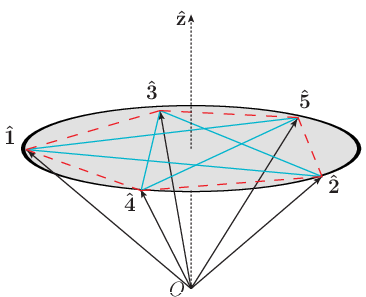
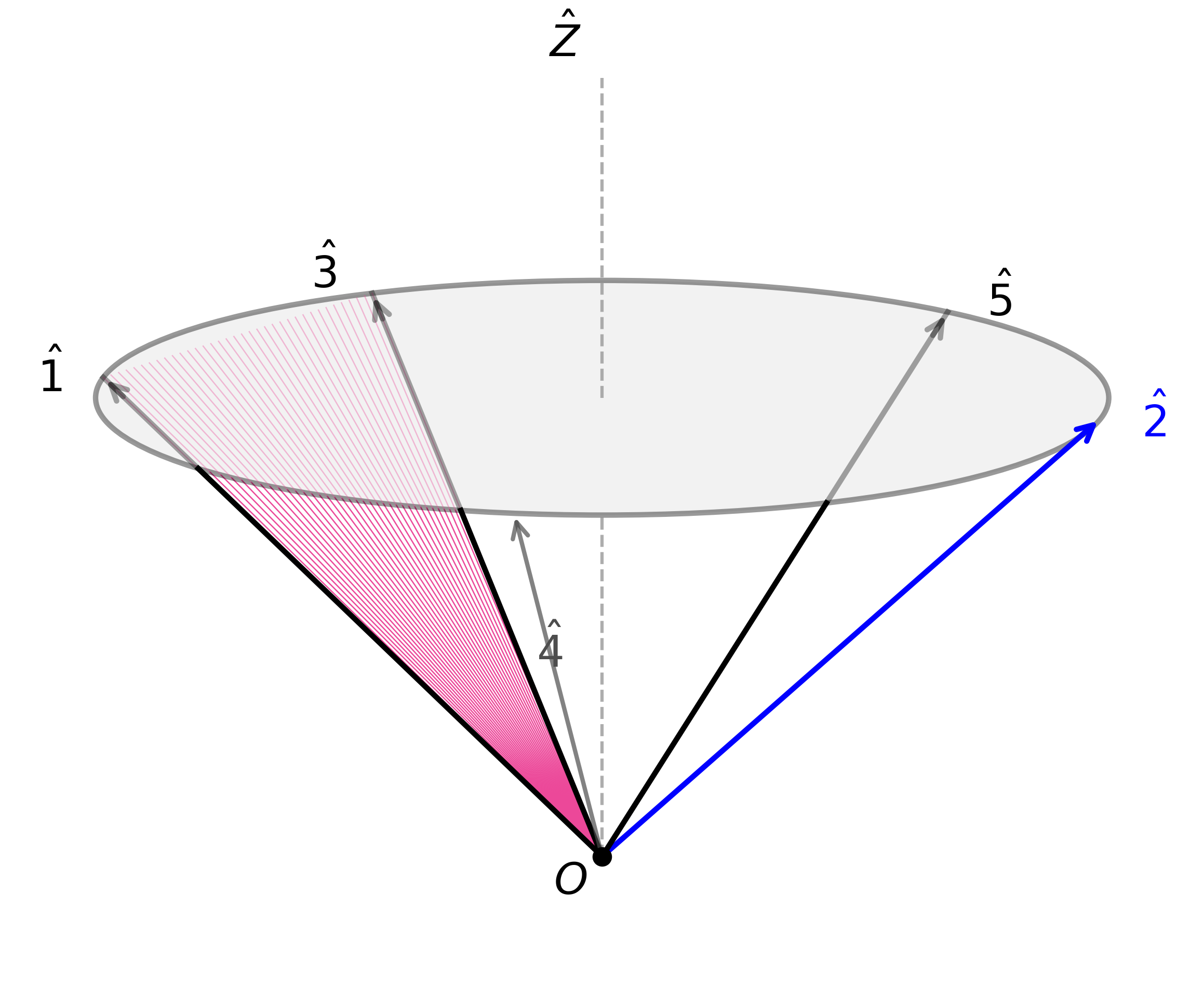
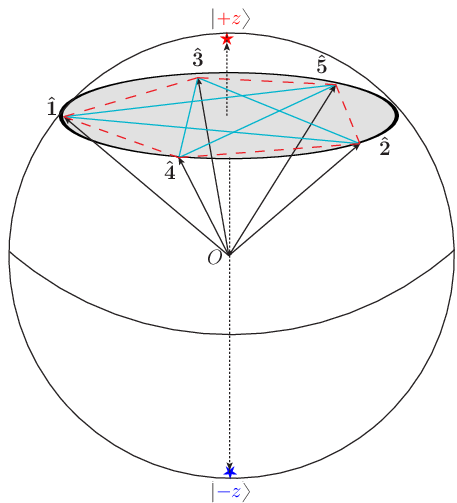
A canonical set of five dichotomic observables {Ak}, each associated with directions cyclically orthogonal in R3, define overlapping contexts on a pentagonal graph structure.
Figure 1: KCBS configuration of five observables forming overlapping contexts on a great circle with pentagonal symmetry.
For these KCBS measurement structures:
Each directional triple forms a context as required by the KS theorem.
All relevant quantities (MIE, operational measure, spectral and purity-corrected prefactors) admit closed-form algebraic expressions owing to the symmetry.
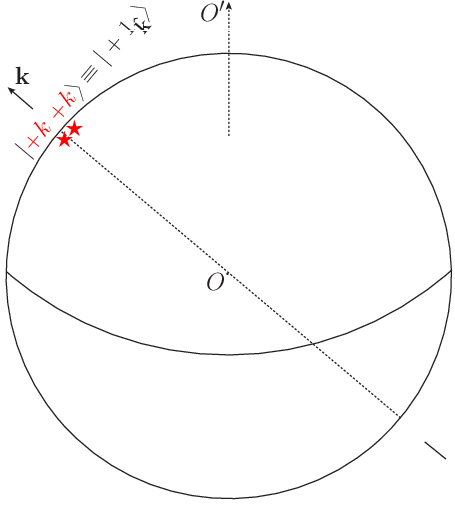
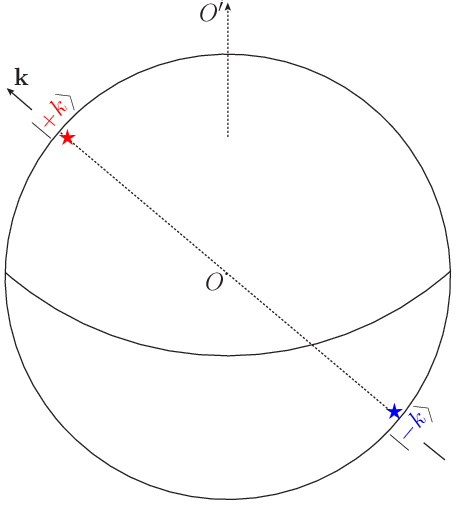
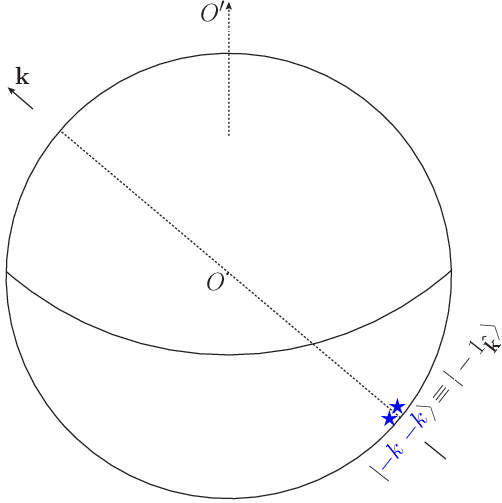
The Majorana–stellar representation is leveraged: each pure spin-1 state corresponds to a pair of points on the Bloch–Poincaré sphere, reducing calculations for overlaps and variances to simple geometric relations.
Figure 2: Majorana–stellar representation of the ∣+1k⟩ spin-1 eigenstate as double stars on the Bloch sphere.
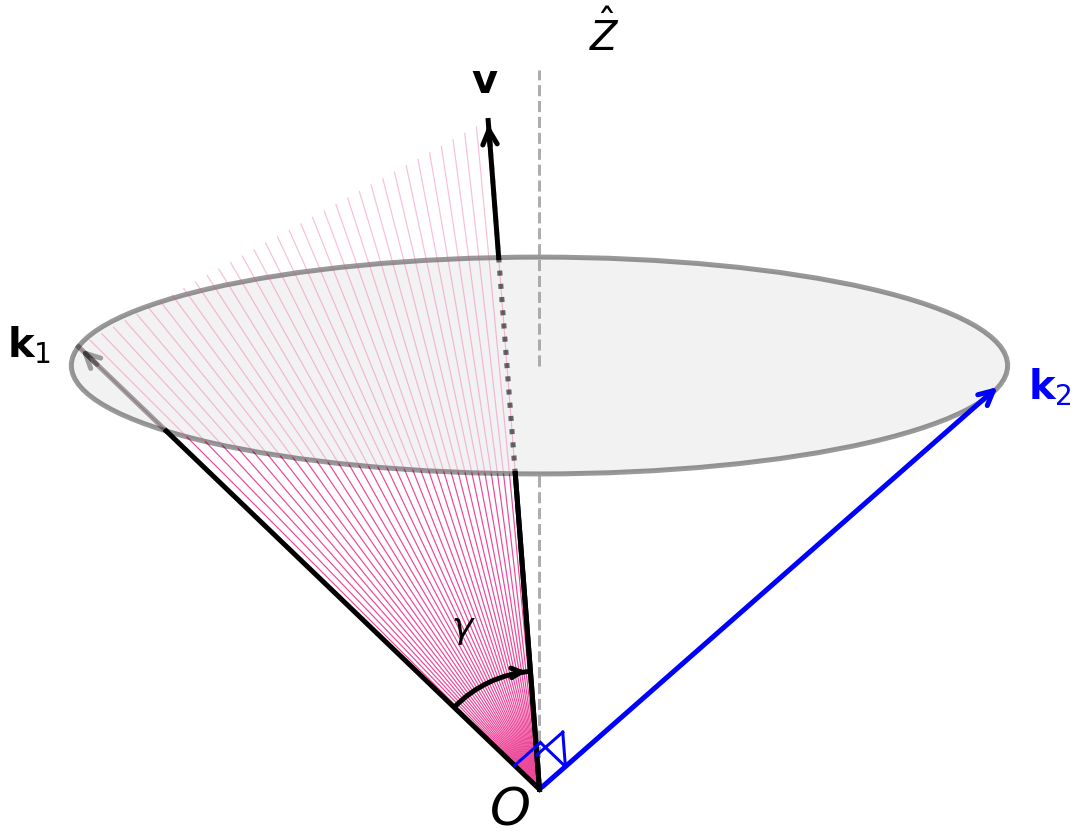
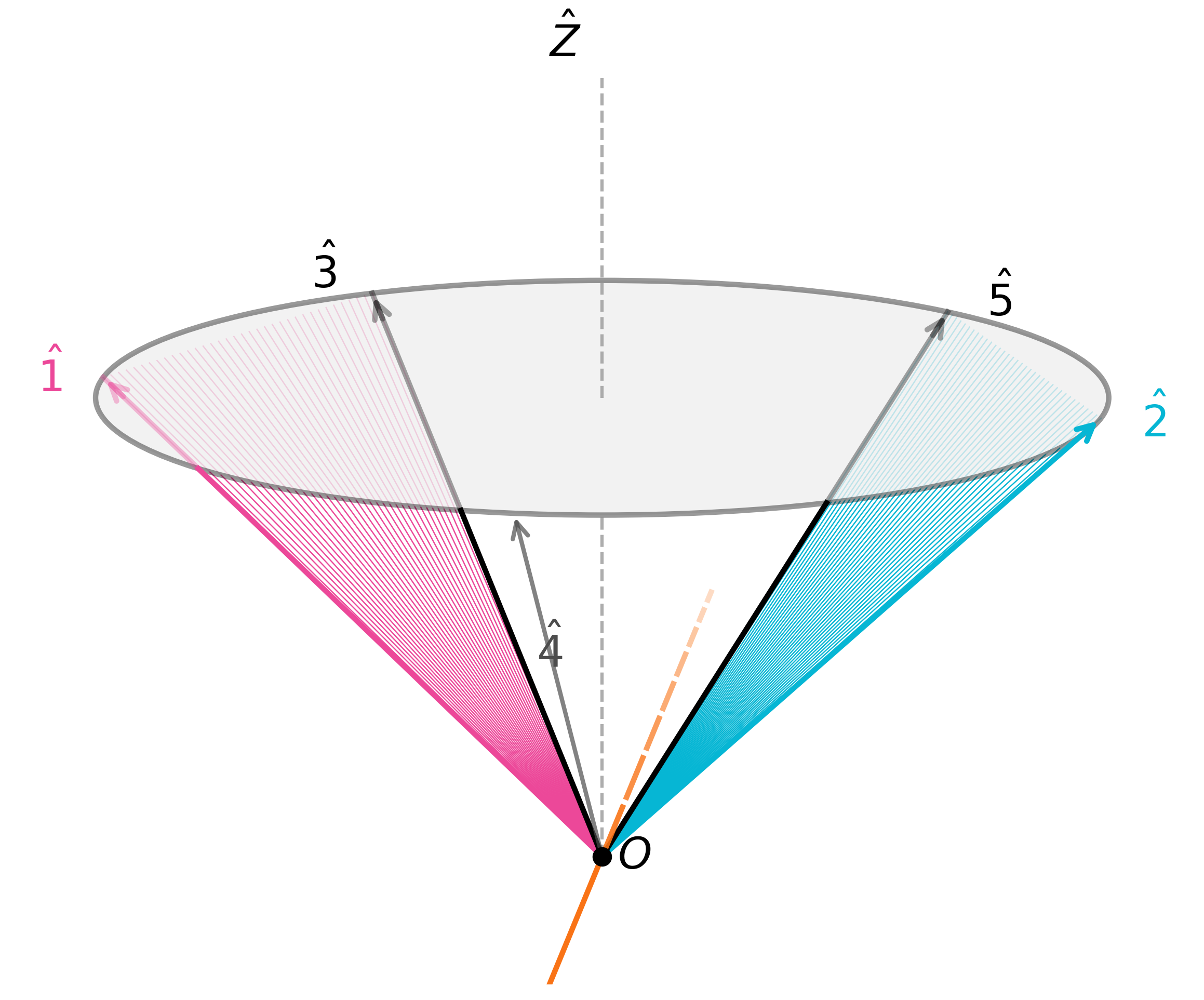
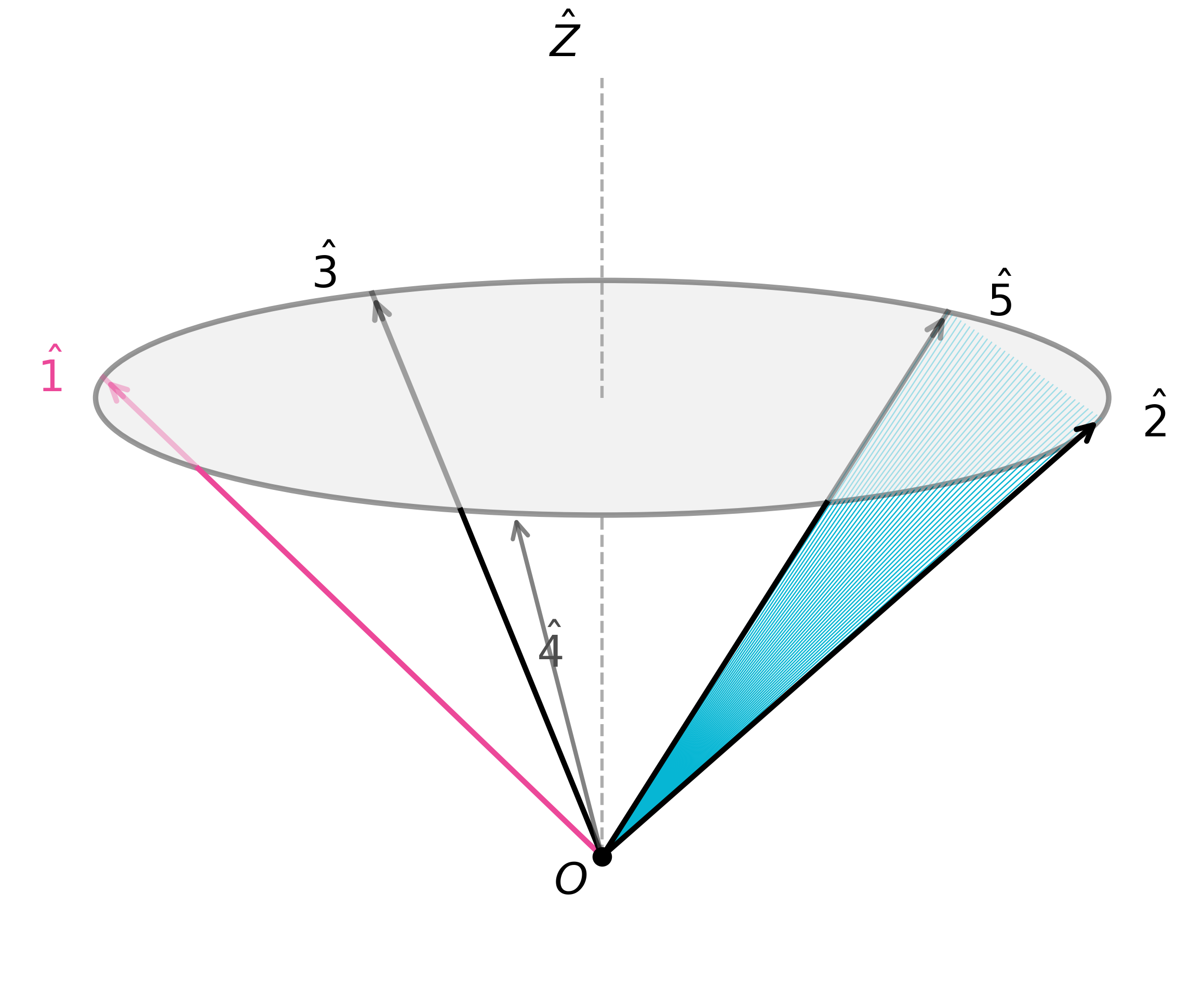
Figure 4: Maximum-uncertainty planes for spin-1 states in Majorana space: each observable corresponds to a surface, and their intersections select optimal states.
Figure 3: KCBS pentagram and the ∣0z⟩ state, the unique optimal-uncertainty state by symmetry.
Striking analytic and numerical results demonstrated in the KCBS construction:
The MIE for each context achieves E≈0.685, representing intrinsic geometric contextuality.
The operator norm bound (≈1.94 per context) is more than twice as strong as the raw spectral bound (≈4.12).
The unique state maximizing the sum of uncertainty products is ∣0z⟩, the m=0 eigenstate along the system’s symmetry axis. This state, by construction, exhibits vanishing operational contextuality (D=0) despite maximizing the uncertainty product, highlighting the nontrivial geometry of contextuality versus uncertainty.
Generic eigenstates, e.g. ∣±1z⟩, yield substantial D∼6.5—about 67% of the hybrid bound.
Implications and Perspectives
The theoretical structure provided by the information-theoretic and geometric approach consolidates the operational and foundational pictures of quantum contextuality. The explicit connection to (and strict limits on) the commutator-based operational measures makes the MIE a fundamental control parameter for state design and measurement structure in quantum information protocols.
The unique finding that optimal uncertainty and maximal operational contextuality are achieved by inequivalent quantum states has significant implications: resource tradeoffs in quantum advantage and limitations in contextuality-based computational or cryptographic protocols must take state–measurement compatibility into account. Moreover, the approach is robustly extensible: the Majorana–stellar geometry directly scales for higher spin or dimension, and the algebraic structure can be adapted to model contextuality in more complex scenarios and resource-theoretic settings.
Conclusion
The information-theoretic framework formulated here provides both a rigorous geometric measure (mutual information energy) and sharp state-dependent operational bounds for quantum contextuality. The results clarify structural limitations on contextuality signatures inherent in measurement geometry and demonstrate that operational manifestations cannot exceed these limits, regardless of state choice.
The application to the KCBS scenario provides analytic and geometric transparency, revealing decoupling between uncertainty optimization and contextuality, and highlighting the importance of symmetries specific to the underlying observable structure. Future directions include generalization to arbitrary contextuality graphs, extension to higher local dimension, and integration into resource theories and quantum computation.
Reference:
"Information-Theoretic and Operational Measures of Quantum Contextuality" (2512.11049)
“Emergent Mind helps me see which AI papers have caught fire online.”
Philip
Creator, AI Explained on YouTube
Sign up for free to explore the frontiers of research
Discover trending papers, chat with arXiv, and track the latest research shaping the future of science and technology.Discover trending papers, chat with arXiv, and more.