- The paper introduces TGRET to equate high-energy graviton and dilaton amplitudes in 3D TMG, yielding dramatic cancellations in energy scaling.
- It extends the double copy paradigm from gauge theory to gravity, verifying amplitude matches through explicit three- and four-point calculations.
- The work employs modified gravitational power-counting methods that reveal suppressed energy scaling, crucial for understanding finiteness in lower-dimensional quantum gravity.
Structure of 3D Chern-Simons Graviton Scattering: TGRET and Double Copy
Introduction and Context
The analysis of scattering amplitudes in three-dimensional (3D) topologically massive gravity (TMG), governed by the gravitational Chern-Simons term, offers deep insights into the mechanism of topological mass generation and the nontrivial structure of physical processes in lower-dimensional quantum gravity. The paper "Structure of Chern-Simons Graviton Scattering Amplitudes from Topological Gravity Equivalence Theorem and Double Copy" (2512.10870) provides an authoritative treatment of TMG amplitudes, the interplay between gauge theory and gravity via the double copy, and a new topological gravity equivalence theorem (TGRET) governing the high-energy behavior of these amplitudes.
The work systematizes the amplitude structure, provides explicit analytic and diagrammatic results, and elucidates the mechanism ensuring remarkable cancellations in graviton scattering, highlighting the role of a conformally-coupled dilaton and the generalization of color-kinematics duality.
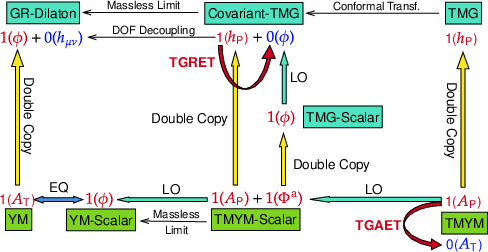
Figure 1: Schematic summary of the analytic structure, the TGRET, and the double-copy relations linking gauge theory and gravity in the topologically massive setting (N-point amplitudes and scalar–gravity interrelations).
The TMG model is extended to a covariant framework in which the metric is parametrized via a conformal transformation, introducing an unphysical dilaton ϕ: gμν=gˉμνe−κϕ
This formulation is BRST quantized with appropriate gauge-fixing and ghost sectors, systematically maintaining diffeomorphism invariance. The resulting spectrum comprises:
- One physical polarization in the massive graviton sector (helicity ±2),
- An unphysical dilaton, which upon taking the massless limit, becomes a physical massless scalar, preserving the physical DoF count (1→1 conversion graviton→dilaton).
The Landau and unitary gauges are analyzed, showing specifically how the dilaton decouples when the gauge parameter ζ→∞ (unitary gauge). Crucially, in the Landau gauge, graviton and dilaton propagators exhibit different high-energy scaling, critical for subsequent energy counting analyses.
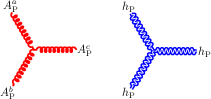
Figure 2: Structure of asymptotic states and double-copy construction, connecting gauge field and graviton sectors with explicit dilaton components.
Topological Gravity Equivalence Theorem (TGRET)
The core result is the establishment of the TGRET, a rigorous all-orders statement equating physical graviton scattering amplitudes with corresponding dilaton amplitudes in the high-energy limit: M[hP(h1),…,hP(hN)]=2−NCmodM[ϕ(p1),…,ϕ(pN)]+O(Em)
where Cmod incorporates quantum corrections. Unlike the situation for massive gauge bosons in 3D Chern-Simons Yang–Mills (TMYM), where large-E behavior is mirrored by the amplitude for transverse polarizations, TGRET demonstrates that in the gravitational sector the pertinent mapping is between physical gravitons and dilatons.
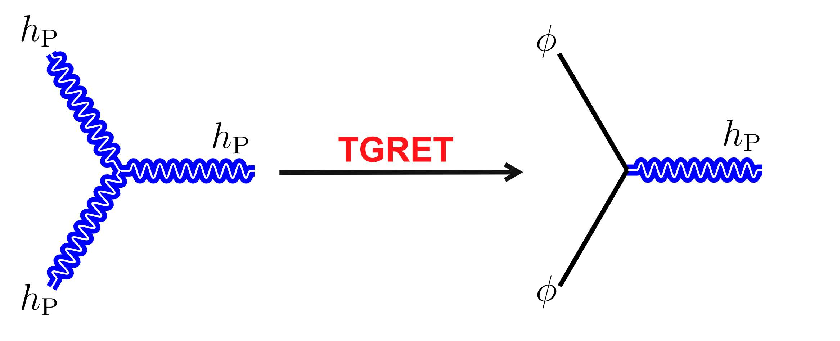
Figure 3: Feynman diagrams for triple graviton and ϕϕh processes—key for demonstrating TGRET at three-point.
This theorem explains the otherwise mysterious large power-law energy cancellations observed in direct calculations of TMG amplitudes, notably the reduction from naïve E12 scaling to E1 for the four-point amplitude. Explicit analyses are given for three- and four-point amplitudes, including all relevant diagrams.
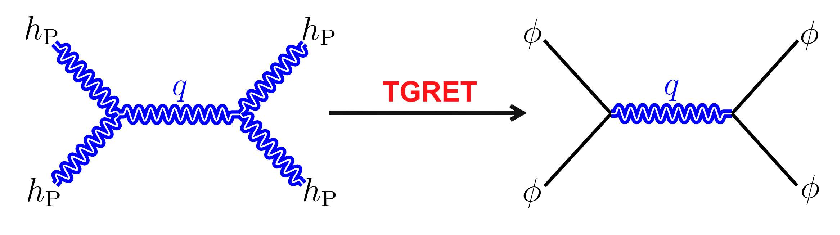
Figure 4: Four-point graviton scattering (left) and four-point dilaton scattering (right), illustrating the role of TGRET in identifying leading energy contributions.
Gravitational Power Counting and Large Energy Cancellations
Systematic application of an adapted gravitational power-counting method reveals the mechanism whereby energy scaling in TMG amplitudes is suppressed relative to naive expectation, due to the topological BRST structure, and the interrelation via TGRET between tensor and scalar amplitude sectors.
Concretely, for N-point tree-level amplitudes, the energy scaling is reduced by powers proportional to (5/2)N (Landau gauge) or (7/2)N (unitary gauge). For example, the four-graviton amplitude exhibits a cancellation from E12 (unitary gauge) or E11 (Landau gauge) to E1, with the leading power matching that of the four-dilaton amplitude.
Massive Double Copy and Color-Kinematics Duality
A central technical contribution is the extension of the double copy paradigm (color-kinematics duality à la Bern-Carrasco-Johansson) to the 3D topologically massive setting. The graviton (and dilaton) amplitudes in TMG are systematically constructed from TMYM gauge theory and TMYM–adjoint-scalar theory by:
- Demonstrating the validity of kinematic Jacobi identities for the relevant numerators, modulo generalized gauge transformations,
- Writing massive four-point amplitudes as sums over s-, t-, u-channel diagrams with squared numerators,
- Verifying that the explicit double-copied graviton amplitude matches the directly calculated result, while the double-copy of the dilaton amplitude agrees at leading order in high energy with the genuinely computed dilaton amplitude (fixed by TGRET).
The double copy is thus established to hold for physical graviton amplitudes at all energies, and for dilaton amplitudes at leading order.
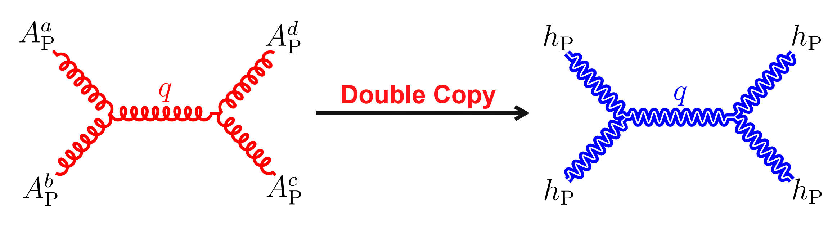
Figure 5: Schematic for massive double-copy construction—gauge boson four-point amplitude (left) mapped to physical graviton amplitude (right).
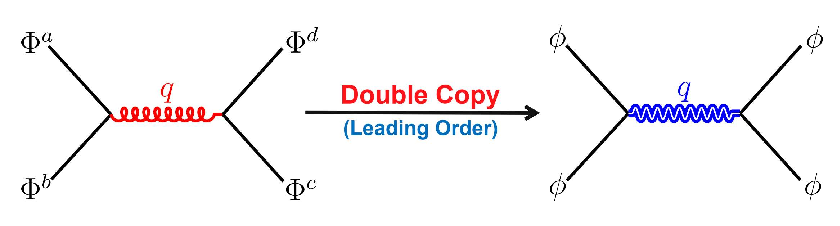
Figure 6: Double copy for adjoint scalar amplitudes (left) and leading-order dilaton amplitudes (right); full agreement at E≫m fixed by TGRET.
Furthermore, in the massless limit, the structure matches naturally onto the amplitude systematics of three-dimensional massless Yang-Mills and general relativity plus scalar.
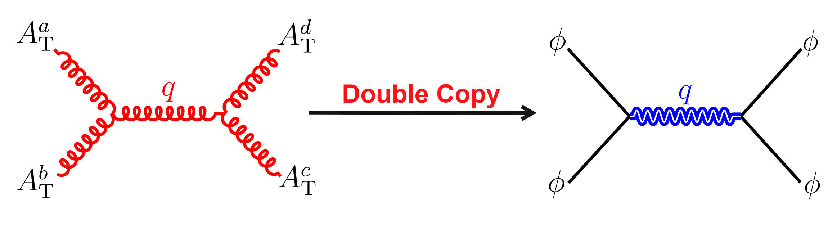
Figure 7: Four-point massless gauge boson and dilaton scattering; correspondence via massless double copy in 3D.
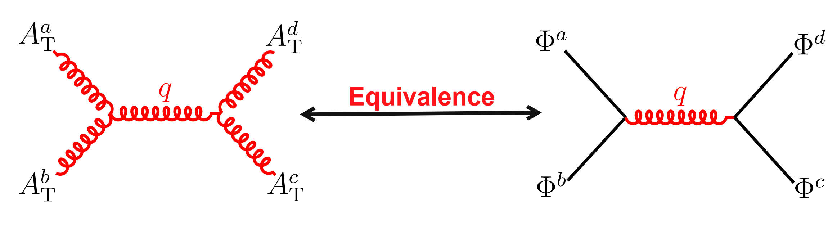
Figure 8: Explicit equality of massless gauge boson and massless adjoint scalar four-point amplitudes, as required by the matching of physical DoFs in 3D.
Explicit Results for Amplitudes
The paper provides closed-form analytic expressions for the three-point and four-point amplitudes, for both graviton and dilaton external states, in various gauges. Notable features include:
- The gauge-independence of on-shell physical graviton amplitudes (equality between Landau and unitary gauge computations despite different individual diagram behaviors),
- Explicit verification for three- and four-point TGRET (sections 4.1.1 and 4.1.2),
- The non-equivalence of high-energy graviton and transverse-mode amplitudes in TMG (contrasting with TMYM),
- The necessity of including the dilaton for a consistent covariant quantization and achieving the correct high-energy mapping.
Theoretical and Practical Implications
The results demonstrate that in TMG, the physical structure of scattering at high energies is correctly exposed only in a covariant/dilaton-extended formulation, necessitating the TGRET description. The extended double copy and power-counting rules establish a rigorous mapping from Chern-Simons TMYM into TMG plus dilaton, encapsulating the notion [Gravity]=[Gauge Theory]2 in a topologically massive setting.
Practical implications include:
- Understanding of large cancellations in TMG amplitudes, which may inform studies of finiteness and renormalizability in lower-dimensional quantum gravity,
- Algorithms for constructing TMG amplitudes from TMYM (and its scalar extension),
- Rigorous matching of DoFs under massless limits, with potential cross-applications in analyses of anyonic systems and topological phases,
- Framework for exploring further double-copy extensions in higher curvature or parity-violating backgrounds.
Conclusion
This work provides a comprehensive field-theoretic framework for analyzing graviton scattering in 3D topologically massive gravity with Chern-Simons terms. The introduction and proof of the TGRET fundamentally explain the high-energy behavior and structure of large energy cancellations, with explicit analytic verifications for low-point amplitudes. The extended double copy geometrically and computationally ties together the gauge and gravity sectors, fixing the construction of physical amplitudes.
Future works may extend these techniques to loop amplitudes, investigate implications for holographic duals, or generalize to interacting topological phases and emergent gravitation in condensed matter systems, leveraging the deep correspondences revealed by the TGRET and double-copy structure.