Modeling, Segmenting and Statistics of Transient Spindles via Two-Dimensional Ornstein-Uhlenbeck Dynamics
Published 11 Dec 2025 in q-bio.NC and math.SP | (2512.10844v1)
Abstract: We develop here a stochastic framework for modeling and segmenting transient spindle-like oscillatory bursts in electroencephalogram (EEG) signals. At the modeling level, individual spindles are represented as path realizations of a two-dimensional Ornstein{Uhlenbeck (OU) process with a stable focus, providing a low-dimensional stochastic dynamical system whose trajectories reproduce key morphological features of spindles, including their characteristic rise{decay amplitude envelopes. On the signal processing side, we propose a segmentation procedure based on Empirical Mode Decomposition (EMD) combined with the detection of a central extremum, which isolates single spindle events and yields a collection of oscillatory atoms. This construction enables a systematic statistical analysis of spindle features: we derive empirical laws for the distributions of amplitudes, inter-spindle intervals, and rise/decay durations, and show that these exhibit exponential tails consistent with the underlying OU dynamics. We further extend the model to a pair of weakly coupled OU processes with distinct natural frequencies, generating a stochastic mixture of slow, fast, and mixed spindles in random temporal order. The resulting framework provides a data-driven framework for the analysis of transient oscillations in EEG and, more generally, in nonstationary time series.
The paper introduces a two-dimensional Ornstein-Uhlenbeck model that generates spindle-like oscillatory bursts observed in EEG signals.
It employs an EMD-based segmentation method to extract spindles reliably even under variable noise conditions.
Analytical and numerical analyses reveal how noise and damping parameters modulate spindle amplitudes, durations, and inter-event intervals for neurophysiological inference.
Modeling and Statistical Analysis of Transient Spindles via Two-Dimensional Ornstein-Uhlenbeck Dynamics
Introduction and Motivation
Transient spindle-like oscillatory bursts in EEG signals are prominent during several brain states, including sleep, general anesthesia, and meditative or sensory-evoked conditions. Existing modeling approaches for these phenomena often either lack mechanistic grounding or fail to capture the statistical variability inherent to such nonstationary bursts. The study "Modeling, Segmenting and Statistics of Transient Spindles via Two-Dimensional Ornstein-Uhlenbeck Dynamics" (2512.10844) develops a rigorous stochastic modeling and signal-processing framework to clarify the mechanistic basis and statistical structure of such transient neural events.
The paper advances three core contributions: (i) a generative model for spindles rooted in a two-dimensional Ornstein-Uhlenbeck (OU) process with a stable focus, (ii) a principled segmentation procedure for extracting spindles based on Empirical Mode Decomposition (EMD), and (iii) an analytical and numerical investigation of spindle statistical properties, including burst durations, amplitudes, and inter-event intervals. The analysis further extends to coupled OU systems to study mixtures of slow and fast spindle events.
Generative Model: The Two-Dimensional OU Process
The fundamental model posits that individual spindles are path-realizations of a stochastically-driven, two-dimensional linear focus:
x˙=Ax+2σw˙
with
A=(−λω−ω−λ)
Here, λ>0 denotes damping, ω>0 is the rotational (resonant) frequency, and w is a standard planar Brownian motion. The eigenstructure of A (complex-conjugate pair −λ±iω) implies spiral trajectories contracting toward the origin in the absence of noise. Under stochastic forcing, however, trajectories exhibit intermittent excursions away from this fixed point, leading to spontaneous oscillatory bursts aligned to the natural frequency but with variable amplitude and timing.
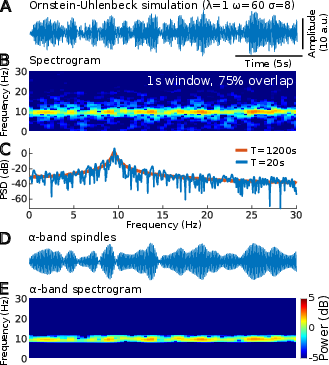
Figure 1: Spectral decomposition and time-frequency analysis of simulated OU process trajectories, highlighting intermittent spindle-like bursts and a concentrated α-band resonance.
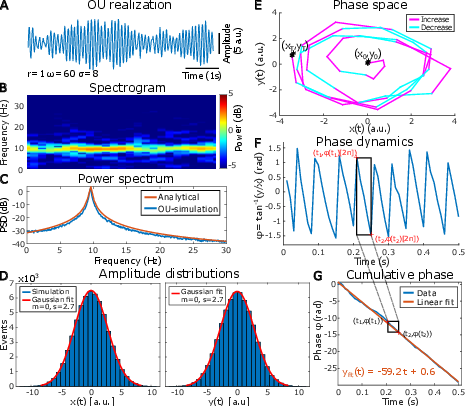
Numerical simulation under parameters ω≫λ and nontrivial σ generates robust spindle-like events. The power spectral density (PSD) of either component exhibits a resonance peak at f=ω/(2π):
S(f)=2πσ(λ2+(ω−2πf)21+λ2+(ω+2πf)21)
This yields a resonance bandwidth (FWHM) primarily controlled by λ, consistent with the stochastic resonance interpretation. Analytical and empirical amplitude marginal distributions for both components are Gaussian, yet the envelope (modulus) amplitude follows a Rayleigh-type distribution reflecting the underlying radial symmetry.
Figure 2: Core statistical properties of the two-dimensional OU process, including phase portraits, amplitude distributions, and power spectral fits.
Spindle Segmentation via Empirical Mode Decomposition
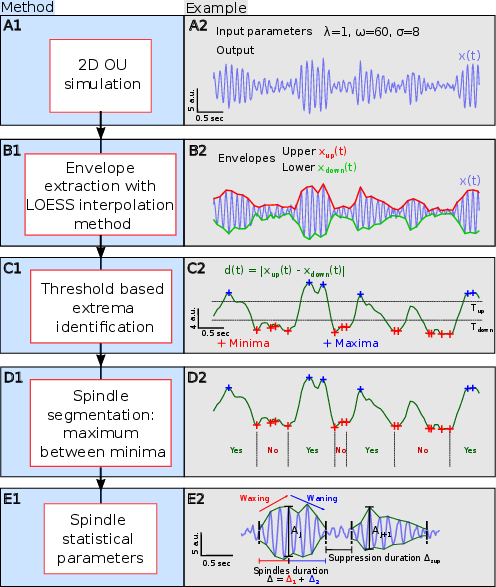
A salient technical contribution is the systematic segmentation of spindles using EMD combined with thresholding of the instantaneous envelope amplitude. The authors define a spindle as the interval between two successive local minima of the envelope (obtained by LOESS-smoothing extrema in EMD-decomposed modes) that contains a single maximum above a higher threshold. The thresholding is calibrated to the noise level via the local signal standard deviation.
Figure 3: The segmentation algorithm outlines extraction of spindle events from the envelope, computing durations of waxing/waning phases and interspindle intervals.
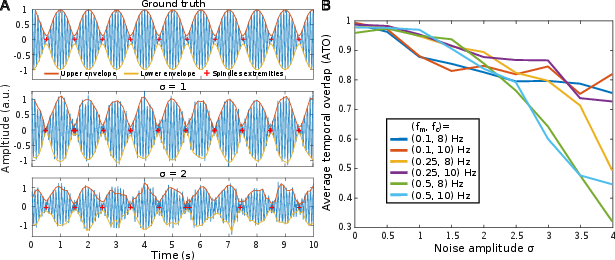
Algorithmic robustness is quantified by temporal overlap (ATO) between ground-truth analytic spindles (modulated cosines) and segmentations in the presence of additive noise. The approach remains reliable for SNRs with noise amplitude up to twice the deterministic spindle amplitude.
Figure 4: Algorithmic performance of Segmentation Algorithm (SSA) over a range of noise levels and analytic spindle parameters.
Analytical Spindle Statistics
Amplitude, Duration, and Intervals
Within the OU framework, the process radius r(t)=∥x(t)∥ obeys a SDE corresponding to motion in a quadratic-plus-log potential:
dr=(−λr+rσ)dt+2σdWt
The steady-state distribution is:
p(r)=σλrexp(−2σλr2)
The mean and variance scale polynomially with σ/λ, implying that adjusting noise or damping parameters modulates observed spindle amplitudes.
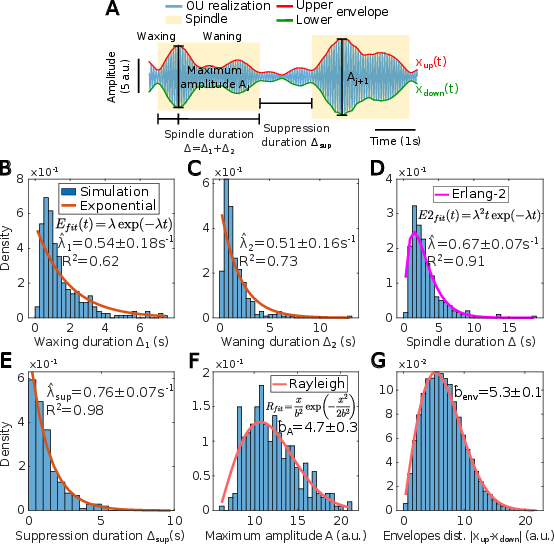
The mean first passage time (MFPT) formalism yields explicit expressions for inter-spindle intervals and durations of waxing (increasing) and waning (decreasing) phases, including asymmetries induced by the shape of the amplitude-boundary conditions. Strongly, inter-spindle intervals are O(1/λ) and do not diverge for vanishing noise amplitude, in contrast to classical barrier-escape scenarios.
Temporal Microstructure and Stability
Eigenfunction expansions (Sturm-Liouville theory) enable asymptotic characterization of the distribution of waxing/waning durations (essentially Poissonian due to a dominant leading eigenvalue). Theoretical analysis shows that long consecutive monotonic sequences of amplitude increase or decrease are exponentially rare, explaining the robust alternation between waxing and waning. This provides a rigorous basis for the observed stability of spindle shape and size.
Figure 5: Empirical distributions of spindle durations, phase durations, interspindle suppressions, and amplitude maxima, with corresponding exponential and Rayleigh fits.
Modeling Mixed-Frequency Spindle Dynamics
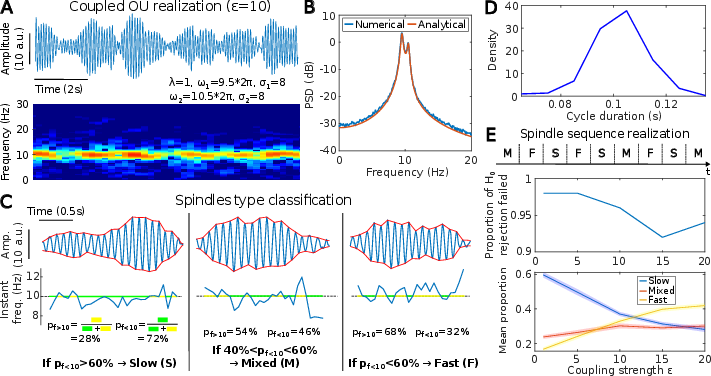
To model co-occurrence and mixture of slow and fast spindles, the study introduces a system of weakly-coupled OU processes:
With small ϵ>0, the observed signal exhibits stochastic alternations between slow, fast, and mixed spindles. Spectral analysis confirms the presence of multiple peaks, and statistical tests (Wald-Wolfowitz runs) demonstrate the random ordering of spindle types, implying absence of deterministic sequencing.
Figure 6: Coupled OU model realizations, revealing mixed-frequency spindle events and statistical randomization of type sequences with varying coupling.
Implications, Limitations, and Future Directions
This framework demonstrates that core features of neural spindles—transient, stochastic bursts, frequency selectivity, stochastic regularization of burst shapes—can be parsimoniously captured by low-dimensional linear SDEs. The explicit statistical calculations offer mathematical underpinnings for observed nonstationary dynamics in neural time series and facilitate principled parameter estimation for physiological inference.
Potential applications include:
Biomarker Discovery: Quantitative deviations in spindle statistics can be evaluated as neurophysiological biomarkers (e.g., for sleep staging or anesthesia depth).
Generalized Multiband Modeling: Extension to coupled OU networks for modeling richer oscillatory nesting/multiplexing beyond α-band physiology.
Real-Time Signal Decomposition: The EMD-based segmentation is viable for adaptive or closed-loop EEG analysis, with well-characterized noise robustness.
Inference of Microcircuit Parameters: Variations in λ, ω, or coupling strengths can potentially be mapped to synaptic or network physiological changes.
Key open problems remain—such as analytic characterization of spindle amplitude maxima, rigorous treatment under non-Gaussian driving noise, and extension to nonstationary or time-varying OU parameters for modeling arousal transitions.
Conclusion
The Ornstein-Uhlenbeck-based framework for spindle analysis unifies mechanistic generative modeling with statistical segmentation and inference. Theoretical and algorithmic advances in this study delineate how noise-driven planar dynamics can replicate and quantify the phenomenology of transient bursts in neural recordings. These results provide a solid analytic and algorithmic foundation for both neuroscientific theory and practical computational EEG analysis.
Reference:
C. Sun, D. Fettahoglu, D. Holcman, "Modeling, Segmenting and Statistics of Transient Spindles via Two-Dimensional Ornstein-Uhlenbeck Dynamics" (2512.10844)
“Emergent Mind helps me see which AI papers have caught fire online.”
Philip
Creator, AI Explained on YouTube
Sign up for free to explore the frontiers of research
Discover trending papers, chat with arXiv, and track the latest research shaping the future of science and technology.Discover trending papers, chat with arXiv, and more.