- The paper demonstrates that a sequence of moderate-mass impacts can build a moon matching Earth’s isotopic and compositional signatures (d_c ≤ 0.3) while achieving realistic masses.
- The paper employs high-resolution SPH simulations to model chains of impacts, tracking debris disks, angular momentum, and cumulative mixing from 0.57 to 1.0 Earth masses.
- The paper finds that successive collisions not only produce a lunar-mass body with low iron content but also reconcile statistical and dynamical constraints of Moon formation.
Multiple Impact Pathway for Lunar Origin: A Numerical Assessment
Introduction
The canonical single giant impact hypothesis for the Moon's formation posits a late collision between Earth and a Mars-sized impactor, ejecting material into orbit to accrete into the Moon. This scenario successfully explains the high angular momentum and relatively iron-poor bulk composition of the Moon. However, persistent difficulties remain, including the necessity for highly specific impactor properties and the anomalously high Earth-Moon isotopic similarity across O, Ca, Ti, Si, and W, which is not reproduced by most plausible impactor population statistics or standard N-body planet formation models. In response, this study presents a comprehensive numerical evaluation of the multiple impact hypothesis, where a sequence of moderate-mass collisions progressively grows both the proto-Earth and its satellite, thereby relaxing the compositional and dynamical constraints of the canonical scenario (2512.10757).
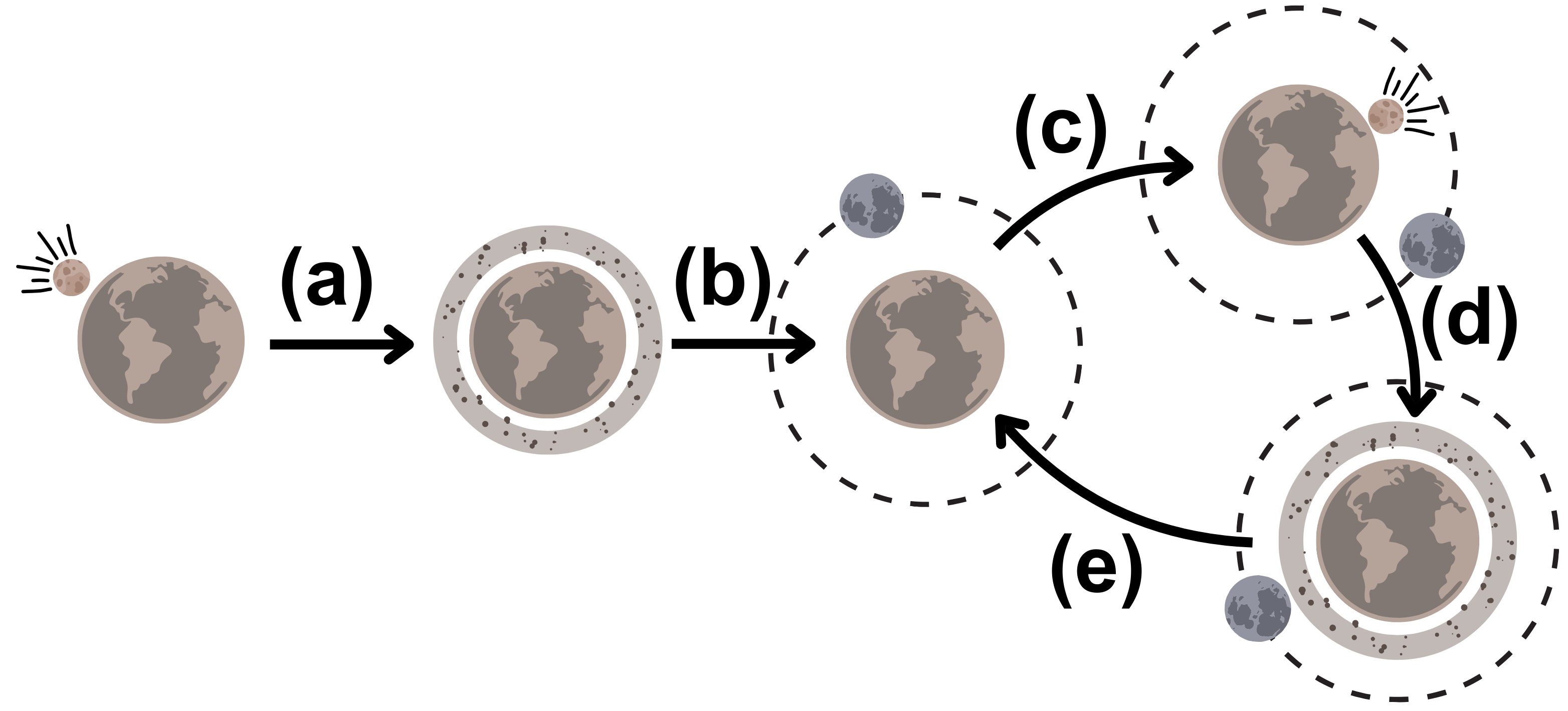
Figure 1: Cartoon schematic of the multiple impact Moon-forming scenario, where a sequence of impactors generates debris disks, sequentially forming moonlets that merge to build the modern Moon.
Model Overview and Methodology
This work applies high-resolution smoothed particle hydrodynamics (SPH) simulations (using SWIFT) to chains of four impacts, following proto-Earth growth from 0.57 to 1.0 M⊕. Target and impactor masses are sampled from distributions grounded in N-body simulations of solar system terrestrial planet assembly. Post-impact debris disks are analyzed for mass and angular momentum to model moonlet formation according to hybrid analytical/semi-empirical prescriptions. Crucially, both the accretion of planetary mass and the compositional inheritance of each impact are tracked, enabling assessment of how multiple moon-forming events blend isotopic and chemical reservoirs.
Pre-impact targets are initialized with rapid (3 hour) spin periods, maximizing debris disc production. Individual simulation outputs feed into subsequent collisions, with moonlets carried forward as point masses on orbits at 8 R⊕. The cumulative output is a set of planet-moon systems for each chain, subjected to compositional, angular momentum, and bulk-mass constraints.
Results
System Growth Trajectories
Simulations produce a range of outcomes in terms of both planet and moon mass accretion. For example, in several chains, the planet achieves >0.9 M⊕ and the final moonlet exceeds 0.8 MMoon. Masses are accumulated incrementally, as shown for representative chains below.
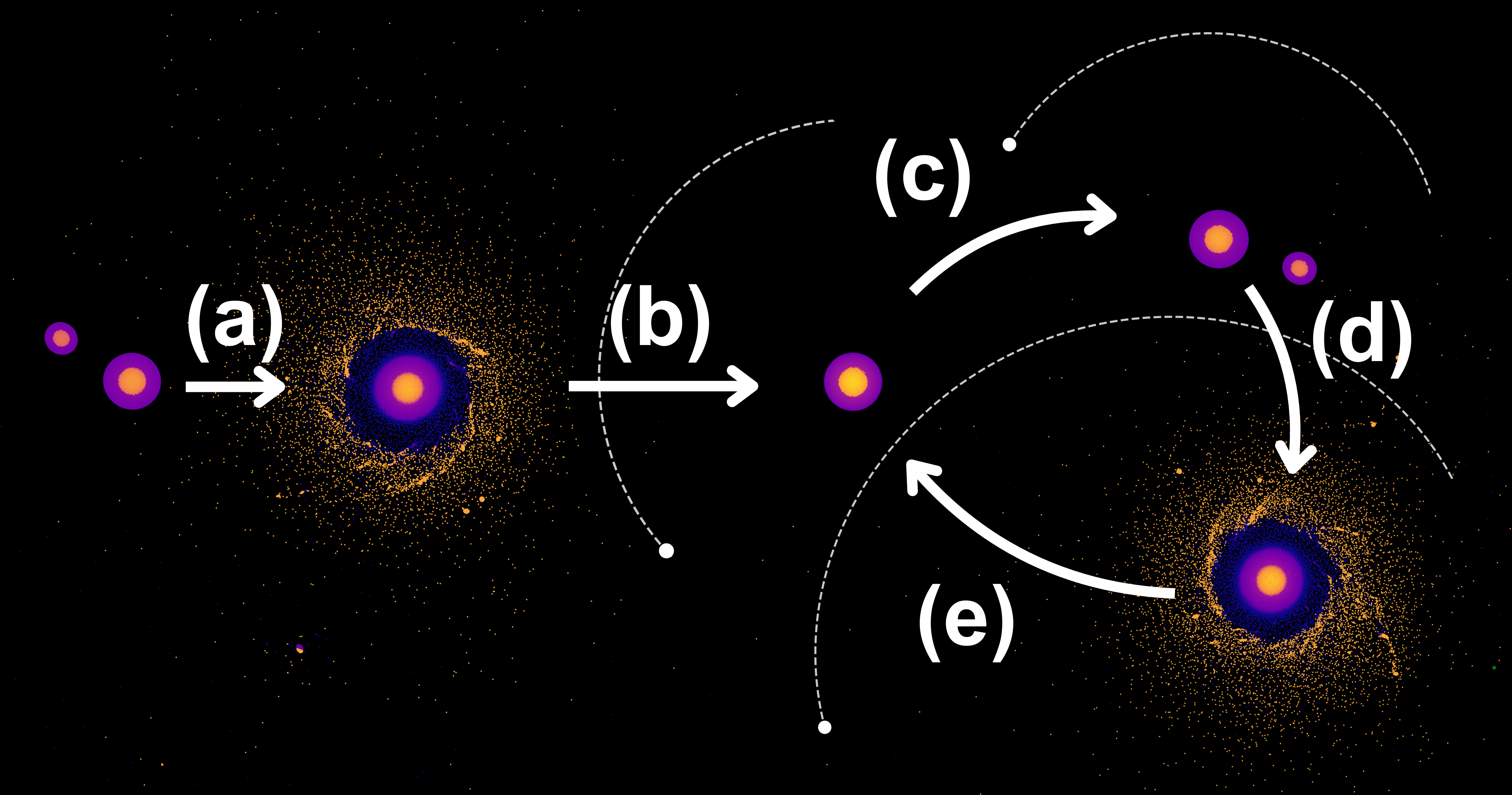
Figure 2: Snapshots from SPH simulations show disk and moonlet accretion after the first and second impacts in Chain 1. Color-coding indicates differentiated planetary layers, disk origins, and unbound debris.
Over successive impacts, not only do planet and moonlet masses increase, but compositional similarity between the two bodies also improves due to mixing of material ejected from both target and impactors in each event.
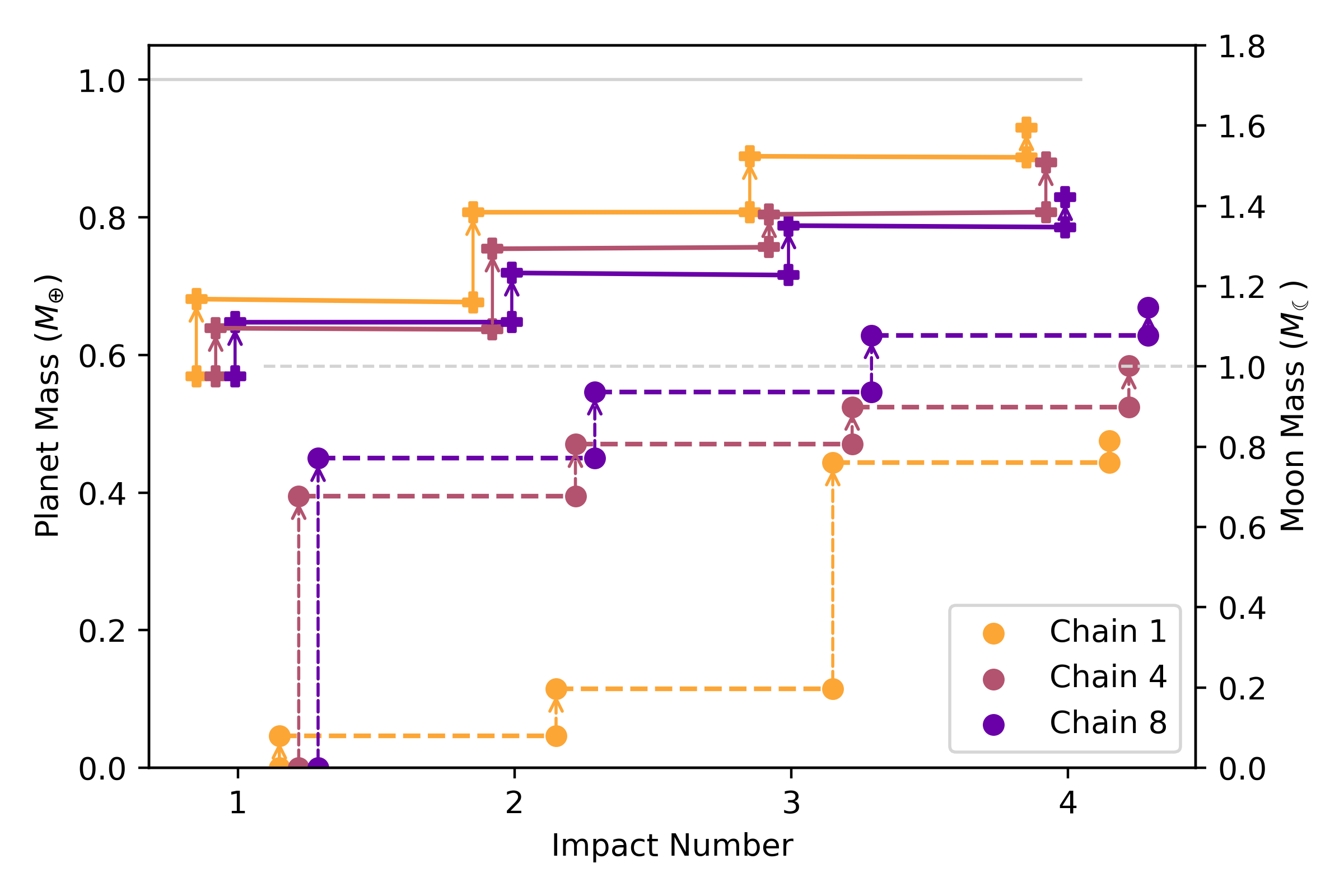
Figure 3: Planet and moonlet mass evolution across four impacts for three selected chains, shown versus the modern Earth and Moon masses for context.
Compositional Outcomes
A primary constraint for any Moon-forming scenario is the compositional distance dc between the silicate mantles of Earth and Moon. Whereas canonical impacts generally yield dc≥0.3 unless special conditions are assumed, several multiple impact chains demonstrate final dc≤0.3, even with the inclusion of material from four distinct impactors. Chain 4 is notable for achieving dc=0.273 with a final moon mass very close to the modern Moon.
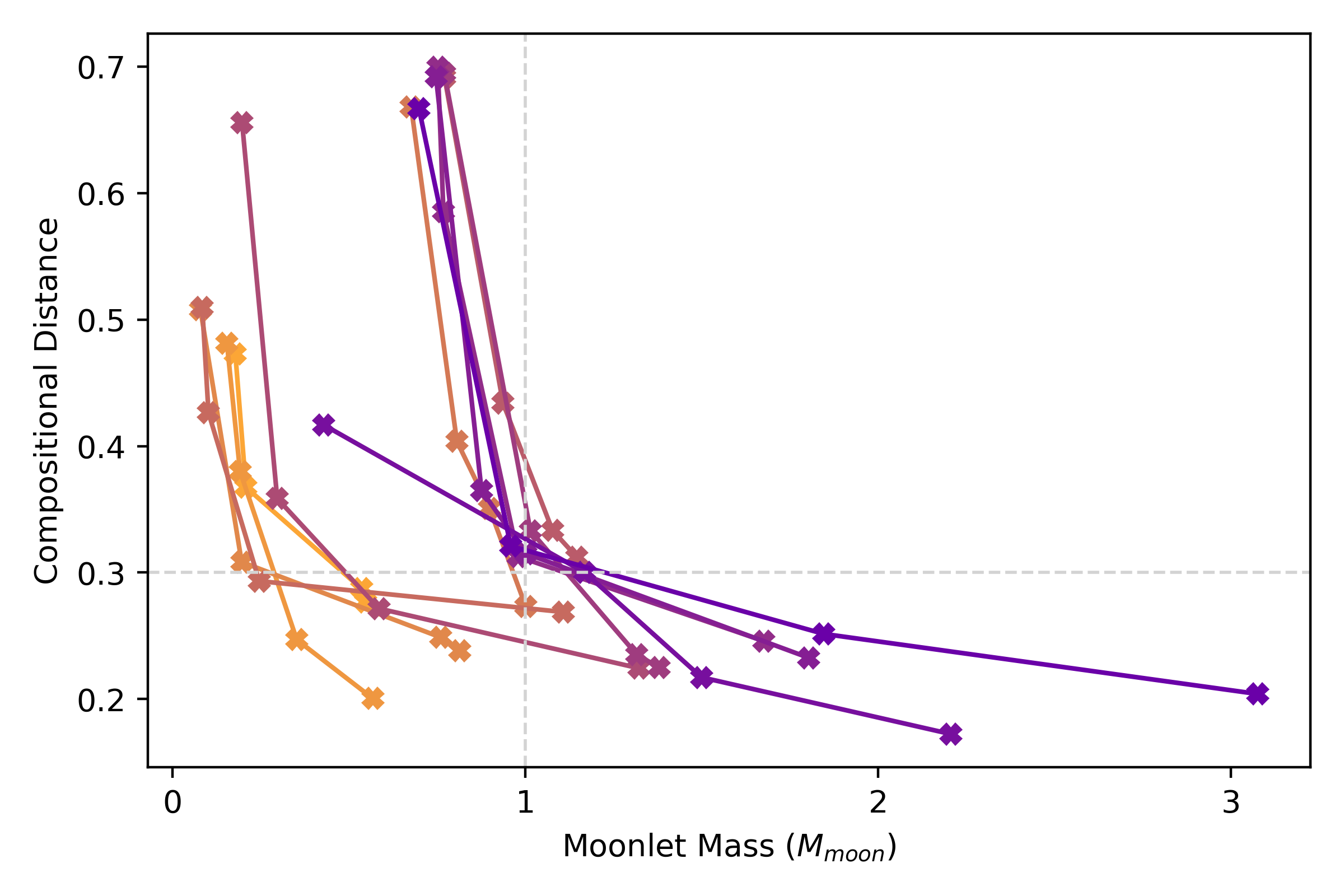
Figure 4: Compositional distance between moonlet and planet plotted against accrued moon mass for all simulated chains; successful chains (meeting mass and dc thresholds) reside in the lower right.
These results suggest that cumulative mixing across multiple moderate-mass impacts is effective at homogenizing isotopic reservoirs, in line with observed lunar and terrestrial mantle compositions. Additionally, the modeled moonlets have iron fractions (2.56–6.02%) consistent with the observed depletion of lunar core material.
Angular Momentum and Dynamical Metrics
Total angular momentum accumulated post-chain varies, ranging from 1.58–3.1 LEM, with most successful chains reaching values consistent with the range possible for the early Earth-Moon system prior to loss processes such as evection resonance. Notably, despite simplifications (e.g., angular momentum resets between collisions), at least one chain—Chain 4—satisfies the compositional, mass, and system angular momentum requirements simultaneously, except for a somewhat low total planet mass (0.88 M⊕).
Theoretical and Practical Implications
The multiple impact hypothesis addresses key limitations of the canonical giant impact model:
- Statistical Plausibility: The need for a near-identical composition between Earth and a giant impactor is circumvented. Moderate-mass impactors are far more frequent and better matched to planet formation simulations.
- Compositional Homogenization: Successive impacts yield enhanced isotopic mixing, broadening the region of allowable material feeding zones contributing to both planet and moon.
- Preservation of Core-Formation Histories: Multiple core formation episodes inherent to this model provide mechanisms for partially equilibrating isotopic anomalies sensitive to siderophile/lithophile partitioning (notably W, as required by observation).
- Flexibility in Angular Momentum Evolution: Moderate-mass impacts on fast-spinning targets can accumulate sufficient angular momentum, and plausible removal via early resonance-driven evolution is consistent with dynamical studies [Cuk2012, Cuk2021].
From a practical standpoint, the successful formation of lunar-mass satellites with correct iron depletion and compositional similarity in this regime enhances the credibility of the multiple impact pathway. Remaining issues include the evolution and survival of moonlets during and between impacts (with studies such as [Citron18] highlighting possible loss/merger scenarios), and the precise fate of angular momentum in the presence of overlapping dynamical resonances and obliquity evolution.
Future Directions
Further progress requires simulating long-term dynamical stability and tidal evolution with multiple moonlets, including their interactions and mergers, and explicit tracking of angular momentum through more realistic, continuous evolutionary models. The inclusion of pre-existing moonlets in future SPH chains, as supported by preliminary studies in this work, is likely to systematically increase disk yields and moon masses. Detailed geochemical modeling to resolve tungsten isotopic anomalies further will be essential for robust validation of this scenario.
Conclusion
This work provides detailed, state-of-the-art numerical evidence that multiple moderate-mass impacts, typical of stochastic differentiation-era planet growth, can collectively produce a planet-moon system with the observed mass, compositional, and dynamical properties of Earth and its Moon (2512.10757). The multiple impact pathway removes the statistical improbability and isotopic hurdles embedded in the giant single impact scenario, representing a compelling, physically motivated alternative for lunar origin modeling.