- The paper presents a rigorous proof of the existence and classification of twisted homoclinic orbits by mapping Lorenz and Chen systems to a universal normal form.
- It employs nonlocal manifold analysis, Lyapunov functions, and Riccati equations to characterize bifurcation structures that distinguish orientable and non-orientable attractors.
- The study delineates clear parameter regimes separating Lorenz-like and Chen-like dynamics, offering practical insights for designing chaotic systems.
Introduction and Problem Statement
This work presents a comprehensive, mathematically rigorous investigation into the homoclinic bifurcation structure underpinning the Lorenz and Chen families of dynamical systems, formulated via a universal normal form (UNF). By reducing generalizations of the Lorenz and Chen systems to a minimal, canonical parameterization, the study delineates both common and distinct homoclinic phenomena, offering explicit bifurcation-theoretical and topological classifications of attractors.
The UNF under consideration encapsulates three-parameter generalizations of the classical Lorenz system, with coordinates (x,y,z) and positive parameters (α,β,λ). Through explicit, orientation-tracking diffeomorphisms, the generalized Lorenz, Chen, Lu, and Tigan systems are mapped to this UNF. This mapping is singular along a parameter locus (q=0), separating Lorenz-like and Chen-like regimes.
The parameter space is partitioned via analytical conditions expressed in terms of λ and a characteristic combination A=(α+β)/2:
- Lorenz-like systems: λ>A
- Chen-like systems: λ<A
- The singular line λ=A corresponds to the Tigan system.
The domain structure in the (A,λ) plane is crucial for distinguishing the nature of attractors and homoclinic connections in each family.
Nonlocal Manifold Analysis and Twisted Homoclinic Orbits
A detailed nonlocal analysis of invariant manifolds associated with the saddle at the origin is conducted, employing Lyapunov functions and Riccati equations to track the geometry and rotation of stable and unstable manifolds. The main results show for the UNF:
- An explicit construction of the 1D unstable (Wu) and 2D stable (Ws) manifolds is derived, with special attention to their intersection properties on suitable Poincaré sections.
- The stable manifold Ws in Chen-like parameter regions exhibits a sequence of transverse folds and rotations about the axis I, generating an infinite set of “twisted” homoclinic orbits, each characterized by the integer number of windings.
- In Lorenz-like regimes, homoclinic connections are untwisted (oriented), corresponding topologically to classical butterfly-like returns.
Classification and Bifurcation of Homoclinic Orbits
The principal result is the rigorous proof of the existence of an infinite sequence of bifurcation surfaces in parameter space, each corresponding to a pair of symmetric homoclinic orbits with distinct topological type:
- For each positive (α,β), there exists a primary surface λ=λ0(α,β) supporting oriented (untwisted) homoclinic connections, responsible for the classical Lorenz attractor.
- In the Chen-like regime, additional surfaces α=αk(λ,β), indexed by k∈N, correspond to twisted homoclinic orbits—each with m or m+21 windings—an invariant not present in the Lorenz case.
- The presence of twisted (non-orientable) homoclinic orbits is rigorously traced to the nonlocal rotation of Ws and is inherited by the topology of Chen-like attractors.
Such bifurcations are codimension-one within the UNF and remain robust under perturbations of system parameters, supporting the physical relevance of the mathematical results.
Bifurcation Diagrams and Attractor Scenarios
The theoretical claims are substantiated by extensive numerical bifurcation diagrams for representative parameter cuts:
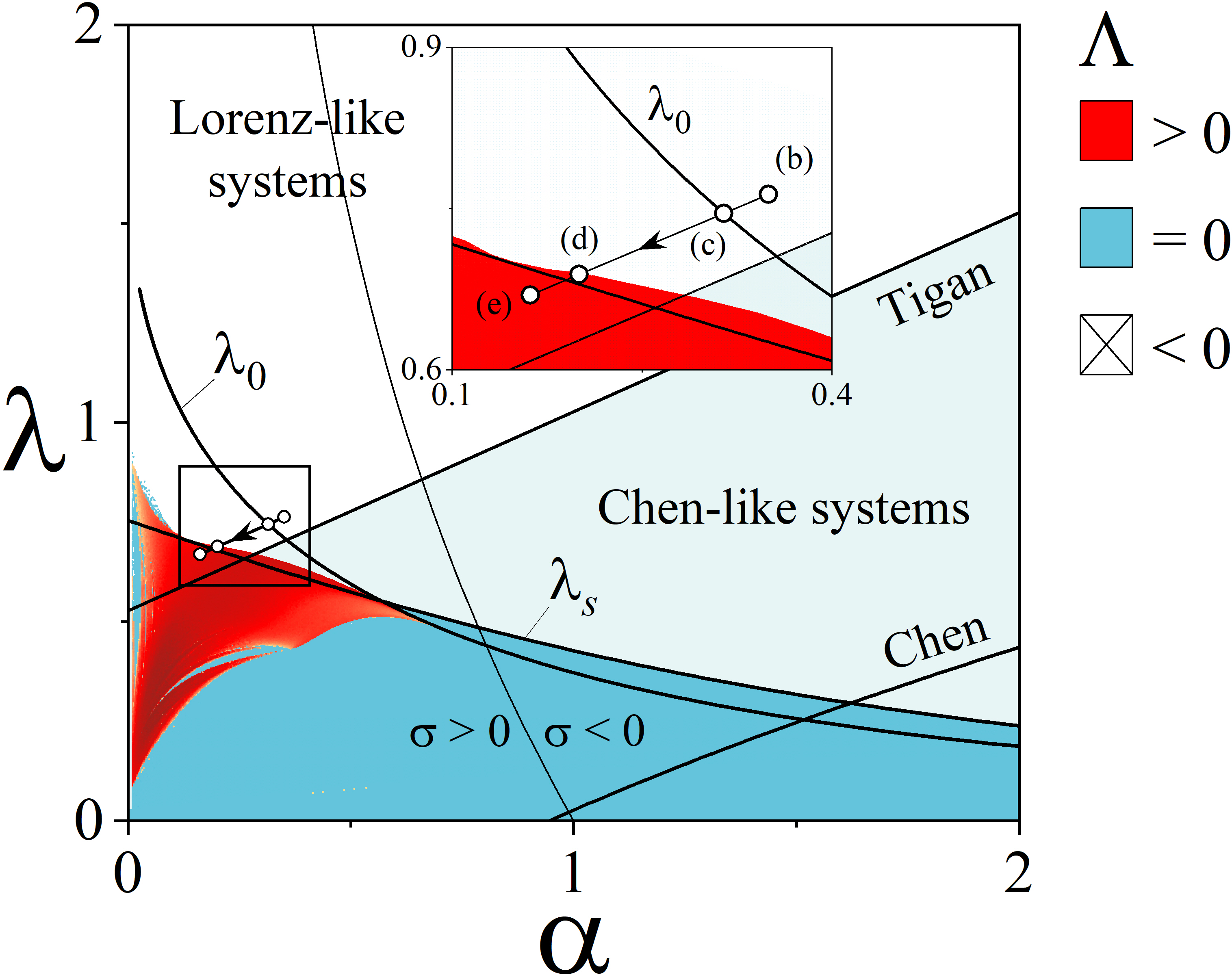
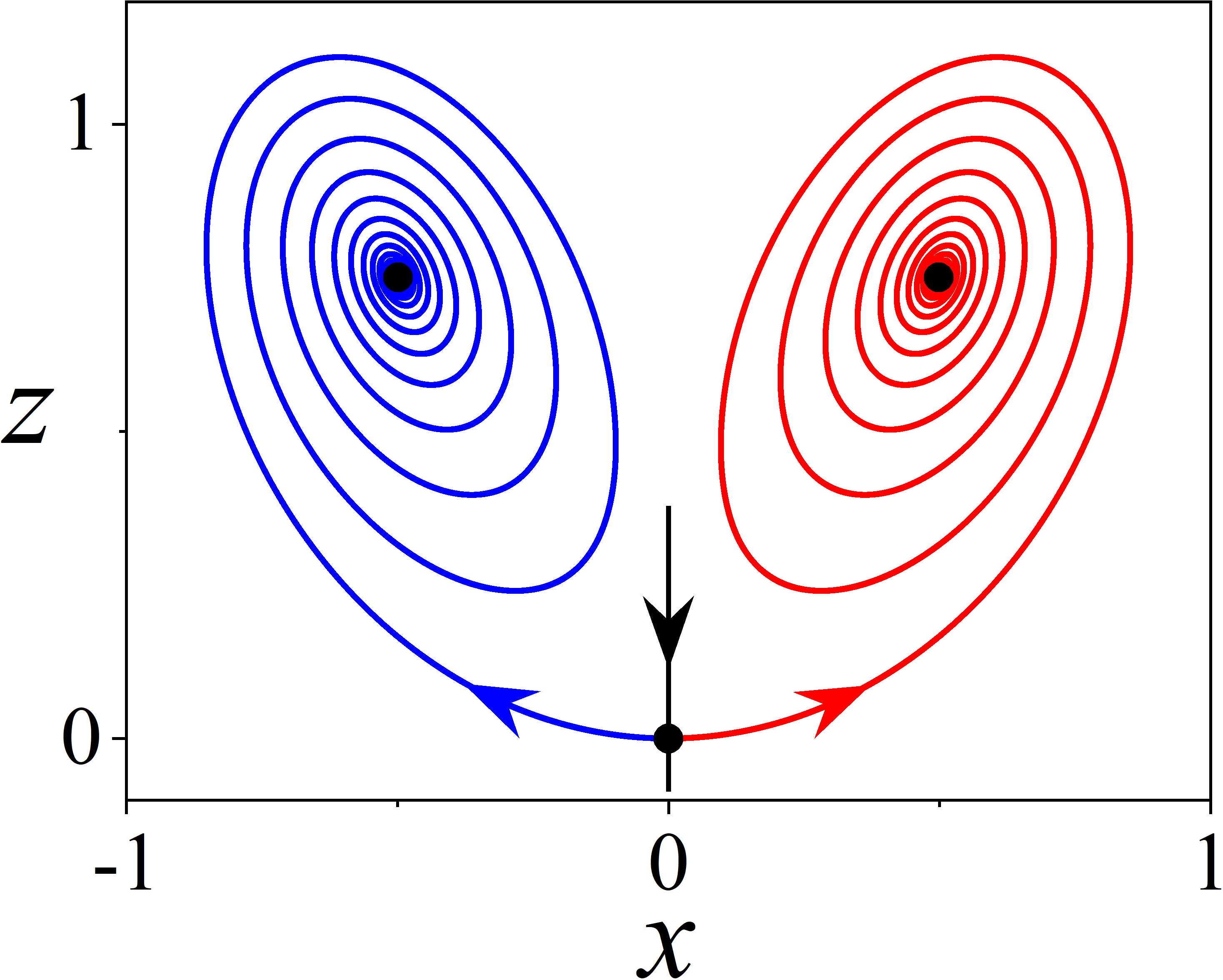
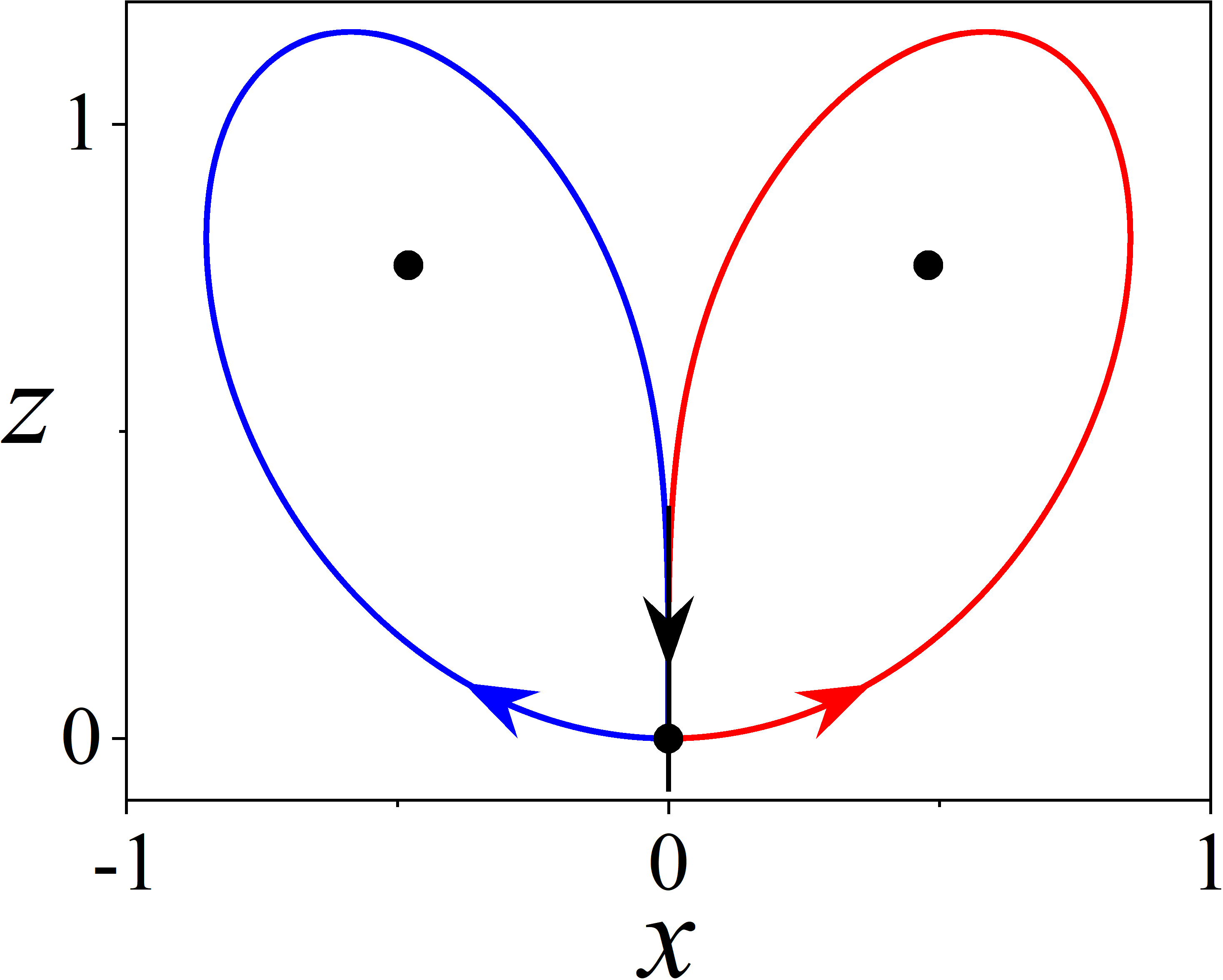
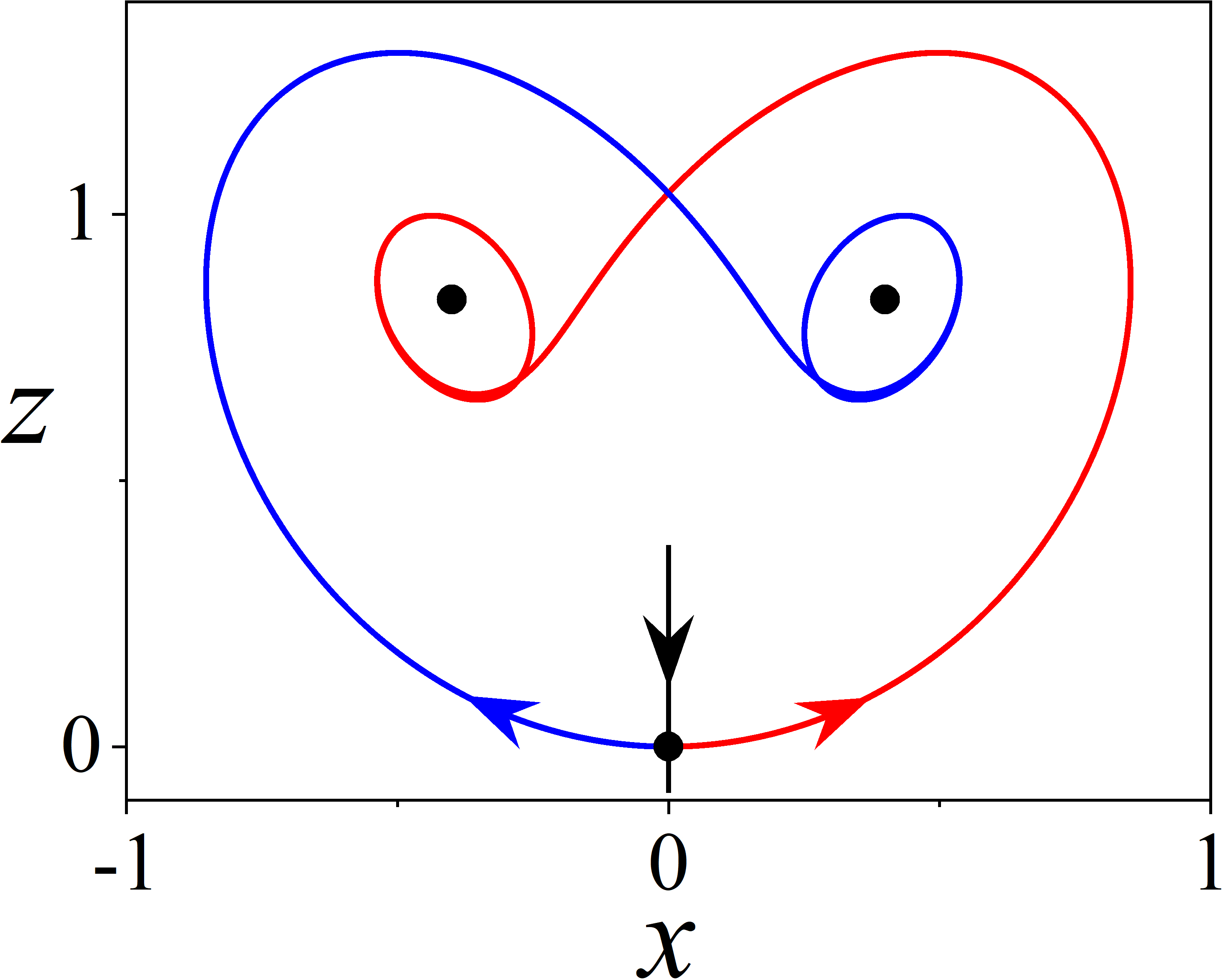
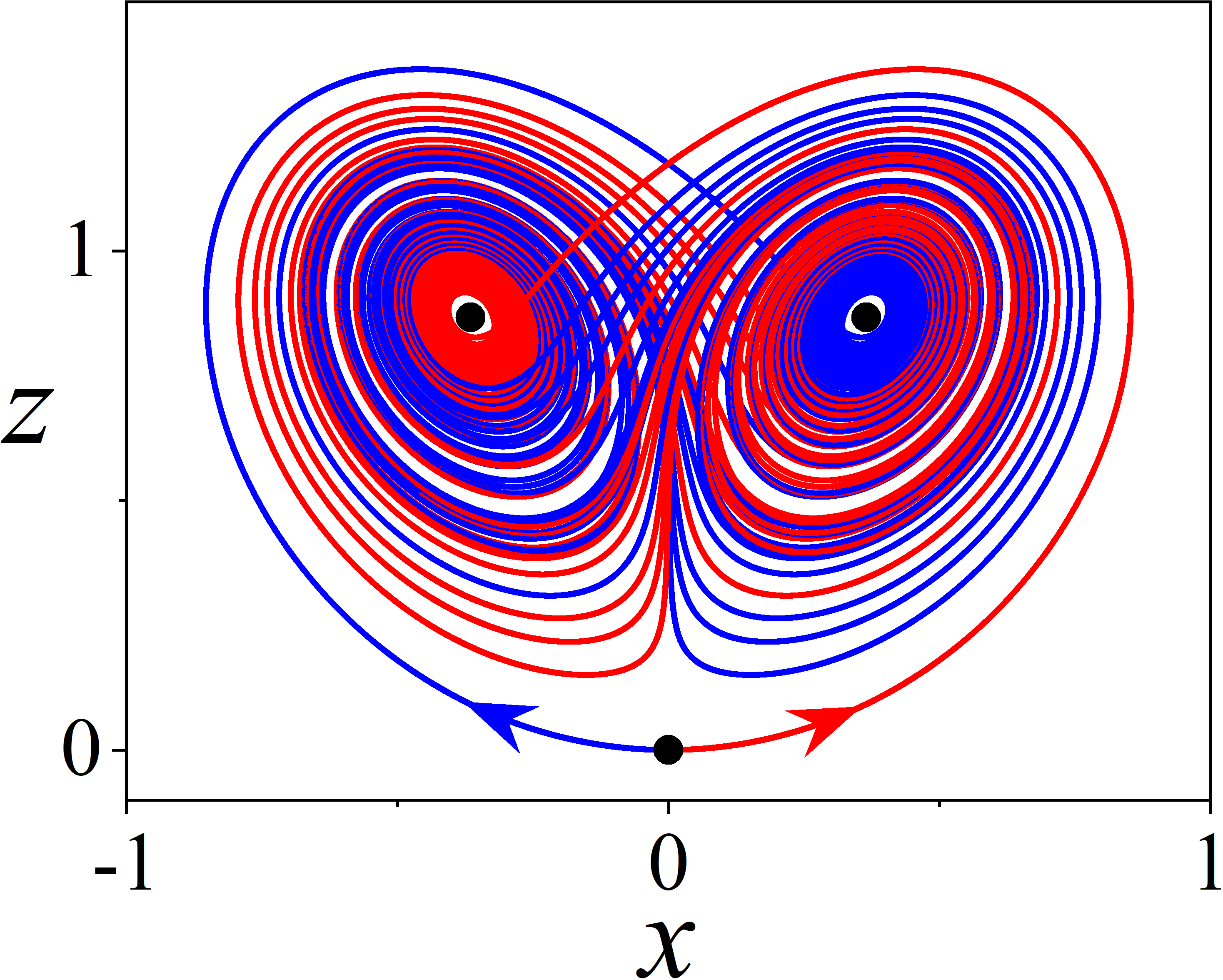
Figure 2: The bifurcation diagram of the universal normal form for β=1.05487 illustrates classical transitions to chaos and the Lorenz attractor structure in the Lorenz-like regime.
An analogous diagram for the Chen-like parameter set exposes the proliferation of twisted homoclinic connections, corresponding to more complex, multi-scroll attractors.
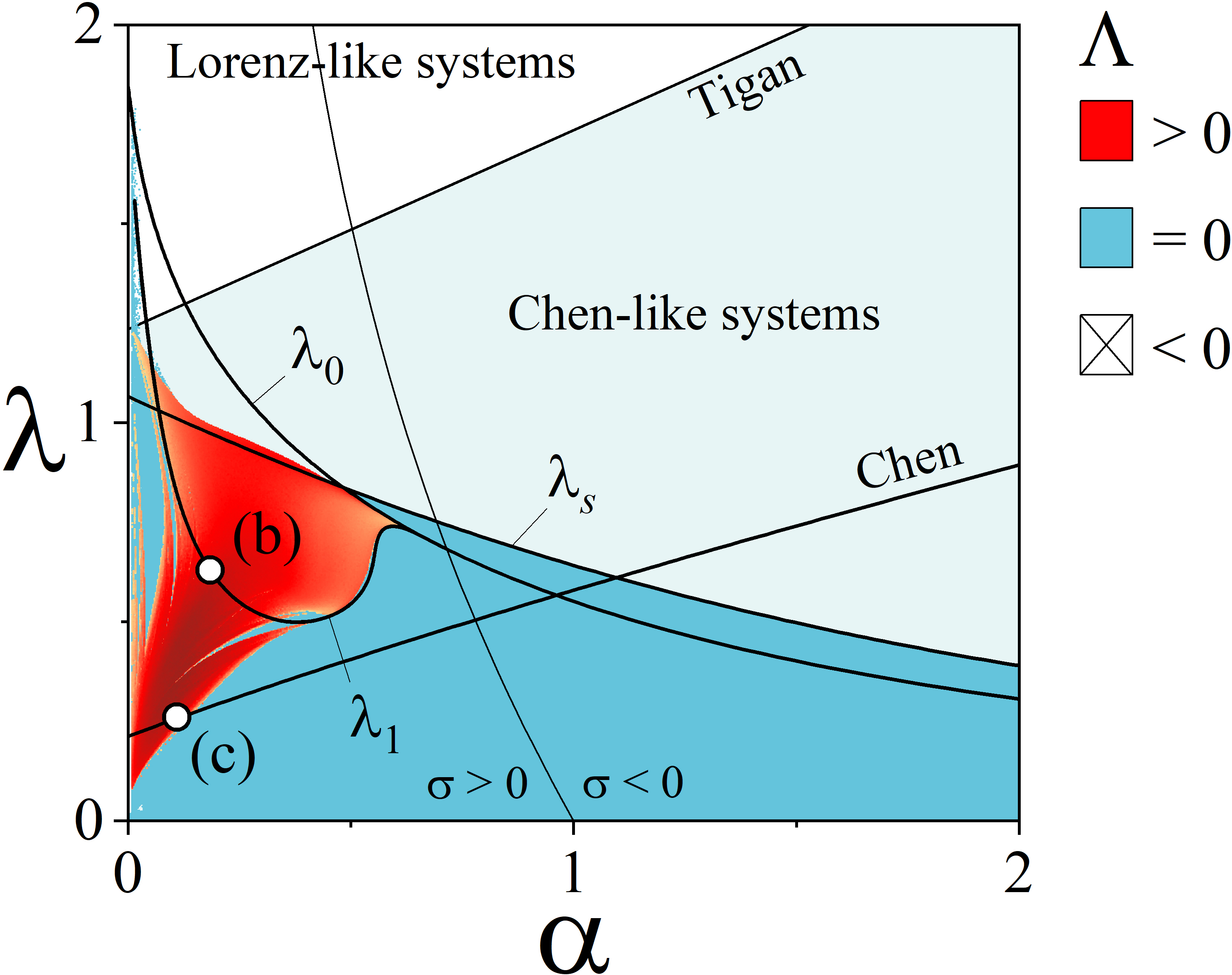
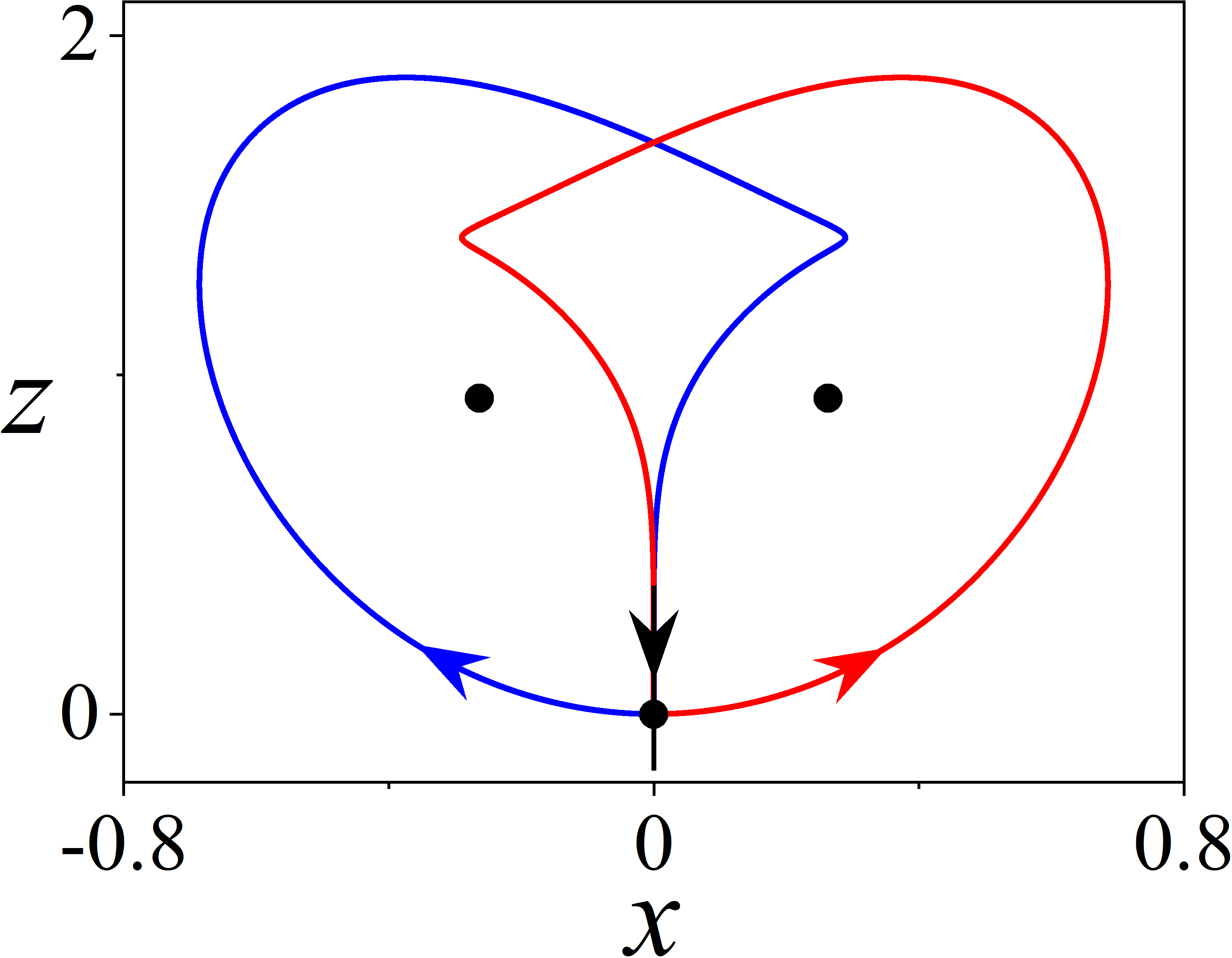
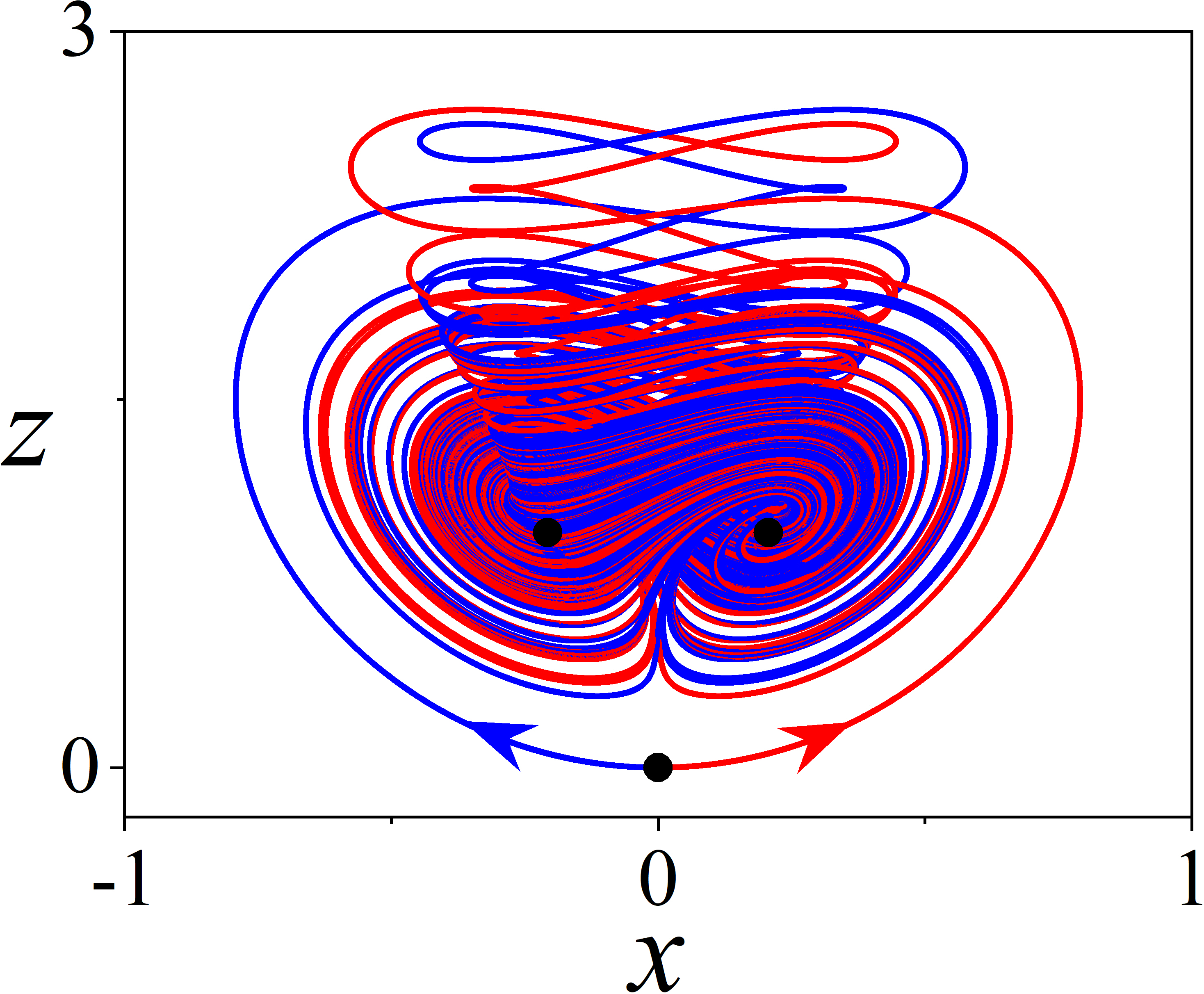
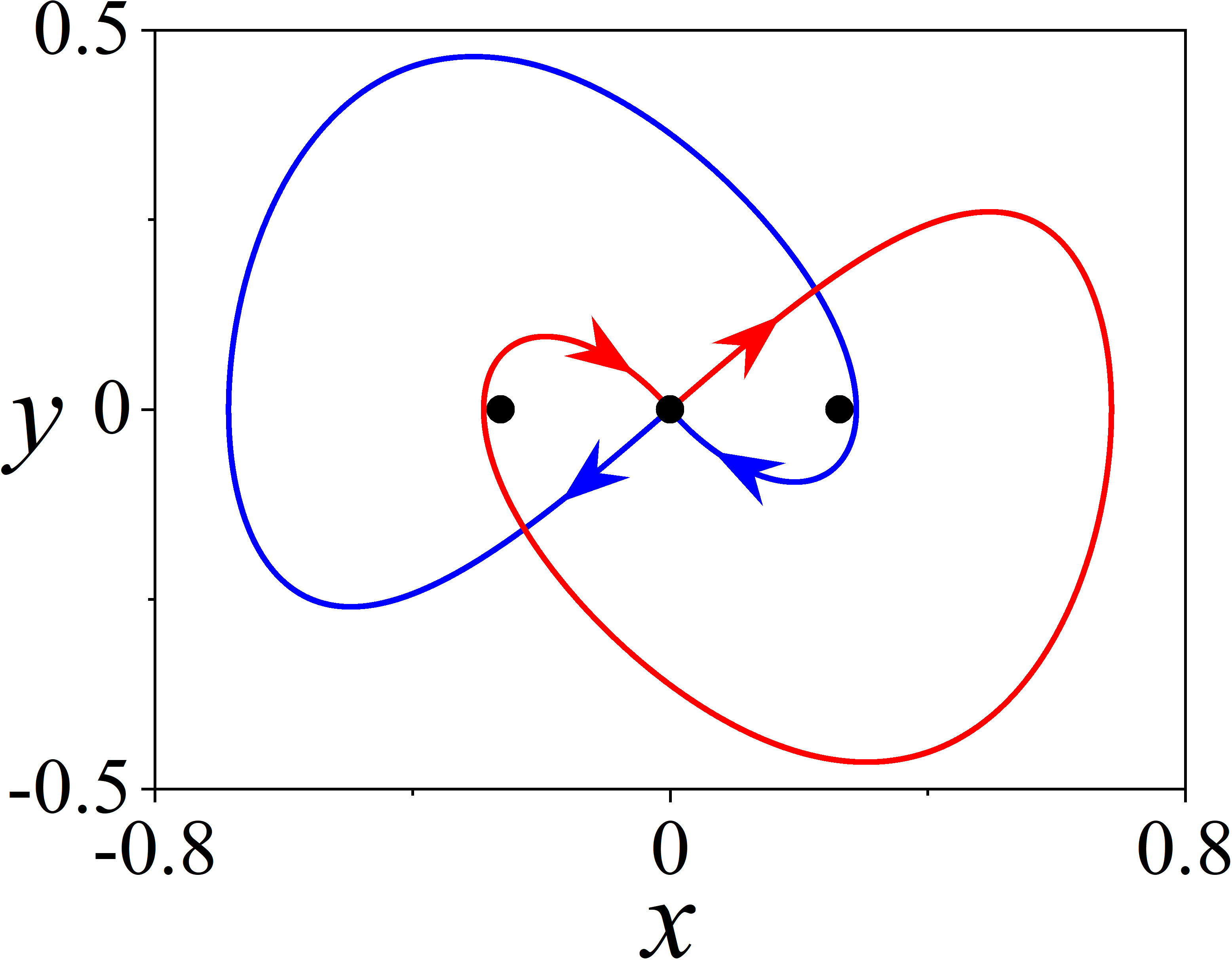
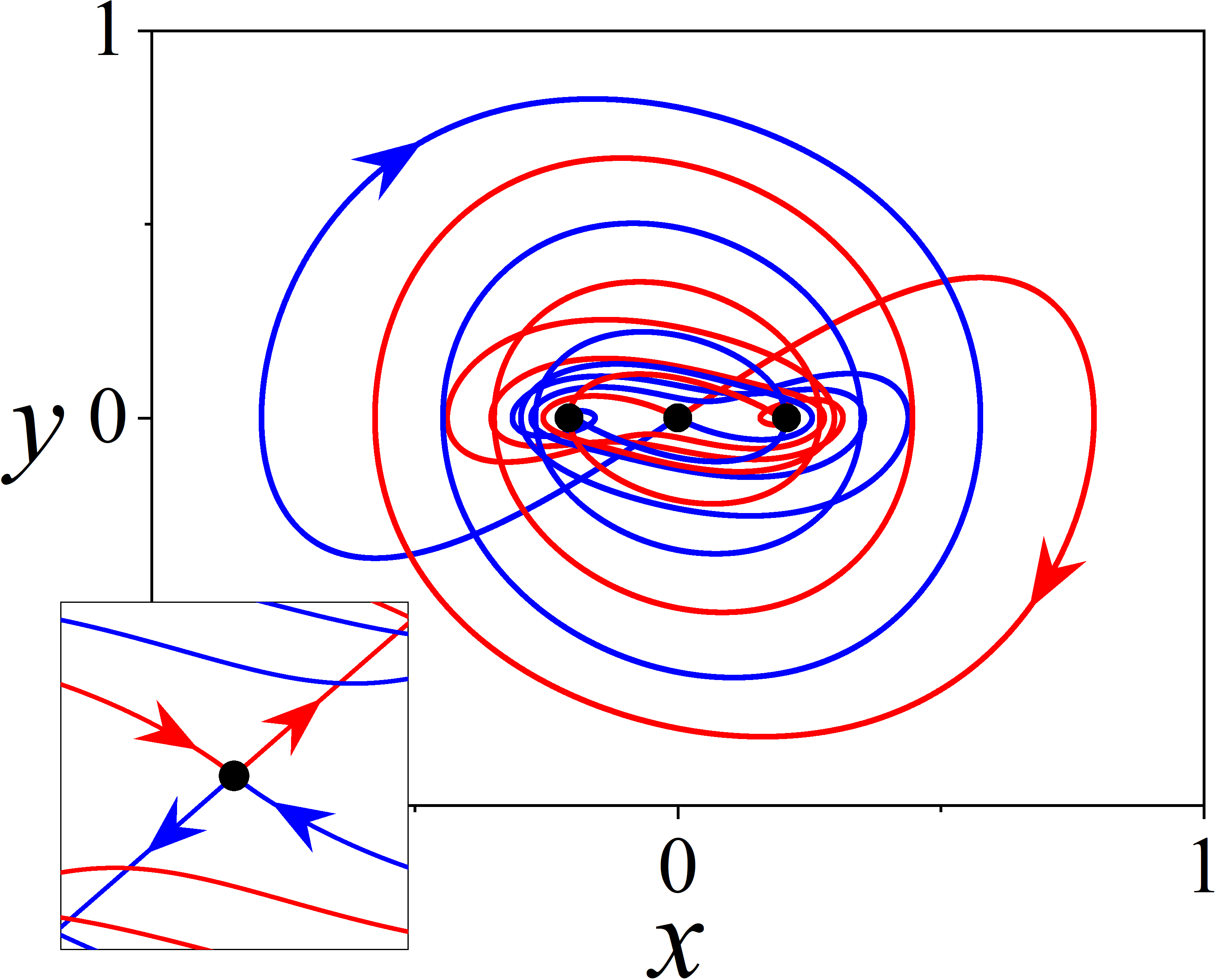
Figure 4: The bifurcation diagram of the universal normal form for β=2.47 delineates the locus of twisted homoclinic bifurcations distinctive for Chen-like systems, with regions supporting non-orientable attractors.
Phase portrait analysis confirms that attractor topology changes fundamentally—Chen-like attractors feature additional symbolic dynamics associated with the number of rotations around the axis of symmetry, absent from the Lorenz scenario.
Theoretical and Practical Implications
The study provides an explicit, mathematically rigorous mechanism for the emergence of non-orientable attractors within Chen-like systems, clarifying ambiguities in prior literature regarding the topological relationship between Lorenz and Chen attractors. The main theoretical implication is the strict non-conjugacy of the two attractor types resulting from the existence of twisted homoclinic connections exclusive to Chen-like parameter domains.
From a practical standpoint, the work offers:
- Parameter regime boundaries for engineering and physical modeling using Lorenz-like and Chen-like templates.
- Analytical predictions about the onset of structurally complex, possibly multi-stable or non-orientable chaotic behavior in systems with axial symmetry subject to parameter drift across the Lorenz–Chen boundary.
- Pathways for constructing new classes of attractors with controlled topological invariants for applications in secure communications or analog computation exploiting chaos.
The clarification of bifurcation structure also informs the design of global continuation schemes and homoclinic-heteroclinic detection algorithms in high-dimensional parameter spaces.
Conclusion
This work presents a rigorous, constructive proof of the existence and classification of twisted homoclinic orbits in the universal normal form encompassing Lorenz and Chen systems. The analysis demonstrates the topological distinctions between Lorenz- and Chen-like attractors, attributed to the presence of twisted homoclinic orbits in Chen-like regimes. An infinite sequence of such bifurcations is established, leading to a hierarchy of attractors parametrized by the number of rotations around the invariant axis. The results resolve longstanding theoretical questions on the conjugacy and fundamental differences between these canonical chaotic systems, and open avenues for the systematic discovery of new classes of strange attractors in symmetric dynamical systems.