- The paper develops a rigorous model showing that SAWs induce valley currents via the valley acoustogalvanic effect in intervalley coherent states.
- Numerical simulations in rhombohedral trilayer graphene reveal a significant Ω⁻² divergence in valley current response driven by nonreciprocal pseudo-superfluid density.
- The work demonstrates the experimental viability of detecting SAW-induced valley currents using nonlocal valley-Hall and optical Kerr rotation techniques.
Surface Acoustic Wave-Driven Valley Current Generation in Intervalley Coherent States
Overview and Motivation
This study presents a thorough theoretical investigation of anomalous transport phenomena induced by surface acoustic waves (SAWs) in two-dimensional (2D) honeycomb materials with intervalley coherent (IVC) order. IVC states, which exhibit spontaneous breaking of valley gauge symmetry, serve as analogs to gauge symmetry-breaking superconductors. The paper develops a rigorous framework for valley current generation by SAWs via the valley acoustogalvanic (VAG) effect, elucidates the analogy with superconductivity, and provides extensive numerical results for rhombohedral trilayer graphene (R3G). The work ultimately establishes the nonreciprocal pseudo-superfluid density (NRPSF) as a hallmark of the coherent, symmetry-broken IVC regime.
Theoretical Framework: Valley Gauge Field, Pseudogauge Field, and IVC States
The authors first formalize the analogy between the electromagnetic/mechanical vector potentials and their valley-dependent counterparts. In monolayer graphene, a valley gauge field couples oppositely to the K and K′ valleys, mirroring the role of the electromagnetic field but acting on the valley degree of freedom. SAWs propagating on a piezoelectric substrate modulate the hopping amplitudes in the lattice, leading to an emergent pseudogauge field that drives valley-specific dynamics and, crucially, can induce valley currents in otherwise charge-neutral regimes.
The analysis is extended to R3G, where multilayer hopping processes lead to complex coupling between electrons and the pseudogauge field. The authors classify the various hopping elements (A: intralayer, B, C1, C2: interlayer) and their respective couplings to the pseudogauge field, incorporating realistic tight-binding parameters. The parameter r=r3=r4 characterizes the deviation of the pseudogauge field coupling from the ideal valley-gauge coupling, due to the geometric structure of interlayer hopping in R3G.
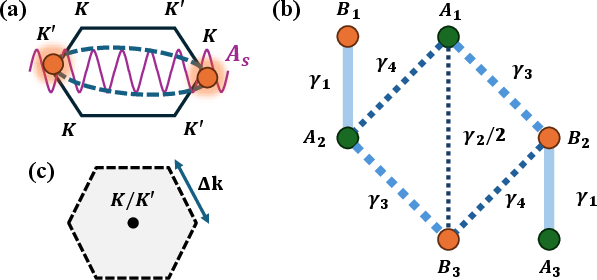
Figure 1: (a) Schematic of the IVC state subjected to SAWs, which induce the pseudogauge field As; (b) R3G lattice and hopping processes; (c) definition of the k-space domain D near K,K′ valleys.
Valley Acoustogalvanic Effect and Nonreciprocal Pseudo-Superfluid Density
The core phenomenon addressed is the VAG effect: the generation of steady, spatially uniform valley currents in response to oscillating SAWs. The nonlinear valley current is captured by the second-order VAG conductivity σsα;βγ, which decomposes into Drude, Berry connection polarizability (BCP), and nonreciprocal superfluid (NRSF) contributions.
Of particular significance is the NRSF term, associated with a nonreciprocal pseudo-superfluid density (NRPSF) fsα;βγ. This term diverges as Ω−2 at low SAW frequencies, dominating the nonlinear response in the IVC regime and closely paralleling the nonreciprocal nonlinear superfluid response in superconductors. The NRPSF is defined as the third derivative of the free energy with respect to valley and pseudogauge fields, encapsulating the macroscopic coherence of the symmetry-broken state.
Numerical Results: Signatures of the IVC Order
Numerical calculations, based on a six-band tight-binding mean-field model for R3G, systematically demonstrate the impact of IVC order on the frequency dependence and magnitude of the VAG response. A key observation is the emergence of a robust Ω−2 divergence in the VAG conductivity in the IVC state, driven by the NRPSF contribution, which is orders of magnitude larger than in the normal (nonsymmetry-broken) state.
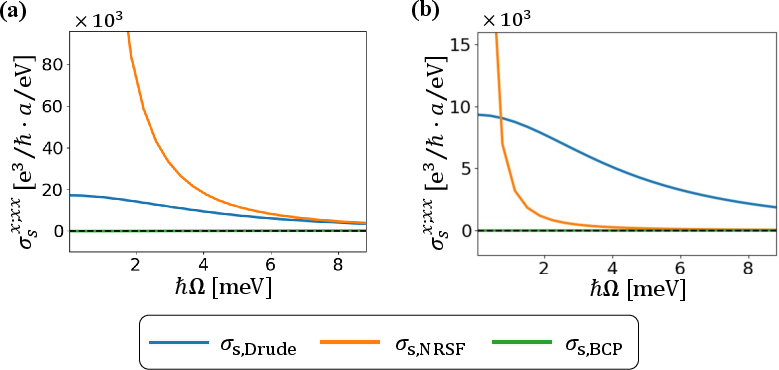
Figure 2: Frequency dependence of the VAG conductivity, comparing the IVC (Δ=30 meV) and normal (Δ=0 meV) states.
The magnitude of the NRPSF shows a strong, monotonic dependence on both the coupling parameter r and the IVC order parameter Δ, verifying its intrinsic link to symmetry breaking. The response is essentially insensitive to the definition of the valley domain D in the IVC state (where the NRPSF is a bulk property), but diminishes rapidly with increasing D in the normal state (where it is reduced to a boundary artifact).
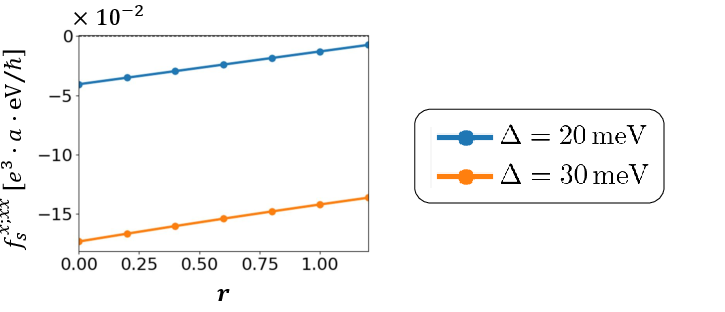
Figure 3: NRPSF fsx;xx as a function of r for the IVC state at varying Δ.
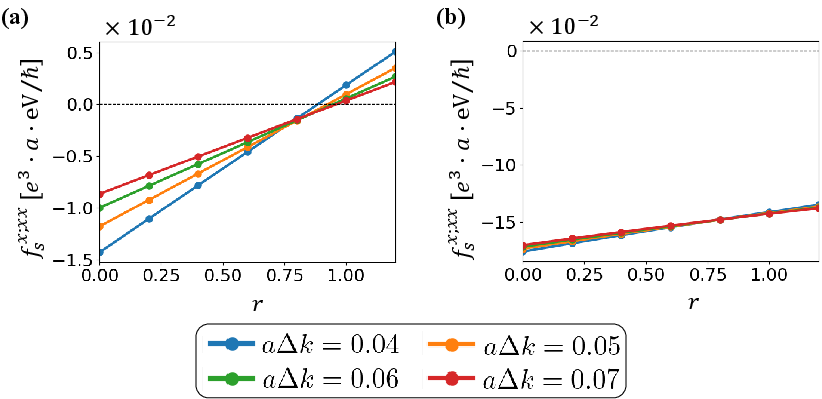
Figure 4: NRPSF fsx;xx for various integration domains Δk; (a) normal state, (b) IVC state.
Quantitative estimates for realistic experimental parameters (e.g., typical SAW displacement, phase velocity, and achievable frequencies/pseudo-electric fields) predict valley currents in the range of 1 A/m for Δ∼30 meV. Such currents are well within reach of current experimental detection via nonlocal valley Hall measurements or optical Kerr rotation techniques.
Theoretical and Experimental Implications
This work establishes the NRPSF as an unambiguous indicator of broken valley gauge symmetry and pseudo-superfluidity in IVC phases. The demonstrated analogy to superconductivity—particularly, the role of the NRPSF mirroring the nonlinear superfluid response—enriches the theoretical landscape connecting valleytronics and unconventional quantum orders. Importantly, the VAG response selectively probes valleys and is insensitive to charge neutrality, offering a powerful tool for experimental verification of IVC order.
Practically, the predicted SAW-induced valley current is accessible in atomically thin 2D systems such as R3G, twisted transition metal dichalcogenides, and multilayer graphene heterostructures. Control of SAW parameters via interdigital transducers enables systematic exploration of the low-frequency divergence. Moreover, the study clarifies the robustness of valley current generation to intervalley scattering and disorder, which do not obscure the signatures of the macroscopic coherent order.
Conclusion
The paper delivers a comprehensive theoretical proposal and numerical demonstration of SAW-driven valley currents in IVC states, mediated by the nonlinear, diverging NRPSF response. The results provide strong guidance for experimental platforms aiming to probe valley gauge symmetry breaking and open a new avenue for the study of exotic transport in 2D quantum materials. The analogy to superconductivity, both formally and experimentally, positions the VAG response as a critical diagnostic for symmetry-broken valley-coherent phases and underlines the broader potential of valleytronics for novel quantum electronic devices.